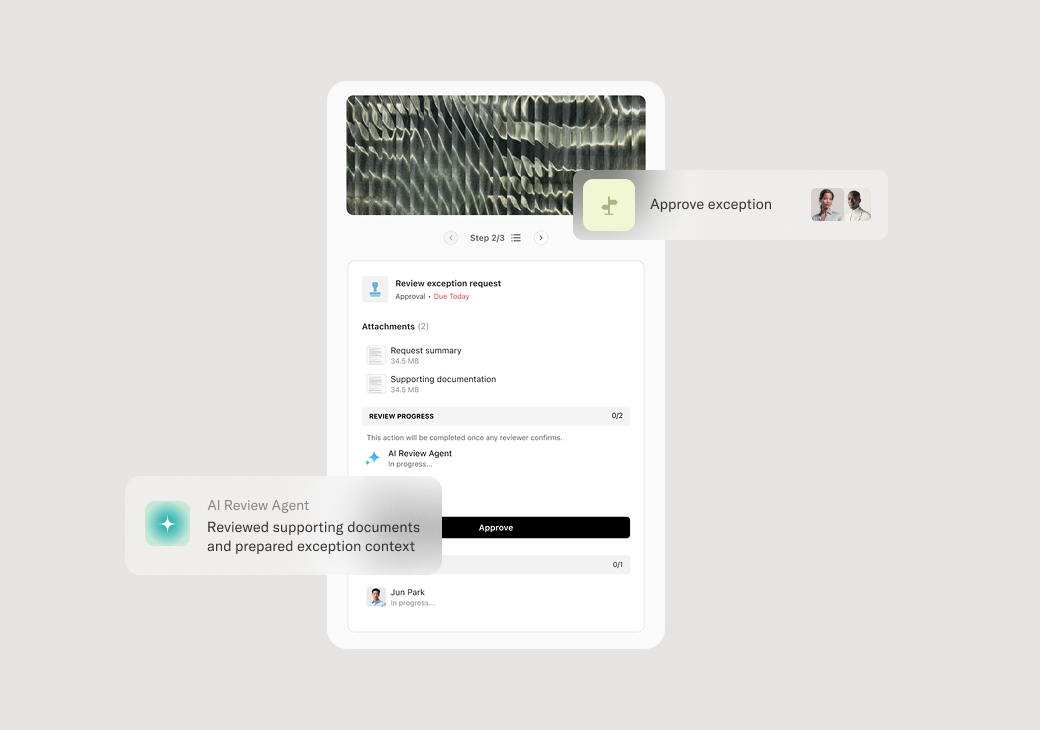
Agreement requester
Legal reviewer
Business approver
Finance reviewer
External counterparty

This process is used whenever an organization needs to review and approve agreements such as customer contracts, vendor agreements, NDAs, or amendments. It becomes especially important when agreements vary in risk, value, or terms, or when multiple teams must coordinate before execution. Agreement approval is commonly triggered during sales, procurement, partnerships, or renewals where legal and financial oversight is required.
Agreement approval typically involves a requester who initiates the agreement, legal reviewers who assess terms and risk, business approvers who confirm alignment with commercial objectives, finance reviewers who validate pricing or financial exposure, and external counterparties who may need to review or accept revisions.
Faster agreement turnaround without bypassing review controls. Clear accountability for contractual decisions and approvals. Improved auditability of agreement history, changes, and sign-off.
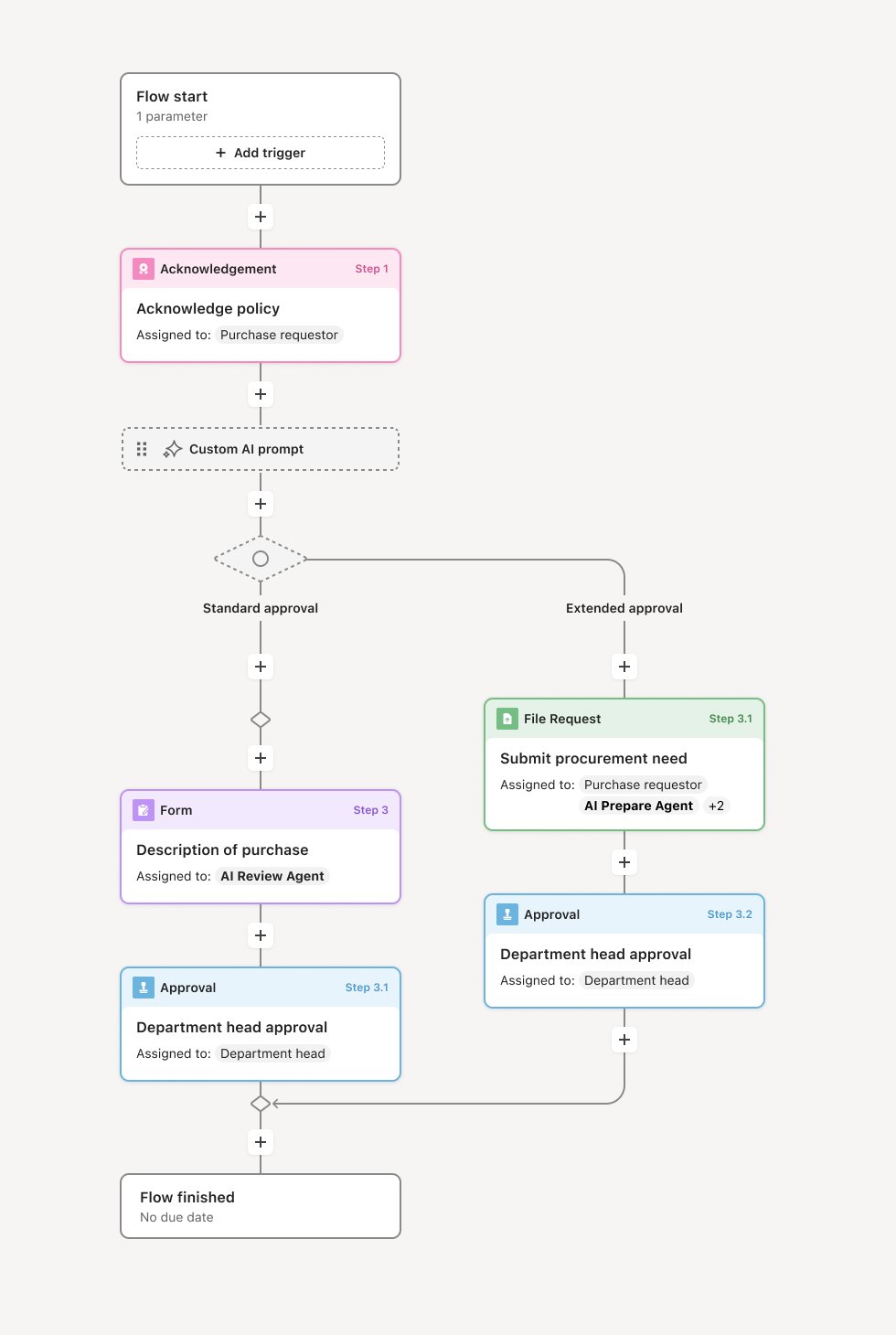
Your version of this process may vary based on roles, systems, data, and approval paths. Moxo’s flow builder can be configured with AI agents, conditional branching, dynamic data references, and sophisticated logic to match how your organization runs this workflow. The steps below illustrate one example.
Agreement initiation and submission
The process typically begins when an agreement is created or submitted for review, often triggered by a deal stage change, procurement request, or renewal event. Key information such as agreement type, counterparty, value, and supporting documents is captured. AI agents may assist by checking completeness, identifying missing documents, or summarizing key terms for reviewers.
Legal and policy review
Legal reviewers assess the agreement for compliance, risk exposure, and alignment with standard terms. If non-standard clauses or high-risk provisions are identified, the workflow can branch to require additional scrutiny or revisions. AI agents may support this phase by flagging deviations from templates or highlighting areas that require attention, without making approval decisions.
Business and financial approval
Once legal review is complete, the agreement is routed to business and finance approvers as needed. Approval paths may vary based on deal size, agreement type, or risk level. Human judgment is required to balance commercial objectives, financial exposure, and operational impact.
Revision and negotiation cycles
If changes are required, the process may loop through revision and re-review phases. Feedback and clarifications remain tied to the agreement context, allowing stakeholders to collaborate without losing visibility. AI agents can assist by tracking changes or ensuring updated versions are routed correctly.
Final approval and execution readiness
After all required approvals are obtained, the agreement is marked ready for execution. Final confirmation is captured before signature or execution steps proceed. System actions can coordinate downstream steps such as e-signature or record updates.
Closure and record retention
Once executed or formally rejected, the process concludes with outcomes recorded and stakeholders notified. The full approval trail, versions, and decisions are retained as part of the operational record.
This process commonly relies on inputs such as agreement drafts, counterparty information, pricing details, and approval thresholds. It may be triggered by events like a CRM stage change, form submission, or start link, and often connects with systems such as Salesforce, NetSuite, DocuSign, or contract repositories.
Key decision points include determining whether the agreement meets standard terms, whether legal or financial risk requires escalation, and whether revisions are needed before approval or execution.
Manual handoffs slow review and approval cycles. Unclear approval ownership causes agreements to stall. Negotiations happening outside the process reduce visibility and traceability
Orchestrates agreement review across legal, finance, and business stakeholders in a coordinated process that maintains deal momentum.
Routes agreements through appropriate approval paths based on value, risk, and term type ensuring the right reviewers see each agreement.
AI agents extract key terms and flag unusual provisions helping reviewers focus on material issues.
Supports redlining and revision cycles with counterparties participating directly in the workflow for negotiation.
Captures complete approval history documenting who reviewed, what concerns were raised, and how decisions were made.
Connects to CRM and contract management systems to pull deal context and push executed agreements to the appropriate repositories.