Operations director
Finance manager
Department head
VP of operations
CFO
Compliance manager
Process owner
Administrative lead

Approval management is an ongoing operational function rather than a single triggered process. It applies when organizations need visibility across multiple approval queues, when approval backlogs create operational delays, when leadership requires insight into decision velocity and bottlenecks, or when compliance and audit requirements demand evidence of timely and proper authorization. It is essential in organizations with high approval volumes, distributed decision authority, or regulatory oversight of authorization processes.
Approval management involves process owners who oversee approval workflows and policies, operations or administrative leaders who monitor approval queues and address bottlenecks, individual approvers who are accountable for decisions in their queues, and compliance or audit teams who review approval patterns and timeliness. Executive leadership may engage when systemic issues affect organizational performance.
Visibility into approval status across the organization enables leaders to identify bottlenecks, track velocity, and ensure nothing stalls without attention. Reduced approval cycle times result from proactive queue management, automated reminders, and escalation paths that keep decisions moving. Consistent approver accountability follows from clear ownership and tracking that highlights overdue items. Improved compliance posture comes from documented approval histories and evidence of timely authorization. Better resource allocation allows organizations to balance approver workloads and address capacity constraints before they create delays.
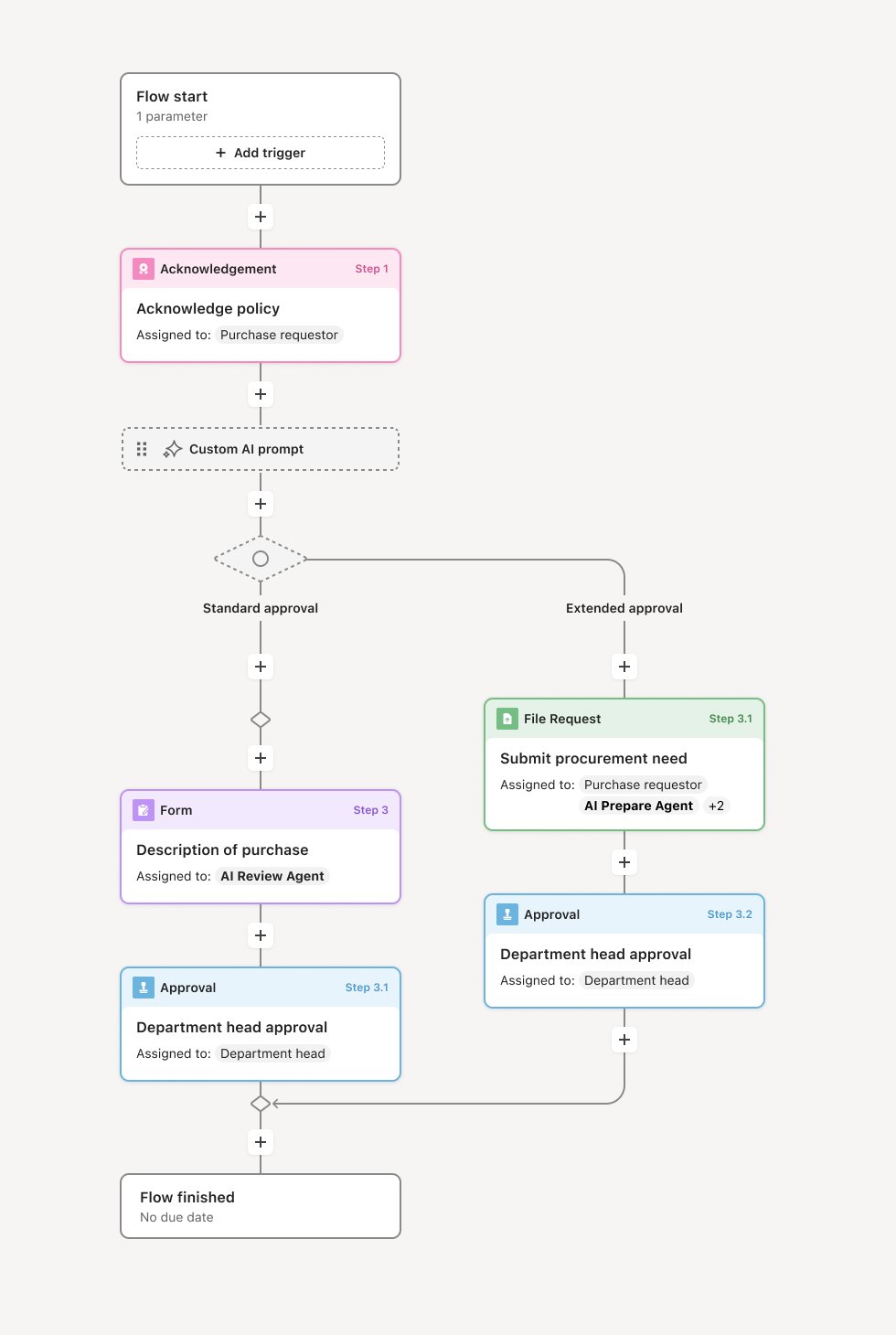
Your version of this process may vary based on roles, systems, data, and approval paths. Moxo's flow builder can be configured with AI agents, conditional branching, dynamic data references, and sophisticated logic to match how your organization runs this workflow. The steps below illustrate one example.
Centralized approval tracking
Approval management begins with visibility into all pending approvals across workflows, departments, and approvers. A centralized view surfaces what is waiting, who is responsible, how long items have been pending, and whether any are approaching or past due. Leaders and process owners can see patterns across the organization rather than only within individual workflows.
Proactive queue monitoring
Operations or administrative teams monitor approval queues for signs of delay or bottleneck. Items approaching deadlines are flagged. Approvers with growing backlogs are identified. Patterns such as specific approval types consistently stalling or certain approvers regularly delayed are surfaced for attention. AI agents may assist by summarizing queue status, highlighting outliers, and recommending actions.
Automated reminders and escalation
The workflow automatically sends reminders to approvers as items age or approach deadlines. If items remain unaddressed beyond configured thresholds, escalation paths activate, routing to backup approvers, managers, or administrative support. Escalation ensures decisions are made even when primary approvers are unavailable or overloaded.
Approver support and delegation
When approvers face capacity constraints, approval management processes support delegation, temporary reassignment, or batching of similar items. Approvers can see their full queue, prioritize effectively, and request support when needed. Administrative teams can redistribute workload based on urgency and availability.
Reporting and analysis
Approval management includes ongoing reporting on approval velocity, cycle times, bottleneck patterns, and compliance with authorization policies. Reports support process improvement by identifying where approval paths create unnecessary friction, where additional approver capacity is needed, or where policy changes could streamline decisions.
Continuous improvement
Insights from approval management feed back into workflow design. Approval paths that consistently cause delays are reviewed and optimized. Thresholds and routing rules are adjusted based on operational experience. The goal is continuous improvement of both approval velocity and decision quality.
Approval management relies on data from all workflows containing approval actions, including request details, approver assignments, timestamps, and decision outcomes. It integrates with reporting and analytics functions to surface patterns and trends. Supporting systems may include any platform where approvals occur, such as ERP, procurement, HRIS, or contract management systems.
Key decision points include determining when escalation should trigger for overdue items, how to redistribute workload when approvers are at capacity, whether approval paths should be redesigned based on performance data, and when systemic issues warrant leadership attention.
No visibility into approval queues, causing bottlenecks to go unnoticed until they create downstream problems. Reminders not sent or ignored, allowing items to age indefinitely without action. No escalation path for absent or overloaded approvers, stalling decisions with no resolution mechanism. Approver workload imbalances, concentrating delays in specific queues while others have capacity. Lack of reporting on approval patterns, preventing identification and resolution of systemic issues.
Provides centralized visibility across all approval queues so leaders and process owners can see status, identify bottlenecks, and track velocity organization-wide.
Automates reminders and escalation ensuring items are addressed timely and decisions are made even when primary approvers are unavailable.
AI agents surface queue status summaries and highlight outliers so attention goes where it is needed.
Supports delegation and reassignment when approvers face capacity constraints or are unavailable.
Generates reporting on approval velocity and patterns to support continuous process improvement.
Maintains a complete record of all approvals for compliance, audit, and operational analysis.