Operations manager
Finance leader
Compliance manager
Procurement lead
IT governance lead
Risk or internal audit manager

Approval matrix logic is applied when organizations need to ensure requests route to approvers with appropriate authority based on defined criteria. This occurs across procurement, capital expenditure, contract execution, hiring, policy exceptions, and any process where decision authority varies by amount, type, risk, or organizational scope. The framework applies when multiple approval levels exist, when authority thresholds must be enforced consistently, or when audit and compliance requirements demand clear evidence of proper authorization. It is common in enterprises with delegated authority structures, regulated industries, and organizations scaling operations while maintaining governance controls.
Approval matrix processes involve requesters who initiate items requiring approval, first-level approvers who handle routine requests within their authority, senior approvers or executives who review items exceeding standard thresholds, finance or procurement teams who validate budget and policy alignment, and compliance or risk teams who ensure approval paths meet governance requirements. In cross-functional requests, multiple approval chains may operate in parallel or sequence.
Consistent enforcement of approval authority ensures requests reach decision-makers with appropriate delegation rather than being approved by parties without proper authority. Reduced approval bottlenecks result from routing directly to the correct approver level without unnecessary escalation or manual triage. Clear audit trail of authorization decisions provides defensible evidence of who approved what, under which authority, and with what context. Lower risk of unauthorized commitments comes from systematic enforcement of thresholds and approval rules embedded in the workflow. Faster request resolution follows from eliminating confusion about who should approve and reducing time spent determining the correct path.
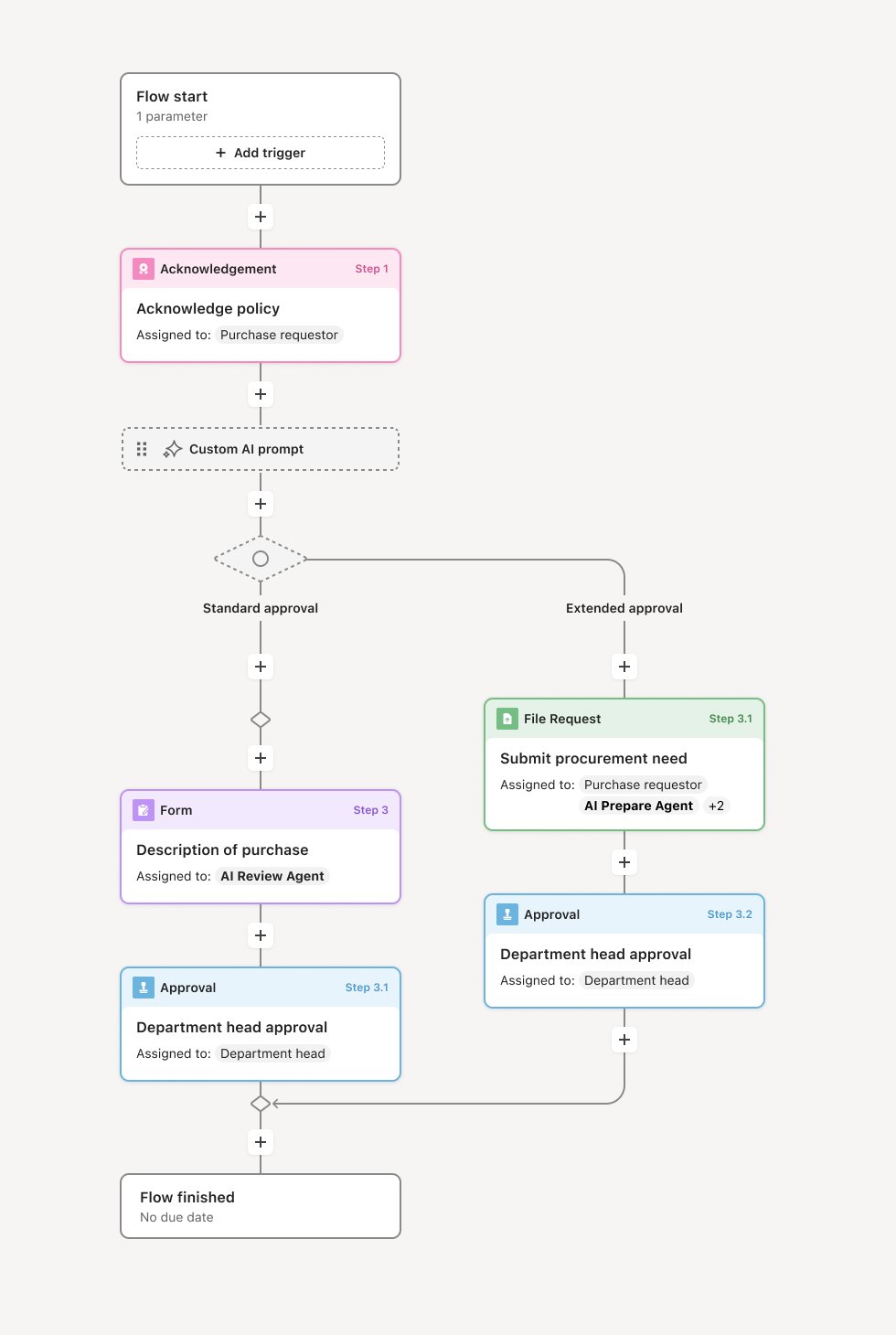
Your version of this process may vary based on roles, systems, data, and approval paths. Moxo's flow builder can be configured with AI agents, conditional branching, dynamic data references, and sophisticated logic to match how your organization runs this workflow. The steps below illustrate one example.
Request submission and classification
The process begins when a requester submits an item requiring approval, such as a purchase request, contract, hiring decision, or policy exception. The submission captures key attributes that determine routing: request type, value or amount, department, risk classification, or other organizational criteria. An AI agent may assist by validating submission completeness, flagging missing information, and classifying the request based on configured rules.
Matrix evaluation and routing
The workflow evaluates the request against the configured approval matrix to determine the appropriate approval path. Routing logic considers factors such as dollar thresholds, request category, organizational hierarchy, and any special conditions that trigger additional review. If the request falls within a first-level approver's authority, it routes directly. If it exceeds thresholds or meets escalation criteria, it routes to higher-level approvers or parallel approval chains. Conditional branching handles the variety of paths different request types may follow.
Approver review and decision
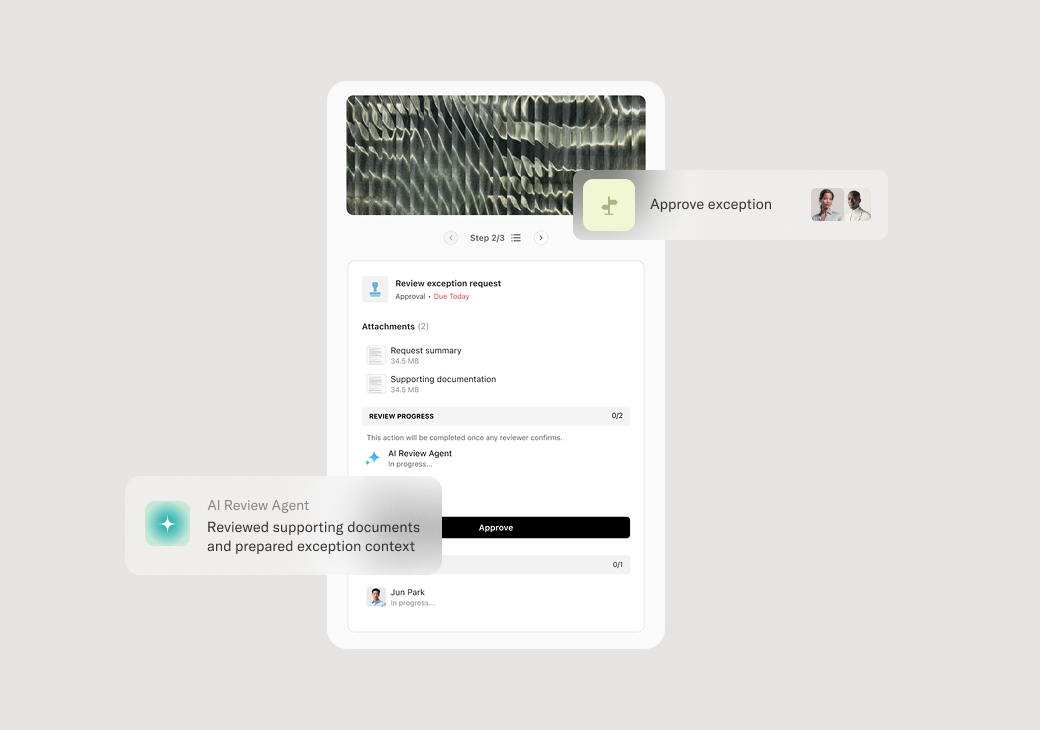
The designated approver receives the request with full context, including the request details, supporting documentation, and any relevant history. The approver reviews and either approves, rejects, or requests additional information. If additional information is needed, the workflow returns to the requester with clear guidance. If the approver is unavailable or the request requires delegation, alternate routing paths may activate based on configured rules.
Escalation and exception handling
If a request exceeds the initial approver's authority, requires additional sign-off due to risk or policy, or triggers exception conditions, the workflow escalates to the appropriate level. Escalation paths are defined by the approval matrix and may involve sequential approvals, parallel approvals from multiple functions, or executive review. AI agents may flag requests that appear unusual or fall outside normal parameters for additional scrutiny.
Approval confirmation and execution
Once all required approvals are captured, the request is confirmed and proceeds to execution. The workflow records every approval decision with full traceability: who approved, when, under what authority, and any conditions attached. If the request was rejected, the workflow notifies the requester with the decision rationale and any options for resubmission.
Record retention and reporting
All requests, decisions, and supporting documentation are retained as part of the operational record. The approval history supports audit requirements, compliance reporting, and analysis of approval patterns. Organizations can review matrix effectiveness and adjust thresholds or routing rules based on operational experience.
This process commonly relies on inputs such as request forms, budget data, contract details, organizational hierarchy information, and approval authority documentation. It may be triggered by a form submission, system event from an ERP or procurement platform, or manual initiation. Supporting systems often include ERP platforms like NetSuite or SAP, procurement systems like Coupa or Ariba, HRIS systems for hiring approvals, and contract management platforms.
Key decision points include determining the correct approval level based on request attributes, whether the request meets criteria for escalation or parallel approval, whether the approver has authority to approve or must delegate, and whether exceptions require additional review before proceeding.
Requests routed to wrong approvers, causing delays while the correct authority is identified. Approval thresholds not consistently enforced, leading to unauthorized commitments or compliance gaps. Complex matrix rules creating confusion, resulting in requests stalling while participants determine the correct path. Approver unavailability causing bottlenecks, with no clear delegation or alternate routing. Lack of visibility into approval status, forcing requesters and managers to chase updates manually.
Embeds approval matrix logic directly in workflows so requests automatically route to the correct approvers based on configured rules without manual triage.
Supports conditional branching for complex approval paths including sequential approvals, parallel sign-offs, and escalation based on thresholds or exceptions.
AI agents validate request completeness on submission and flag items that may require additional information or fall outside normal parameters.
Provides full traceability of every approval decision with clear records of who approved, when, and under what authority.
Maintains visibility for all stakeholders so requesters, approvers, and managers can see status without chasing updates.
Connects to existing ERP, procurement, and HRIS systems to pull request data and push approval outcomes without manual re-entry.