Finance controller
IT asset manager
Facilities manager
Operations director
Compliance officer
Procurement lead
CFO
Internal auditor

Asset disposal approval is triggered when assets reach end of useful life, become obsolete, are replaced, or are identified for sale, donation, or scrapping. This occurs across IT equipment, vehicles, machinery, furniture, and any tracked organizational assets. The process applies when disposals must be authorized based on value or asset class, when compliance or regulatory requirements govern disposal methods, when data security concerns require verified destruction, or when accurate asset records must be maintained for financial reporting. It is common in enterprises with significant fixed asset bases, regulated industries, organizations with data security requirements, and any company subject to asset tracking and reporting obligations.
Asset disposal approval typically involves asset managers or custodians who initiate disposal requests, finance teams who verify asset records and approve write-offs, IT security teams who ensure data destruction for technology assets, facilities or operations teams who coordinate physical removal, compliance officers who verify disposal methods meet regulatory requirements, and senior leadership who approve high-value disposals. External parties such as disposal vendors, recyclers, or auction services may participate in execution.
Proper authorization before assets leave organizational control ensures disposals are reviewed by parties with appropriate authority and nothing is removed without approval. Accurate asset records reflecting disposal outcomes keeps financial statements and inventory systems aligned with physical reality. Compliant disposal methods for regulated or sensitive assets reduces risk of data breaches, environmental violations, or improper handling. Clear audit trail from disposal request through execution provides defensible documentation for internal audit, tax, and regulatory purposes. Reduced risk of unauthorized asset removal comes from structured approval paths that prevent informal or undocumented disposals.
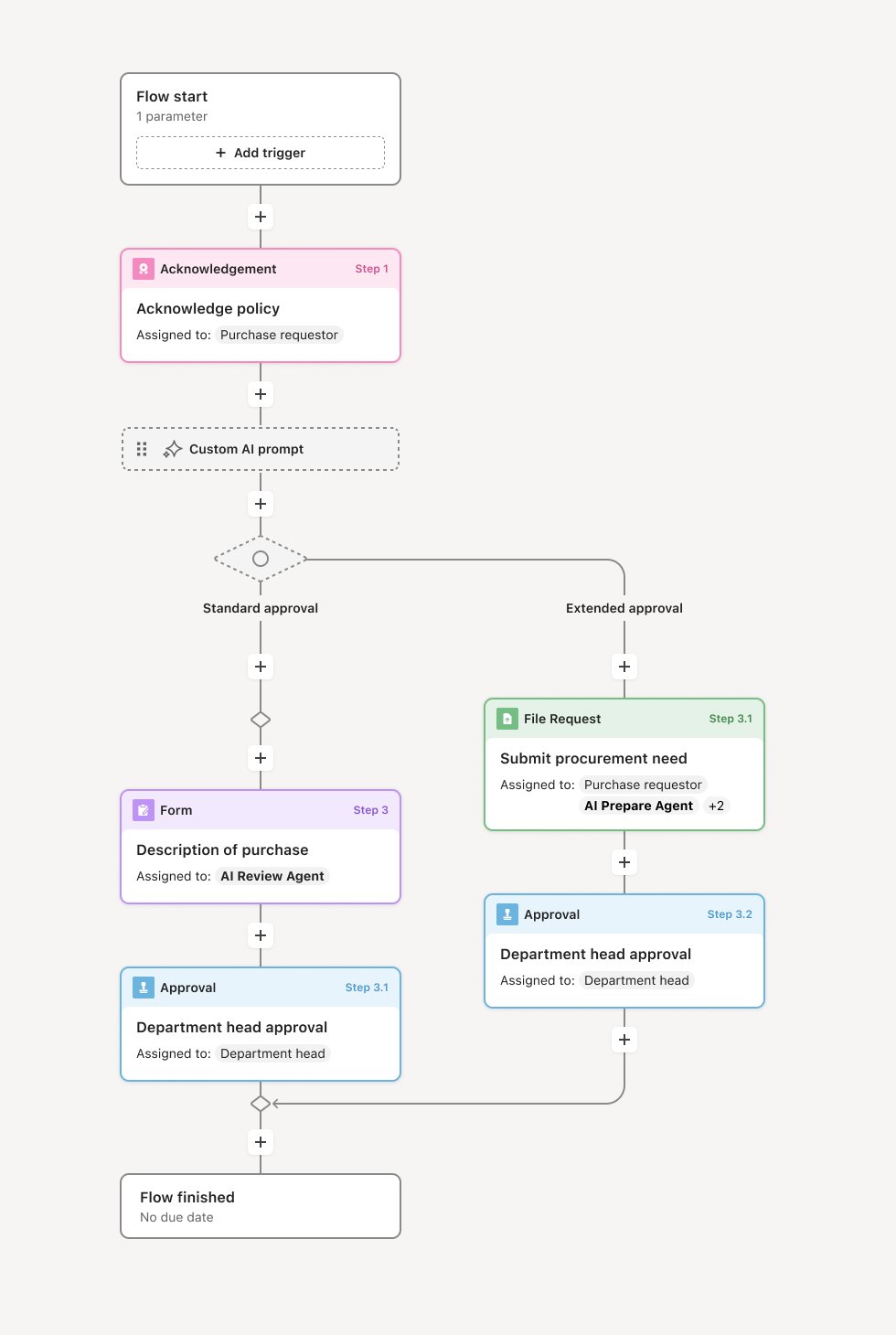
Your version of this process may vary based on roles, systems, data, and approval paths. Moxo's flow builder can be configured with AI agents, conditional branching, dynamic data references, and sophisticated logic to match how your organization runs this workflow. The steps below illustrate one example.
Disposal request initiation
The process begins when an asset custodian, department, or asset management team identifies an asset for disposal and submits a request. The request includes asset identification, reason for disposal, proposed disposal method (sale, donation, recycling, destruction), and any relevant condition or valuation information. An AI agent may assist by pulling asset details from inventory systems, attaching purchase history, and validating that the asset is eligible for disposal.
Asset verification and valuation
Finance or asset management reviews the request to verify asset records, confirm current book value, and assess any financial implications of disposal. If the asset has residual value, valuation may determine whether sale, auction, or trade-in is appropriate. For fully depreciated assets, the focus shifts to ensuring records are updated correctly. If discrepancies exist between the request and asset records, the workflow routes back for clarification.
Compliance and security review
For assets subject to data security, environmental, or regulatory requirements, the workflow routes to appropriate reviewers. IT security confirms data destruction requirements for technology assets and verifies destruction methods. Compliance reviews disposal methods for regulated items such as hazardous materials or controlled equipment. If special handling is required, the workflow captures requirements and routes to qualified disposal vendors or internal teams.
Approval based on value and asset class
The disposal request routes to approvers based on asset value, class, and organizational policy. Routine disposals within defined thresholds may require only departmental approval. Higher-value assets or those with special considerations route to finance leadership, executive approval, or board authorization as defined by policy. Conditional logic ensures each disposal follows the appropriate approval path.
Disposal execution and documentation
Once approved, the workflow coordinates disposal execution. This may involve scheduling pickup with disposal vendors, coordinating internal transfers, arranging sale or auction, or verifying destruction. Documentation such as certificates of destruction, sale receipts, or donation acknowledgments is collected and attached to the workflow. External parties may participate directly in the workflow to confirm receipt or completion.
Record update and closure
Upon confirmed disposal, asset records are updated to reflect removal from inventory. Finance is notified to process any write-offs, gains, or losses. The workflow retains all documentation, approvals, and execution records as a complete audit trail. Stakeholders receive confirmation of closure.
This process commonly relies on inputs such as asset identification numbers, inventory records, purchase history, depreciation schedules, and disposal method documentation. It may be triggered by an asset review cycle, replacement project, audit finding, or manual request. Supporting systems often include ERP platforms like SAP or Oracle for asset records, IT asset management systems like ServiceNow or Snipe-IT, and facilities management platforms.
Key decision points include determining the appropriate disposal method based on asset condition and value, whether compliance or security review is required, which approval level is needed based on value and asset class, and whether disposal documentation is complete before closing the record.
Disposals executed without proper authorization, creating compliance gaps and inventory discrepancies. Asset records not updated after disposal, causing inaccurate financial statements and ghost assets. Data destruction not verified for technology assets, creating security and privacy risks. Disposal documentation scattered or incomplete, making it difficult to demonstrate proper handling during audits. High-value disposals approved without appropriate authority, violating delegation policies.
Orchestrates disposal approval across finance, IT, compliance, and operations so all required reviews happen in a coordinated process rather than disconnected approvals.
Routes disposals to correct approvers based on asset value and class using conditional logic that enforces organizational policy.
AI agents pull asset details from connected systems and validate request completeness, reducing manual data gathering.
Coordinates with external disposal vendors who can participate directly in the workflow to confirm execution and provide documentation.
Maintains a complete audit trail of every request, approval, and disposal record supporting compliance and financial reporting requirements.
Updates connected asset management and ERP systems to reflect disposal outcomes without manual re-entry.