Compliance manager
Risk and controls lead
Legal counsel
Operations manager
Internal audit lead
External reviewer

Attestation approval is triggered when organizations require formal confirmation from accountable parties that specific information is accurate, controls are functioning, or compliance requirements have been met. This occurs during periodic compliance cycles, financial close processes, regulatory reporting periods, and internal control certifications. The process applies when multiple individuals across departments or entities must independently attest, when attestations carry legal or regulatory weight, or when organizations need defensible evidence that responsible parties reviewed and confirmed critical information. It is common in financial services, healthcare, public companies, and any organization subject to SOX, regulatory examinations, or internal governance frameworks.
Attestation approval typically involves compliance or internal audit teams who coordinate the attestation cycle and define requirements, business unit owners and department heads who provide attestations within their areas of responsibility, finance leaders who attest to the accuracy of financial information, and legal or risk teams who review attestation language and ensure appropriate coverage. In organizations with external reporting requirements, executive leadership may provide final attestations that roll up from subordinate confirmations.
Consistent attestation collection across all required parties ensures no responsible individual is overlooked and every confirmation is captured in a single coordinated process. Clear accountability for each attestation provides defensible evidence of who confirmed what, when, and with what knowledge. Reduced cycle time for periodic attestation rounds results from automated routing and reminders that eliminate manual follow-up. Lower risk of missed or incomplete attestations comes from validation that flags gaps before the cycle closes. Improved audit readiness follows from a complete, traceable record of all attestations and supporting context retained in one place.
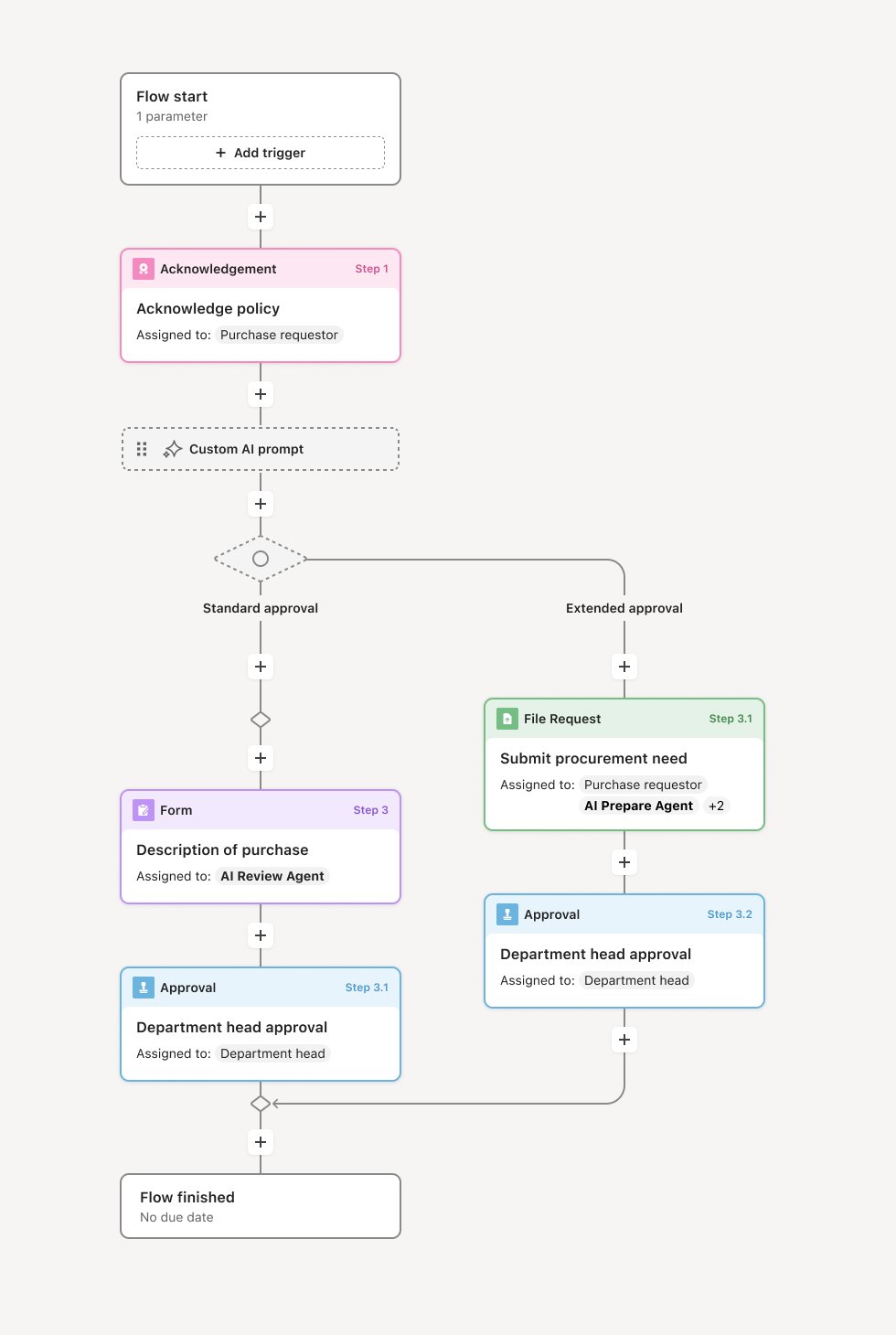
Your version of this process may vary based on roles, systems, data, and approval paths. Moxo's flow builder can be configured with AI agents, conditional branancing, dynamic data references, and sophisticated logic to match how your organization runs this workflow. The steps below illustrate one example.
Attestation cycle initiation
The process begins when a compliance, audit, or finance team initiates an attestation cycle based on a regulatory deadline, internal policy requirement, or governance calendar. The coordinating team defines which attestations are required, who must provide them, and what supporting information or acknowledgments are needed. An AI agent may assist by preparing attestation requests with pre-populated context, attaching relevant policies or prior attestations, and identifying the correct recipients based on organizational structure.
Attestation request distribution
Attestation requests are routed to designated individuals across departments, business units, or entities. Each recipient receives clear instructions on what they are attesting to, any supporting documentation they must review, and the deadline for completion. Requests may go out in parallel to multiple parties or in sequence where subordinate attestations must be collected before management roll-up. The workflow tracks which requests have been sent and which are pending response.
Review and confirmation
Recipients review the attestation statement, any supporting materials, and the scope of what they are confirming. If the recipient identifies issues, exceptions, or requires clarification, they can raise questions directly within the workflow, keeping context attached to the specific attestation. Once satisfied, the individual formally confirms the attestation. An AI agent may validate that all required acknowledgments are captured and flag incomplete submissions for follow-up.
Exception handling and escalation
If a recipient cannot attest as written, declines to attest, or identifies material exceptions, the workflow routes the issue to compliance, legal, or management for review. Exception paths allow for documentation of concerns, modification of attestation scope where appropriate, or escalation to senior leadership. Conditional logic ensures that exceptions are handled according to organizational policy rather than falling through the cracks.
Consolidation and management attestation
Once individual attestations are collected, the workflow consolidates confirmations for management review. Senior leaders or executives who must provide roll-up attestations can see the status of subordinate confirmations before providing their own. If gaps remain, the workflow prevents premature closure and routes back to incomplete parties. Management attestations are captured with the same traceability as individual confirmations.
Closure and record retention
Upon completion of all required attestations, the cycle is formally closed. Every attestation, exception, communication, and timestamp is retained as a complete operational record. Stakeholders receive confirmation of cycle completion, and the attestation package is available for audit, regulatory examination, or internal review.
This process commonly relies on inputs such as attestation templates, control documentation, policy acknowledgments, prior period attestations, and organizational charts defining responsible parties. It may be triggered by a compliance calendar event, regulatory notification, financial close milestone, or manual initiation. Supporting systems often include GRC platforms, HRIS systems like Workday for personnel data, ERP systems for financial attestations, and document management platforms for policy storage.
Key decision points include determining whether the recipient can attest as written, whether exceptions require escalation or modification of scope, whether subordinate attestations are complete before management roll-up, and whether the attestation cycle can be closed or requires additional follow-up.
Attestation requests lost in email, causing delays and requiring manual follow-up to track down missing confirmations. Unclear attestation language, leading recipients to attest without understanding what they are confirming. Exceptions raised but not properly documented, creating gaps in the compliance record. Management attestations provided before subordinate confirmations are complete, undermining the integrity of the roll-up. No central record of attestations, making it difficult to demonstrate compliance during audits or examinations.
Orchestrates attestation collection across all required parties in a single coordinated process so nothing is lost in email and every confirmation is tracked.
Routes attestation requests to the right individuals based on role, department, or organizational hierarchy ensuring accountability is clear from the start.
AI agents prepare attestation requests with relevant context, attaching policies, prior attestations, and supporting materials so recipients can act immediately.
Validates completeness before cycle closure and flags missing or incomplete attestations for follow-up.
Maintains a complete, auditable record of every attestation, exception, and communication supporting compliance requirements and providing defensible documentation.
Extends existing GRC, HRIS, and document management systems by connecting attestation workflows to where organizational and policy data already live.