Compliance officer
Internal audit manager
External auditor
Risk and controls lead
Finance director
Operations manager
Legal counsel
Chief compliance officer

Audit approval is triggered when an audit cycle reaches the point where collected evidence, findings, or remediation plans require formal review and sign-off before the audit can be closed. This occurs in scheduled internal audits, external regulatory examinations, and ad hoc compliance reviews. The process applies when multiple reviewers must validate findings, when evidence packages require cross-functional input, or when audit conclusions carry risk, financial, or regulatory implications. It is common in financial services, healthcare, manufacturing, professional services, and any organization subject to regulatory scrutiny or internal governance requirements.
Audit approval typically involves internal audit teams who compile findings and coordinate evidence, compliance officers who validate alignment with policy, external auditors or regulators who review and certify outcomes, and business unit owners who acknowledge findings and commit to remediation. Finance, legal, and operations leaders may participate depending on the scope and sensitivity of the audit. In multi-party audits, coordination spans internal departments and external parties who do not share a single system of record.
Faster audit closure by eliminating delays caused by unclear ownership or scattered evidence across email and file shares. Clear accountability at every approval milestone so auditors and reviewers know exactly who signed off, when, and with what context. Reduced rework and resubmission cycles through upfront validation of evidence completeness before review stages begin. Improved auditor confidence from structured, traceable processes that demonstrate control maturity. Lower coordination overhead as follow-ups, reminders, and status tracking happen automatically within the workflow.
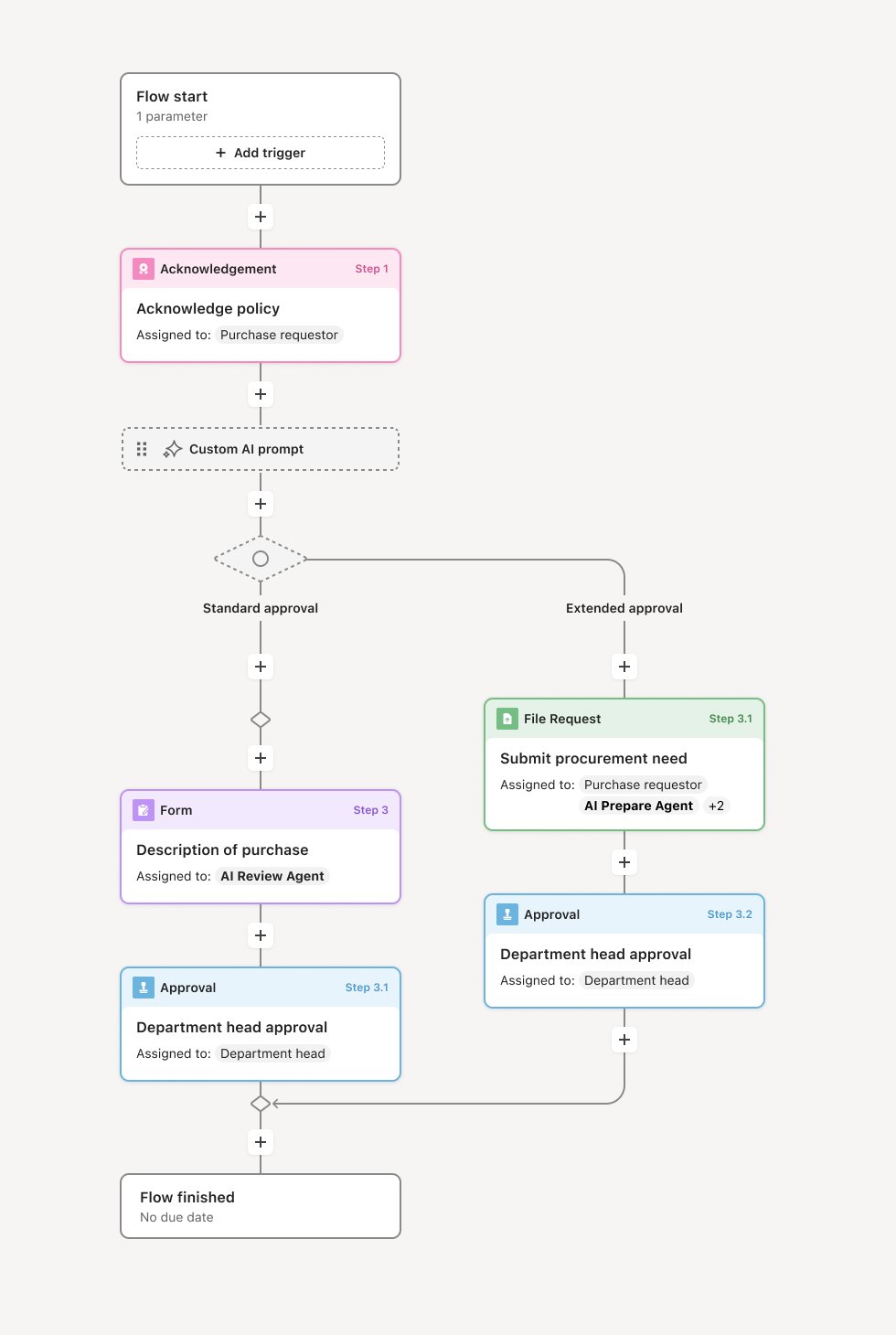
Your version of this process may vary based on roles, systems, data, and approval paths. Moxo's flow builder can be configured with AI agents, conditional branching, dynamic data references, and sophisticated logic to match how your organization runs this workflow. The steps below illustrate one example.
Audit initiation and scoping
The process begins when an audit is scheduled or triggered by a compliance event, regulatory requirement, or risk assessment outcome. The audit lead defines scope, timelines, and the parties who will participate. Relevant stakeholders are notified of their roles and the evidence they will need to provide. An AI agent may assist by preparing the initial request package, populating known data fields, and attaching prior audit documentation for reference.
Evidence collection and submission
Business unit owners and process owners submit required documentation, records, and supporting evidence. Submissions may arrive in parallel from multiple departments or external parties. As evidence is uploaded, an AI review agent validates completeness against defined requirements and flags missing items or formatting issues. If submissions are incomplete, the workflow reopens the request with clear guidance on what is needed, reducing back-and-forth with auditors.
Preliminary review and analysis
Internal audit or compliance teams review submitted evidence against audit criteria. Reviewers assess whether documentation supports control effectiveness, identifies gaps, or raises exceptions. If additional clarification is required, the workflow routes questions back to the appropriate owners with full context attached. AI agents may prepare summaries of submitted materials to accelerate reviewer orientation.
Finding documentation and response
Audit findings are documented and shared with responsible parties for acknowledgment and response. Business owners review findings, provide context or dispute where appropriate, and commit to remediation timelines if corrective action is required. If findings require escalation due to severity or risk, the workflow routes to senior leadership or risk committees for additional review. Conditional paths handle different finding categories, ensuring responses follow the appropriate approval chain.
Approval and sign-off
Once findings are addressed and evidence is validated, designated approvers formally sign off on the audit outcome. This may involve sequential approvals from compliance, finance, legal, or executive leadership depending on audit type and organizational policy. Each approval is captured with full traceability, including who approved, when, and any conditions attached. If an approver requests revisions, the workflow returns to the relevant stage with clear instructions.
Closure and record retention
Upon final approval, the audit is formally closed. All evidence, findings, approvals, communications, and decisions are retained as a complete operational record. Stakeholders receive confirmation of closure, and any open remediation items are tracked through connected processes. The workflow ensures nothing is lost between audit cycles and that the organization maintains a defensible audit trail.
This process commonly relies on inputs such as prior audit reports, control documentation, policy records, evidence files, and remediation plans. It may be triggered by a scheduled audit calendar event, a regulatory notification, a risk assessment outcome, or a manual start link. Supporting systems often include document management platforms, GRC tools like ServiceNow or LogicGate, ERP systems such as NetSuite or SAP for financial controls, and HR systems like Workday for personnel-related audits.
Key decision points include determining whether submitted evidence meets audit requirements, whether findings warrant escalation to senior leadership or risk committees, whether remediation commitments are acceptable, and whether the audit can proceed to final approval or requires additional review cycles.
Evidence scattered across email and file shares, making it difficult for auditors to locate and validate required documentation. Unclear ownership of approval stages, causing delays when reviewers are unsure whether action is required of them. Insufficient context provided to approvers, forcing them to chase down background information before they can act. Remediation commitments made without accountability, leading to repeat findings in subsequent audits. Manual follow-up consuming audit team capacity, delaying closure and increasing coordination overhead.
Orchestrates the full audit cycle across internal teams and external auditors so evidence collection, review, and approval happen in a single coordinated process rather than fragmented email threads.
Routes approvals to the right owners based on audit type, finding severity, and organizational hierarchy ensuring decisions reach accountable parties without manual triage.
AI agents validate evidence completeness on submission and reopen requests with clear guidance when documentation is missing, reducing rework and back-and-forth.
AI agents prepare approval actions with relevant context by attaching prior findings, summarizing submissions, and populating dynamic references so approvers can act immediately.
Maintains a complete, auditable record of every submission, decision, and communication supporting compliance requirements and providing defensible documentation for regulators.
Extends existing GRC, ERP, and document management systems by connecting audit workflows to the tools where evidence and control data already live, rather than requiring manual re-entry.
Automates reminders and escalations while keeping humans accountable for every judgment call, approval, and sign-off throughout the audit lifecycle.