Audit manager
Compliance officer
Risk manager
Internal audit lead
Finance leader
Operations leader
External auditor

This process is used at the start of an audit cycle, before detailed audit work begins, to ensure alignment on objectives, boundaries, and expectations. It commonly applies when regulatory requirements, risk assessments, or organizational changes introduce complexity, and when multiple teams or external auditors must agree on what is in or out of scope.
Audit scope approval typically involves audit leads defining the proposed scope, compliance or risk teams reviewing coverage against obligations, business owners validating feasibility and impact, and authorized approvers providing formal sign-off. External auditors may participate when scope alignment is required across organizations.
Clear alignment on audit boundaries so all stakeholders share the same expectations before execution begins. Reduced downstream rework by resolving scope questions and exclusions early. Improved accountability for audit coverage, approvals, and subsequent execution.
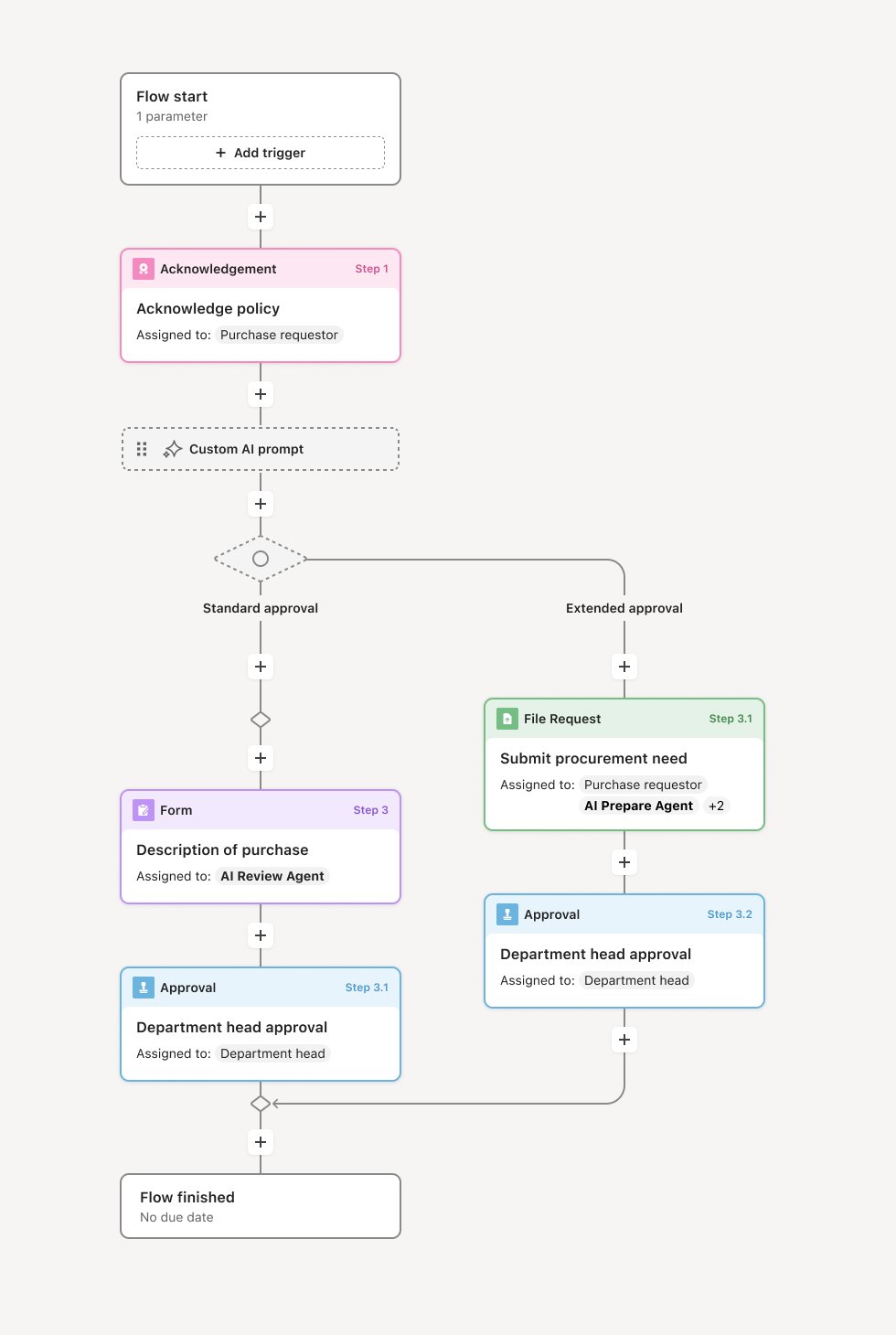
Your version of this process may vary based on roles, systems, data, and approval paths. Moxo’s flow builder can be configured with AI agents, conditional branching, dynamic data references, and sophisticated logic to match how your organization runs this workflow. The steps below illustrate one example.
Initiation and scope definition
The process begins when an audit is planned or triggered by a regulatory requirement, risk assessment, or annual audit schedule. Audit leads define the proposed scope, including entities, time periods, controls, and exclusions. An AI Agent may assist by summarizing prior audits or highlighting relevant risk areas.
Information gathering and validation
Supporting documentation, risk assessments, and prior findings are assembled to justify the proposed scope. AI Agents can help validate completeness, surface missing inputs, or flag inconsistencies, while auditors remain responsible for accuracy and intent.
Review and alignment
Key stakeholders review the proposed scope to assess adequacy, feasibility, and potential impact. If concerns arise, the process may loop back for refinement, clarification, or adjustment, ensuring alignment before approval proceeds.
Approval and escalation
Formal approval is requested from authorized approvers based on governance and risk thresholds. If the scope involves high-risk areas, significant business impact, or regulatory sensitivity, the workflow may escalate to senior leadership or compliance committees. AI Agents can assist by preparing approval context, but final decisions remain human.
Confirmation and handoff
Once approved, the audit scope is confirmed, documented, and shared with all participants. The approved scope becomes the baseline for audit execution, with outcomes recorded for traceability and future reference.
This process commonly relies on risk assessments, prior audit records, policy documentation, and organizational data from systems such as GRC platforms, ERP systems, or document repositories. It may be triggered by an audit plan update, form submission, or a direct start link.
Key decisions include determining whether the proposed scope adequately covers identified risks, whether exclusions are acceptable, and whether additional review or escalation is required based on impact or regulatory exposure.
Ambiguous scope definitions that lead to misaligned expectations later in the audit, late stakeholder involvement causing delays or rework, and insufficient context for approvers resulting in stalled or contested approvals.
Moxo enables audit scope approval through configurable, role-aware workflows that adapt to risk and governance needs. AI Agents assist with preparation, validation, and monitoring, while secure collaboration and auditable records ensure human decision-makers remain accountable from scope definition through approval and handoff.