Engineering manager
Procurement lead
Supply chain director
Manufacturing operations manager
Cost analyst
Product development lead
Quality assurance manager

This process is used when a new product design is ready for release, when engineering changes require component substitutions, or when a production run requires validation of material requirements. It is triggered when cost thresholds require financial review, when supplier availability or lead times create sourcing exceptions, or when quality specifications must be confirmed before procurement begins. The process becomes essential when multiple teams must align on specifications, costs, and timelines before committing to vendor orders. Ideal for manufacturing, electronics, aerospace, automotive, consumer goods, and any industry where component accuracy directly impacts production schedules and product quality.
This process typically involves design engineers who originate the BOM, engineering managers who validate technical specifications, procurement specialists who assess supplier availability and pricing, cost analysts or finance reviewers who confirm budget alignment, quality assurance personnel who verify compliance requirements, and operations or manufacturing leads who confirm production feasibility. In some organizations, external suppliers may participate to confirm lead times or provide alternative component recommendations.
Reduced procurement errors through validated component specifications before orders are placed. Faster time-to-production by eliminating back-and-forth between engineering and procurement over missing or incorrect details. Clear cost visibility with finance sign-off on material costs before commitments are made. Documented approval trail that traces every decision, exception, and substitution for compliance and audit purposes. Fewer production delays caused by last-minute component issues discovered after procurement has begun.
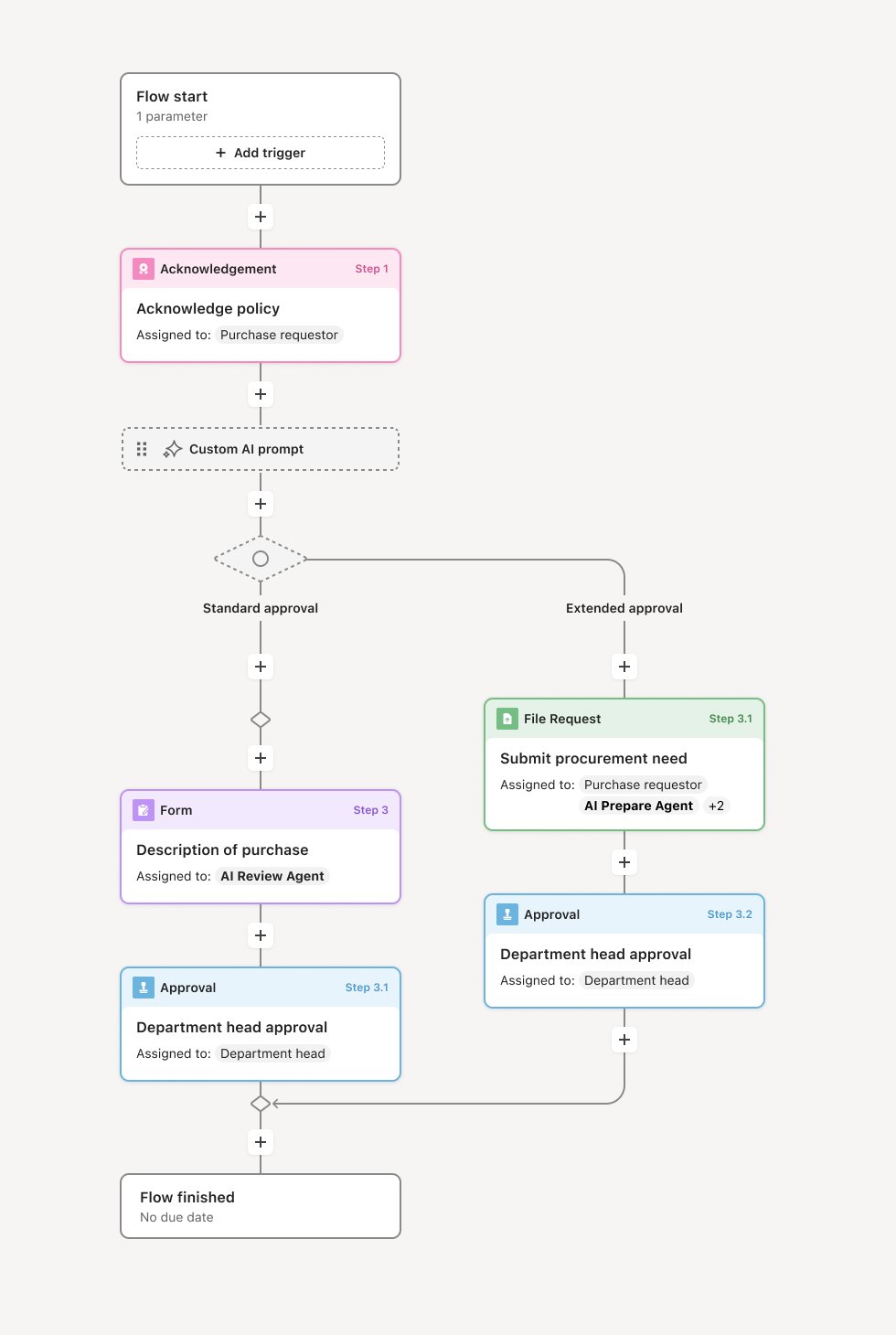
Your version of this process may vary based on roles, systems, data, and approval paths. Moxo's flow builder can be configured with AI agents, conditional branching, dynamic data references, and sophisticated logic to match how your organization runs this workflow. The steps below illustrate one example.
BOM submission and initial validation
The process begins when engineering submits a bill of materials for review. This may be triggered by a product release milestone, an engineering change order, or a production planning request. The submitted BOM includes component part numbers, quantities, specifications, and any relevant drawings or reference documents. An AI agent can assist at this stage by validating completeness, checking for missing fields, flagging duplicate entries, and confirming that required documentation is attached before routing to reviewers.
Engineering review and technical sign-off
An engineering manager or technical lead reviews the BOM for accuracy against design specifications. This includes verifying that component selections meet performance requirements, that quantities align with assembly needs, and that any recent design changes are reflected. If discrepancies are found, the reviewer may request clarification or return the BOM to the originator for correction. Once satisfied, the engineering reviewer provides formal sign-off, confirming the technical validity of the component list.
Procurement assessment and supplier coordination
With engineering approval complete, procurement specialists assess each component for supplier availability, lead times, and pricing. If preferred suppliers cannot meet requirements, alternatives may be proposed, triggering a branch in the workflow where engineering must approve substitutions. An AI agent can assist by summarizing supplier status, highlighting long-lead-time items, and flagging components that exceed target costs. If supplier input is required, external stakeholders can be brought into the flow to confirm availability or provide quotes directly.
Cost review and financial approval
For BOMs that exceed defined cost thresholds or involve significant procurement commitments, a financial review is required. Cost analysts or finance leads review the total material cost, compare against budget allocations, and assess margin impact. If costs are outside acceptable ranges, the workflow may route back to engineering or procurement for value engineering options. If approved, finance provides formal sign-off, authorizing the spend associated with the BOM.
Quality and compliance verification
Depending on the industry and product requirements, quality assurance may need to verify that components meet regulatory or internal compliance standards. This step ensures that materials are sourced from approved suppliers, certifications are current, and any restricted substances are properly documented. If exceptions exist, the quality reviewer escalates for resolution before the BOM can proceed.
Final approval and release to production
Once all reviewers have signed off, the BOM receives final approval and is released for procurement or production use. Stakeholders are notified, the approved BOM is recorded as the official version, and downstream systems such as ERP or MRP can be updated. If the BOM was part of an engineering change order, relevant documentation is linked to maintain traceability. The process concludes with a clear record of who approved what, when, and under what conditions.
This process commonly relies on inputs such as BOM spreadsheets or exports from PLM systems, engineering drawings, supplier quotes, cost estimates, and compliance certificates. It may be triggered by events like an engineering change notification, a milestone completion in a product development system, or a manual submission via a start link or form. Common systems that integrate with this workflow include PLM platforms such as Arena or Teamcenter, ERP systems like SAP or Oracle, procurement tools like Coupa or Jaggaer, and document management systems where specifications and certifications are stored.
Key decision points include determining whether the BOM passes initial validation or requires correction, whether engineering approves component selections or requests changes, whether suppliers can fulfill requirements or substitutions are needed, whether costs fall within budget or require escalation, and whether compliance requirements are met or exceptions must be resolved. Each of these decision points may trigger conditional paths, parallel reviews, or escalation to additional approvers.
Incomplete submissions where missing part numbers or specifications cause repeated cycles of clarification. Disconnected reviews where engineering, procurement, and finance work in silos, discovering conflicts late in the process. Delayed supplier responses that stall procurement assessment without visibility into where the process is stuck. Untracked substitutions where component changes are made informally without engineering re-approval. Cost overruns discovered post-commitment because financial review was bypassed or occurred too late in the cycle.
Orchestrates the full approval cycle across engineering, procurement, finance, quality, and external suppliers within a single coordinated flow.
Routes reviews conditionally based on cost thresholds, component types, or exception flags so approvers only see what requires their judgment.
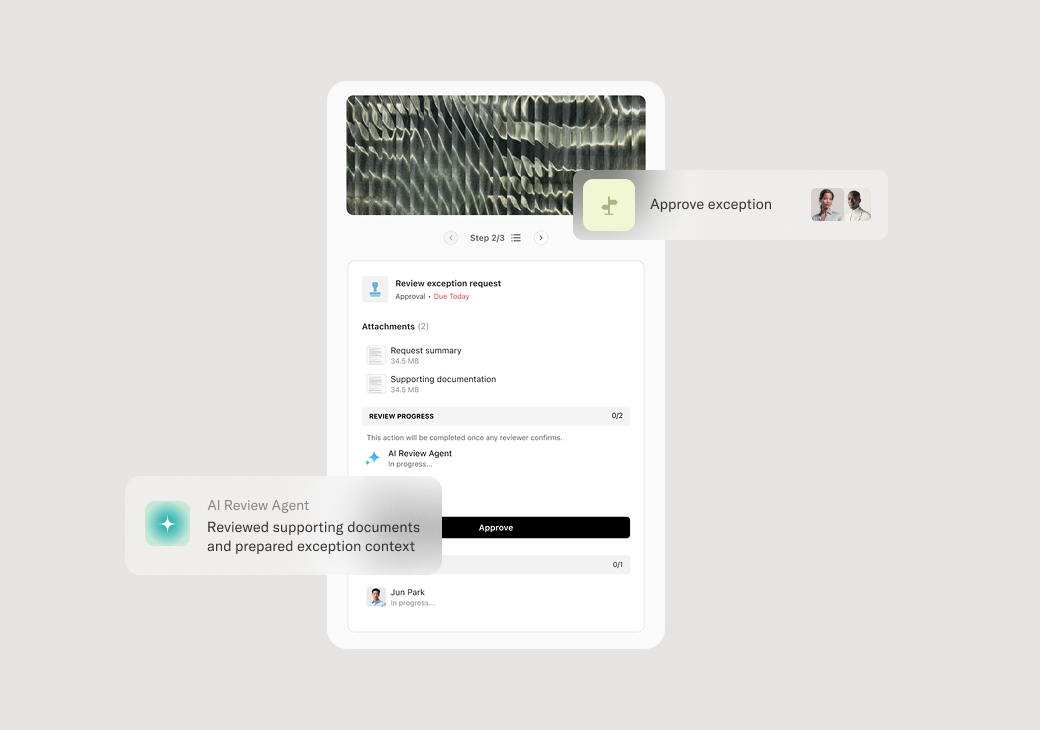
AI agents validate BOM completeness at submission, flagging missing fields and preparing context summaries for reviewers before human review begins.
Brings suppliers into the process securely so lead time confirmations and alternative quotes are captured directly in the workflow without email chains.
Connects to PLM, ERP, and procurement systems so BOM data flows in automatically and approved versions are pushed to downstream systems upon release.
Maintains a complete decision record including approvals, substitution authorizations, cost sign-offs, and exception resolutions for compliance and audit.