Brand director
Partnership manager
Chief marketing officer
Sponsorship manager
Business development lead
Legal counsel

This process is used when organizations evaluate potential brand partnerships, co-branding opportunities, or sponsorship arrangements that will associate the brand with external entities. It is triggered when partnership proposals are received from potential collaborators, when marketing identifies co-branding opportunities, when sponsorship requests require brand association decisions, or when influencer or ambassador relationships involve significant brand exposure. The process becomes essential when partnership terms have financial implications, when brand association carries reputational risk, or when exclusivity or competitive considerations must be evaluated. Ideal for consumer brands, sports and entertainment companies, technology firms with ecosystem partnerships, and any organization where brand associations directly impact market perception and customer trust.
This process typically involves partnership or business development managers who identify and propose opportunities, brand managers who evaluate strategic fit and brand alignment, marketing leadership who assess campaign potential and resource requirements, legal counsel who review contractual terms and liability exposure, finance personnel who validate deal economics and budget availability, and executive leadership who authorize significant partnerships with strategic or financial implications. In some organizations, communications or PR teams assess reputational considerations before final approval.
Protected brand reputation through systematic evaluation of partner alignment before public association.
Strategic partnership selection ensuring collaborations support brand positioning and business objectives.
Controlled financial commitment with deal economics validated before agreements are executed.
Reduced legal exposure through proper contract review and risk assessment before binding commitments.
Clear decision documentation tracking who evaluated and approved each partnership for future reference and accountability.
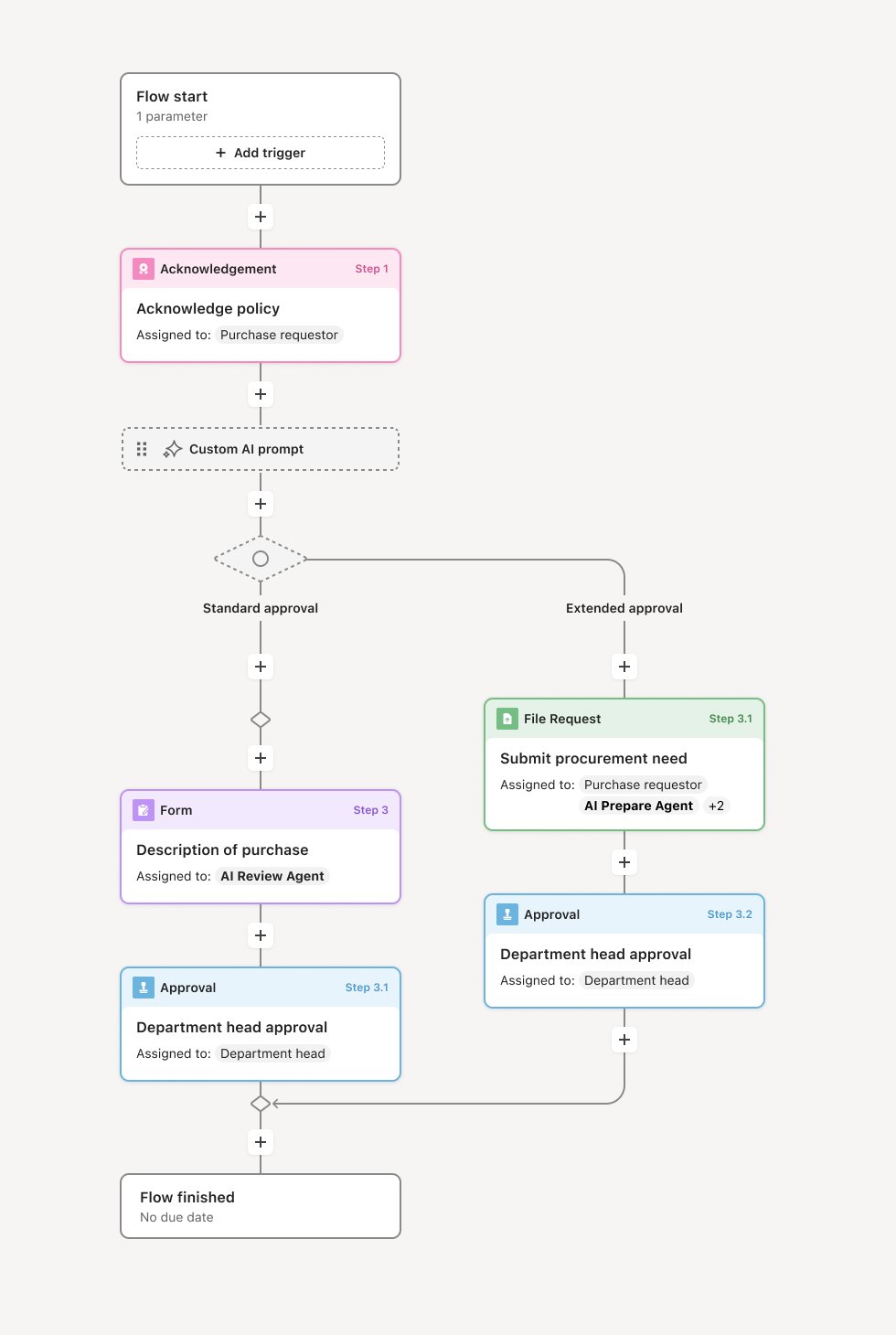
Your version of this process may vary based on roles, systems, data, and approval paths. Moxo's flow builder can be configured with AI agents, conditional branching, dynamic data references, and sophisticated logic to match how your organization runs this workflow. The steps below illustrate one example.
Partnership opportunity submission
The process begins when a partnership manager or business development lead submits a partnership opportunity for evaluation. The submission includes the prospective partner profile, proposed collaboration structure, expected brand exposure, financial terms or investment required, timeline, and strategic rationale. Supporting materials may include partner brand guidelines, audience data, and comparable partnership examples. An AI agent can assist by gathering publicly available information about the prospective partner, flagging any reputational concerns from news sources, and preparing a summary for reviewers.
Brand alignment assessment
A brand manager evaluates the partnership opportunity against brand strategy and values. This includes assessing whether the partner's positioning complements the brand, whether the target audience aligns with strategic objectives, whether the association carries reputational risk, and whether the collaboration supports brand differentiation. If the partnership presents brand concerns—such as conflicting values, audience mismatch, or competitive implications—the brand manager may recommend modifications or decline the opportunity before further review.
Financial and resource evaluation
Finance and marketing operations review the partnership economics and resource requirements. This includes validating proposed investment amounts against available budget, assessing expected return on partnership spend, confirming resource availability for activation and management, and evaluating payment terms and financial risk. If the partnership requires budget allocation beyond approved levels, the workflow may route to senior leadership for additional authorization. Finance confirms that the deal structure is financially sound and properly funded.
Legal review and contract assessment
Legal counsel reviews proposed partnership terms and any draft agreements. This includes evaluating intellectual property rights and usage terms, liability and indemnification provisions, exclusivity and competitive restrictions, termination rights and exit provisions, and regulatory compliance considerations. If contract terms present unacceptable risk or require negotiation, legal provides specific guidance before the partnership can proceed. For complex partnerships, legal may engage directly with the partner's counsel to finalize acceptable terms.
Executive authorization and commitment
For partnerships above defined thresholds—whether financial, strategic, or reputational—executive leadership provides final authorization. The CMO or CEO reviews the complete evaluation including brand assessment, financial analysis, and legal terms before approving the partnership. Once authorized, the organization can execute agreements and proceed with partnership activation. The workflow records the complete approval chain, evaluation summaries, and any conditions attached to the authorization for future reference.
This process commonly relies on inputs such as partner proposals, brand and audience profiles, financial terms and projections, draft partnership agreements, and competitive analysis. It may be triggered by events like an inbound partnership inquiry, a marketing campaign requiring collaboration, a sponsorship opportunity with deadline, or strategic planning identifying partnership needs. Common systems that integrate with this workflow include CRM platforms like Salesforce where partner relationships are tracked, contract management systems like Ironclad, financial planning tools, and brand monitoring services that provide partner reputation data.
Key decision points include determining whether the partnership aligns with brand strategy and values, whether the financial terms represent sound investment, whether legal terms adequately protect the organization, and whether the partnership value justifies executive approval for significant commitments. Each decision point may trigger requests for modified terms, escalation to senior leadership, negotiation guidance for the partnership team, or decline with documented rationale.
Rushed evaluations where deadline pressure leads to inadequate brand or legal review before commitment. Incomplete partner vetting that misses reputational issues or value misalignment discovered only after public announcement. Unfavorable contract terms accepted without proper legal review that create liability or restrict future flexibility. Budget overcommitment when partnership costs are approved without confirming available funding. Siloed decisions where partnerships are approved by one function without cross-functional input on brand, legal, or financial implications.
Orchestrates the complete evaluation cycle from opportunity submission through brand assessment, financial review, legal evaluation, and executive authorization in a single coordinated flow.
Routes partnerships conditionally based on deal value, partnership type, and strategic significance so routine collaborations move quickly while major commitments receive appropriate scrutiny.
AI agents compile partner intelligence gathering publicly available information and preparing context summaries to accelerate evaluation.
Connects to CRM and contract systems so partner data flows in automatically and approved partnerships can trigger agreement execution and tracking.
Maintains complete decision records with timestamps, reviewer assessments, approval conditions, and supporting documentation for accountability and future reference.
Enforces deadline-aware routing so time-sensitive opportunities receive expedited review without bypassing required evaluations.