FP&A manager
Controller
Chief financial officer
Department head
Budget analyst
Finance director

This process is used when business conditions require modifications to approved budgets during the fiscal period. It is triggered when departments need to reallocate funds between line items, when unexpected opportunities or challenges require budget increases, when cost savings in one area should be redirected to higher priorities, or when organizational changes necessitate budget transfers between cost centers. The process becomes essential when changes exceed manager authority to reallocate within their own budgets, when net budget increases require executive approval, or when audit trails must document why and how approved budgets were modified. Ideal for dynamic organizations that need flexibility within financial discipline, project-based businesses where scope changes affect budgets, and any enterprise where mid-cycle adjustments are a regular operational reality.
This process typically involves budget owners who initiate change requests and provide business justification, finance analysts who evaluate the impact on overall financial plans and validate the request structure, FP&A teams who assess organizational implications of reallocations, department heads or VPs who approve changes within their authority, and CFOs or executive leadership who authorize significant changes or net budget increases. In some organizations, budget committees review material changes that affect multiple departments or strategic priorities.
Controlled budget flexibility allowing necessary adjustments while maintaining overall financial discipline. Clear change documentation tracking what changed, why, and who authorized each modification to approved budgets. Preserved budget integrity ensuring changes do not create unauthorized spending or undermine financial controls. Faster reallocation cycles by streamlining the request and approval process for budget modifications. Improved forecast accuracy when budget changes are properly recorded and reflected in financial projections.
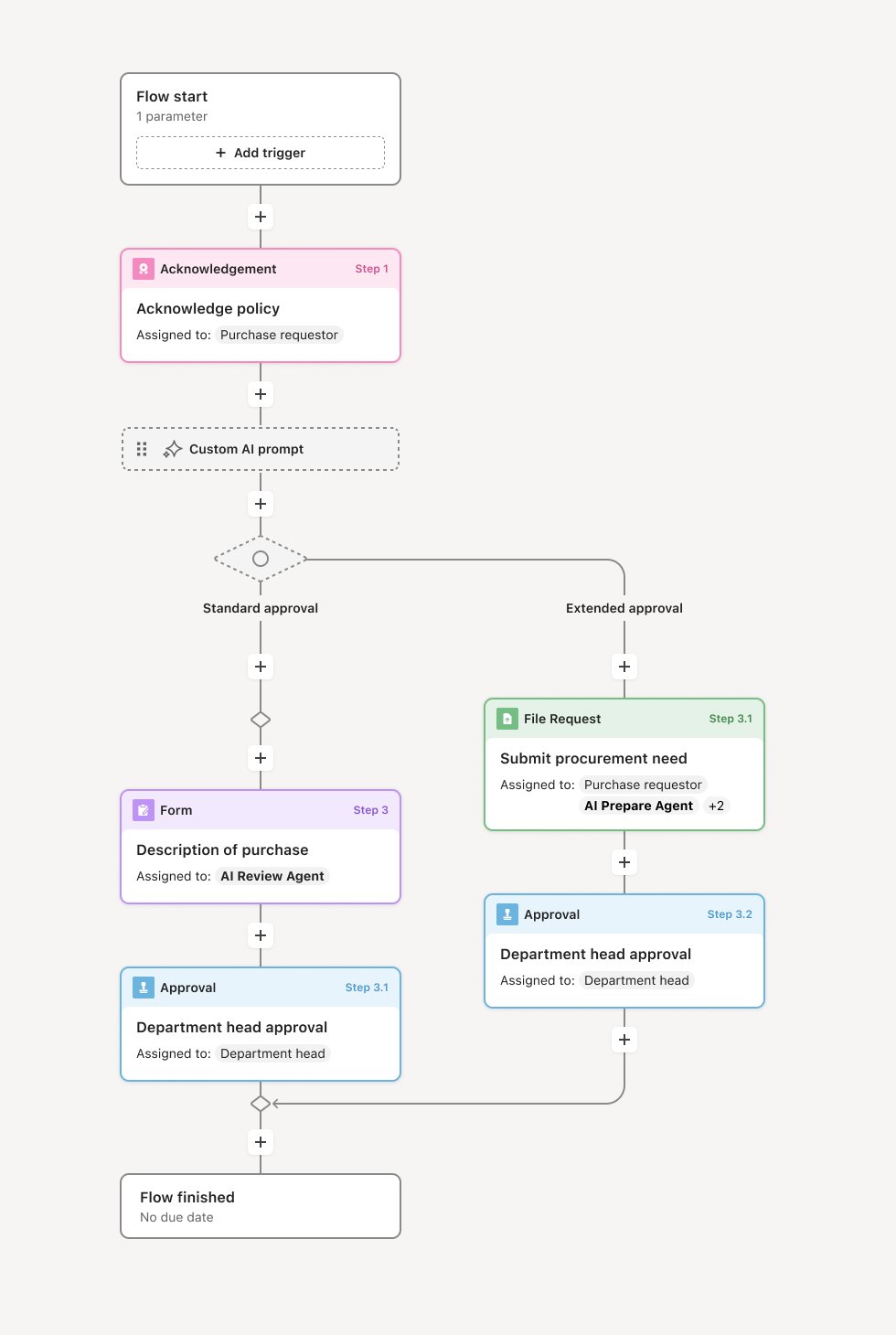
Your version of this process may vary based on roles, systems, data, and approval paths. Moxo's flow builder can be configured with AI agents, conditional branching, dynamic data references, and sophisticated logic to match how your organization runs this workflow. The steps below illustrate one example.
Change request submission
The process begins when a budget owner submits a request to modify approved budget allocations. The request specifies the nature of the change—whether it is a reallocation between line items within the same cost center, a transfer between cost centers, or a request for additional budget. The submission includes the specific accounts affected, amounts to be moved or added, business justification explaining why the change is necessary, and any supporting documentation such as revised project plans or unexpected cost drivers. An AI agent can assist by validating that the request is properly structured, calculating the net impact, and flagging if the change exceeds policy thresholds.
Impact analysis and validation
Finance reviews the change request to understand its implications. This includes confirming that source accounts have sufficient budget to fund reallocations, that the change does not create compliance or policy issues, that accounting treatment remains appropriate, and that the change is properly categorized (reallocation versus net increase). For changes affecting multiple cost centers or departments, finance coordinates with affected parties to confirm alignment. If the request structure is flawed or information is missing, it is returned for correction before proceeding.
Authority-based routing
Budget changes are routed to appropriate approvers based on the nature and magnitude of the modification. Minor reallocations within a single cost center may be approved by the budget owner alone. Larger reallocations or transfers between departments typically require director or VP approval. Net budget increases—where total organizational spending rises—usually require CFO or executive authorization. The workflow branches dynamically based on change type and amount, ensuring appropriate oversight without unnecessary escalation for routine adjustments.
Cross-departmental coordination
For changes that involve transfers between cost centers or affect multiple departments, coordination occurs with all affected budget owners. The receiving department confirms acceptance of transferred budget and responsibility for associated spending. The giving department confirms willingness to reduce their allocation. If disagreements exist, the workflow may route to a common manager or finance leadership for resolution. This coordination ensures that budget transfers reflect genuine organizational alignment, not unilateral decisions that create downstream conflicts.
Approval and budget update
Once all required approvals are obtained, the budget change is authorized and implemented. Financial systems are updated to reflect the new allocations, and affected budget owners are notified of their revised spending authority. The workflow records the complete approval chain, business justification, and before/after budget snapshots. The modified budget becomes the new baseline for spending controls and variance reporting. Documentation is retained to support audit inquiries about why approved budgets were changed during the fiscal period.
This process commonly relies on inputs such as current approved budget data, change request forms specifying accounts and amounts, business justification documentation, policy parameters defining approval authorities, and historical change request patterns. It may be triggered by events like a project scope change, unexpected costs or savings, organizational restructuring, or strategic priority shifts requiring resource reallocation. Common systems that integrate with this workflow include ERP platforms like SAP or Oracle, financial planning tools like Anaplan or Adaptive Insights, and project management systems where scope changes drive budget requirements.
Key decision points include determining whether the change is a reallocation or net increase, whether source accounts have sufficient funds for transfers, whether the business justification warrants the modification, whether affected departments agree to transfers, and whether the change magnitude requires executive approval. Each decision point may trigger requests for additional justification, coordination with affected parties, escalation to higher authorities, or return to the requestor for revision.
Informal adjustments where budget changes happen without proper documentation, undermining financial control integrity. Insufficient justification when changes are approved without clear business rationale, creating audit concerns. Cross-department conflicts where transfers are processed without genuine agreement from affected budget owners. Tracking gaps when approved changes are not properly recorded in financial systems, causing variance reporting errors. Creeping budget expansion when frequent small increases accumulate into significant unplanned spending growth.
Orchestrates the complete change cycle from request submission through impact analysis, cross-departmental coordination, and authorization in a single coordinated flow.
Routes changes dynamically based on change type, magnitude, and affected cost centers so routine adjustments move quickly while significant changes receive appropriate oversight.
AI agents calculate impact and validate structure at submission, flagging policy threshold breaches and preparing before/after comparisons for reviewers.
Connects to ERP and planning systems so current budget data flows in automatically and approved changes can update financial systems directly.
Coordinates affected parties bringing multiple budget owners into the workflow when transfers require cross-departmental agreement.
Maintains complete change history with timestamps, approver identities, justifications, and budget snapshots for audit and financial reporting.