FP&A director
Chief financial officer
Controller
Department head
Revenue operations manager
Finance business partner

This process is used when organizations update their financial projections to reflect current business realities rather than original budget assumptions. It is triggered at scheduled reforecast intervals such as quarterly or mid-year reviews, when significant events materially change revenue or expense expectations, when strategic initiatives are accelerated or delayed, or when market conditions require revised planning assumptions. The process becomes essential when leadership needs accurate projections for decision-making, when board or investor communications require updated guidance, or when operational plans must align with revised financial expectations. Ideal for growth companies with evolving business conditions, organizations with volatile revenue streams, project-based businesses where scope affects financials, and any enterprise where accurate forecasting is critical to resource allocation and stakeholder communication.
This process typically involves department heads who provide revised projections for their areas, finance business partners who work with departments to develop credible forecasts, FP&A analysts who consolidate submissions and analyze organizational impact, FP&A directors who evaluate overall reasonableness and alignment with strategic objectives, and CFOs or executive leadership who approve the reforecast as the new planning baseline. In some organizations, board finance committees review significant reforecasts that affect guidance or strategic commitments.
Accurate planning baseline reflecting current business reality rather than outdated assumptions. Aligned organizational expectations when all departments operate from the same approved forecast. Better resource decisions enabled by projections that accurately reflect anticipated needs and constraints. Credible stakeholder communication with forecasts that have been reviewed and validated before external sharing. Documented forecast evolution tracking how projections changed over time and why revisions were made.
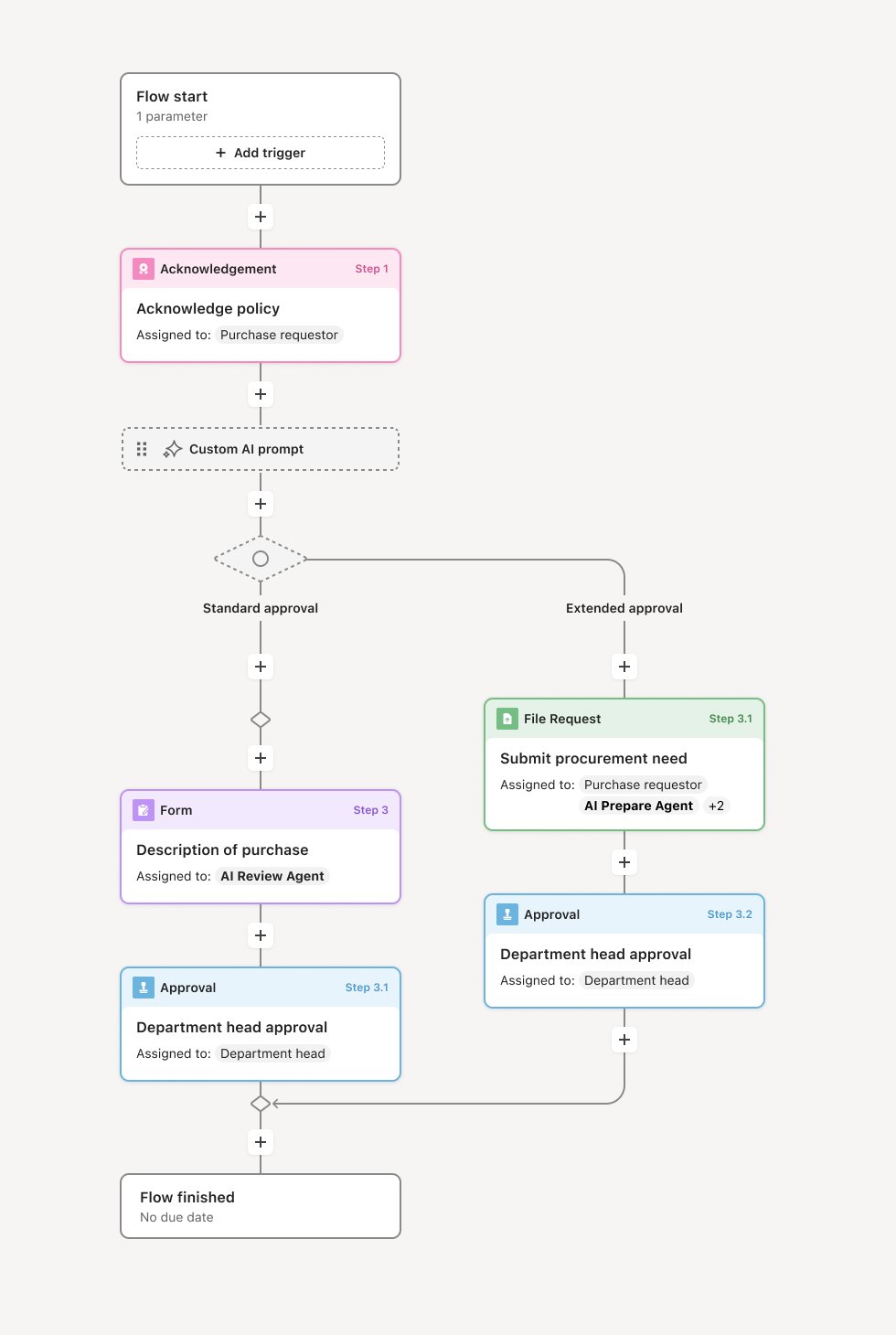
Your version of this process may vary based on roles, systems, data, and approval paths. Moxo's flow builder can be configured with AI agents, conditional branching, dynamic data references, and sophisticated logic to match how your organization runs this workflow. The steps below illustrate one example.
Reforecast initiation and guidance
The process begins when FP&A initiates a reforecast cycle, either at a scheduled interval or in response to material business changes. FP&A provides guidance to department heads including the reforecast timeline, key assumptions to consider, format requirements, and specific areas requiring attention based on known variances or strategic changes. This guidance ensures departments approach the reforecast consistently and focus on the most significant drivers of change from the original budget or prior forecast.
Departmental forecast submission
Department heads develop and submit their revised projections covering the remainder of the fiscal period. Submissions include updated revenue forecasts where applicable, revised expense projections by category, headcount plans reflecting any changes, and narrative explaining key drivers of variance from prior projections. Supporting assumptions and calculations are documented to enable review. An AI agent can assist by comparing submissions to prior forecasts, flagging significant variances, and identifying inconsistencies between departments that may require reconciliation.
FP&A review and consolidation
FP&A reviews each departmental submission for reasonableness, completeness, and alignment with known business conditions. This includes validating that assumptions are credible, that projections are consistent with recent trends and pipeline data, and that explanations adequately support significant changes. FP&A may request revisions or additional detail before accepting submissions. Once departmental forecasts are validated, FP&A consolidates them into an organizational view, identifying total revenue, expense, and profitability implications of the revised projections.
Variance analysis and narrative development
FP&A develops comprehensive variance analysis comparing the reforecast to the original budget and any prior forecasts. This analysis explains the key drivers of change—whether from revenue performance, cost changes, timing shifts, or strategic decisions. A narrative summary is prepared for leadership that highlights the most significant changes, their causes, and their implications for organizational performance. This analysis provides the context leadership needs to evaluate whether the reforecast represents a credible and acceptable outlook.
Executive review and approval
Senior leadership reviews the consolidated reforecast, variance analysis, and supporting narrative. The CFO and executive team evaluate whether the reforecast is credible, whether the implied performance is acceptable, and whether any corrective actions are needed. If leadership requires adjustments—either to projections or to operational plans to achieve different results—the reforecast may iterate before approval. Once accepted, the reforecast becomes the new official projection used for resource decisions, performance tracking, and stakeholder communication.
Publication and baseline update
Upon approval, the reforecast is published as the new planning baseline. Financial systems are updated to reflect revised projections, and variance reporting shifts to compare actuals against the approved reforecast. Department heads are notified of the approved forecast for their areas, along with any specific expectations or commitments attached to the approval. The workflow records the complete approval chain, variance analysis, and narrative documentation for future reference and to establish the audit trail for forecast evolution.
This process commonly relies on inputs such as year-to-date actuals, current approved budget or forecast, departmental forecast templates, pipeline and backlog data for revenue projections, headcount plans, and strategic initiative timelines. It may be triggered by a scheduled reforecast calendar, significant business events such as acquisition or market shifts, board meeting preparation requirements, or material variance identification that warrants formal projection updates. Common systems that integrate with this workflow include financial planning tools like Anaplan, Adaptive Insights, or Planful, ERP systems providing actual data, CRM systems providing pipeline information, and HRIS systems for headcount data.
Key decision points include determining whether departmental submissions are credible and complete, whether the consolidated reforecast represents an acceptable outlook, whether variances from prior projections are adequately explained, and whether the reforecast should become the new planning baseline or requires further refinement. Each decision point may trigger requests for revised submissions, additional analysis, escalation to board level for significant changes, or iteration before final approval.
Sandbagged forecasts where departments submit overly conservative projections to ensure they can exceed expectations. Inconsistent assumptions where departments use different planning parameters, undermining consolidation validity. Inadequate variance explanation when changes from prior projections are not supported by clear business rationale. Timeline compression where rushed reforecast cycles produce projections that have not been adequately vetted. Disconnected from operations when approved reforecasts do not translate into aligned operational plans and resource decisions.
Orchestrates the complete reforecast cycle from initiation through departmental submission, FP&A consolidation, variance analysis, and executive approval in a single coordinated flow.
Manages parallel departmental submissions so multiple cost centers can develop and submit forecasts simultaneously within defined timelines.
AI agents analyze variances and flag inconsistencies comparing submissions to prior projections and identifying assumptions that may require reconciliation.
Connects to planning and ERP systems so actual data and prior forecasts flow in automatically and approved reforecasts can update planning baselines.
Maintains forecast version history tracking how projections evolved over time with approver identities and variance documentation.
Enforces reforecast calendar deadlines with automated reminders ensuring submissions and reviews complete on schedule for leadership decisions.