Content marketing manager
Customer marketing lead
Customer success manager
Marketing director
Legal counsel
Brand manager

This process is used when organizations create customer-facing content that references specific client experiences, results, or testimonials. It is triggered when case studies are developed for the website or sales materials, when customer quotes are prepared for press releases or advertising, when video testimonials are produced, or when reference stories are created for specific industries or use cases. The process becomes essential when customer approval is required before public use, when claims must be verified for accuracy, when legal review is needed for contractual compliance, or when brand standards must be maintained across customer content. Ideal for B2B technology companies, professional services firms, healthcare organizations, and any business where customer proof points are central to marketing and sales efforts.
This process typically involves content marketers who develop case study drafts, customer success managers who facilitate customer participation and manage the relationship, customer stakeholders who review and approve content about their organization, legal counsel who review for contractual compliance and liability, marketing leadership who validate strategic fit and quality, and brand managers who ensure consistency with brand standards. In some organizations, sales teams participate to ensure case studies support selling motions, and PR teams review for media and communications alignment.
Verified customer consent with documented approval from customer stakeholders before any public use. Accurate claims and metrics with results validated by customers and supported by evidence. Protected customer relationships by respecting customer review processes and incorporating their feedback. Compliant content with legal review confirming contractual and regulatory requirements are met. Brand-consistent presentation ensuring case studies meet quality and style standards.
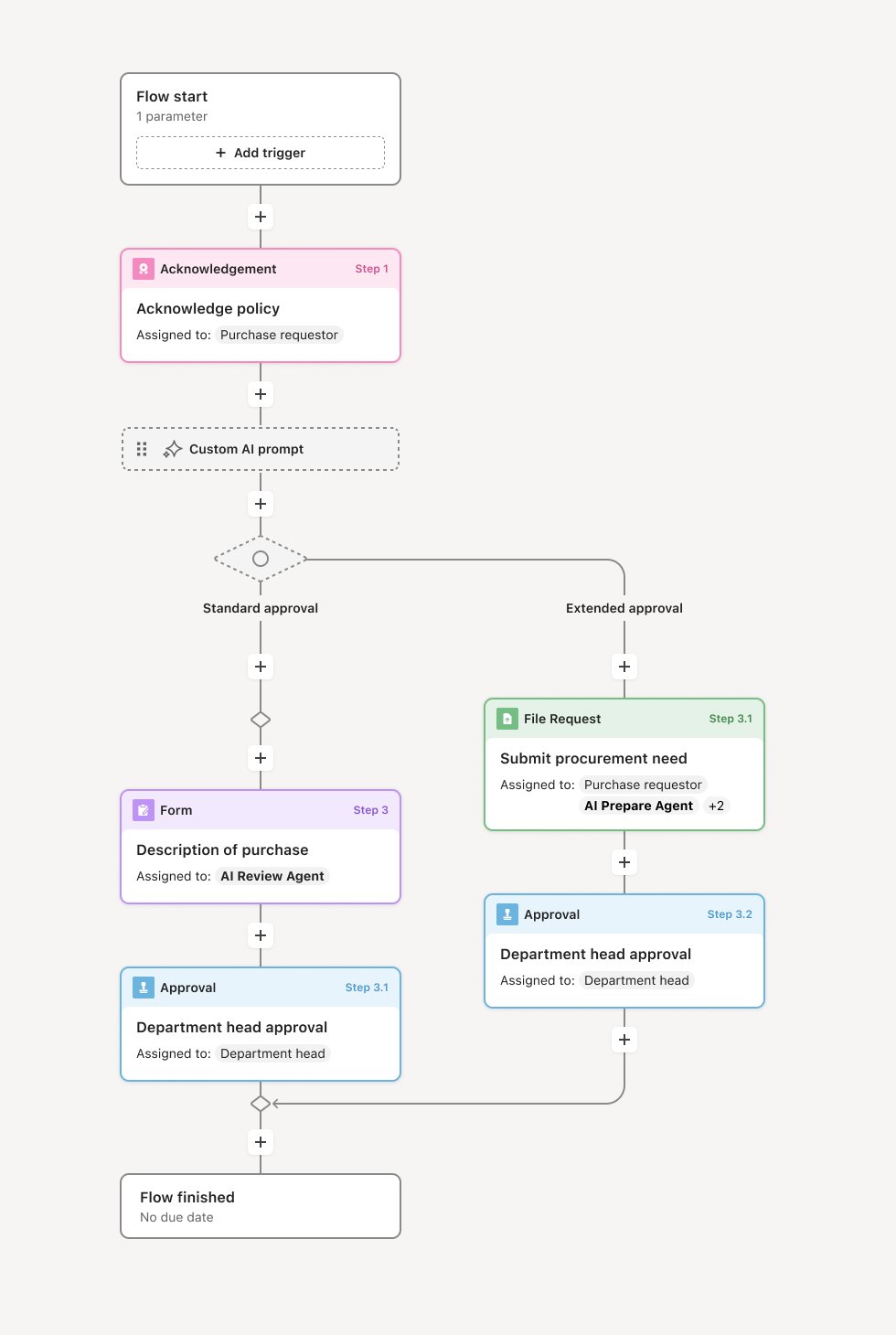
Your version of this process may vary based on roles, systems, data, and approval paths. Moxo's flow builder can be configured with AI agents, conditional branching, dynamic data references, and sophisticated logic to match how your organization runs this workflow. The steps below illustrate one example.
Case study development and draft submission
The process begins when a content marketer develops a case study draft based on customer success information. The draft includes the customer story, challenge addressed, solution implemented, results achieved with specific metrics where available, and customer quotes. Supporting documentation may include interview transcripts, data sources for metrics, and any prior customer communications. An AI agent can assist by checking that required elements are present, validating that claims have documented support, and flagging potential compliance issues before the review cycle begins.
Internal review and quality check
Before customer review, internal stakeholders validate the case study. The customer success manager confirms the story is accurate and that the customer relationship can support a reference request. Marketing leadership evaluates strategic fit and content quality. Brand reviewers assess alignment with style guidelines and brand standards. If internal reviewers identify issues—factual concerns, quality gaps, or relationship risks—the draft is revised before proceeding to customer review.
Customer review and approval
The case study is sent to the customer stakeholder for review and approval. The customer reviews all content, verifies accuracy of claims and metrics, ensures their organization is represented appropriately, and may request changes before granting approval. The workflow provides secure access for the customer to review materials and submit feedback or approval. If the customer requests revisions, those are addressed and resubmitted until customer approval is obtained. Customer approval is documented with explicit consent for specified uses.
Legal and compliance review
Legal reviews the case study and customer approval documentation. This includes confirming that customer agreements permit reference use, that any required NDAs or reference agreements are in place, that claims made are substantiated and defensible, and that the content does not create legal exposure. If the customer contract restricts public references, legal confirms that proper authorization has been obtained. Legal sign-off confirms that the case study can be used as intended without contractual or liability concerns.
Final approval and publication authorization
Once customer and legal approvals are obtained, marketing leadership grants final publication authorization. The case study is cleared for its intended uses—website, sales materials, advertising, or other specified channels. The workflow records the complete approval chain including customer consent documentation, legal review, and authorized usage scope. The approved case study is added to the content library with metadata indicating approved uses, and stakeholders are notified that the content is available for deployment.
This process commonly relies on inputs such as case study drafts, supporting data and metrics, interview transcripts or customer communications, customer contact information, customer agreements governing reference rights, and brand guidelines for case study formatting. It may be triggered by events like a customer success milestone, a sales team request for specific proof points, a marketing campaign requiring customer content, or periodic case study development programs. Common systems that integrate with this workflow include CRM platforms like Salesforce where customer relationships are tracked, content management systems, digital asset management platforms, and contract management systems where customer agreements are stored.
Key decision points include determining whether the case study meets internal quality standards, whether the customer relationship supports a reference request, whether the customer approves all content for specified uses, whether contractual and legal requirements are satisfied, and whether the content is ready for publication. Each decision point may trigger revision requests, relationship assessment with customer success, scope modifications based on customer preferences, or advancement toward final publication.
Unverified metrics where results claims are published without customer confirmation, creating credibility risk. Missing customer consent when content is used beyond what the customer explicitly approved. Contractual violations where reference use restrictions in customer agreements are overlooked. Relationship damage when customer review processes are rushed or their feedback is not genuinely incorporated. Stale content where approved case studies continue to be used after customer relationships or results have changed.
Orchestrates the complete approval cycle from draft development through internal review, customer approval, legal sign-off, and publication authorization in a single coordinated flow.
Engages customer stakeholders securely providing external access for customers to review content and submit approval without email chains or portal friction.
AI agents validate content completeness at submission, checking for required elements and flagging unsupported claims before review cycles begin.
Connects to CRM and content systems so customer context flows in automatically and approved case studies can be published to content libraries.
Documents customer consent explicitly capturing exactly what the customer approved for which uses, protecting both the relationship and the organization.
Maintains approval records with version history, customer approvals, legal sign-off, and authorized usage scope for compliance and future reference.