Chief financial officer
Finance director
Accounting manager
Financial systems administrator
Business unit controllers
Compliance manager
IT administrator
External auditor

This process is triggered when organizations need to modify their chart of accounts structure, whether adding new accounts, retiring existing ones, or restructuring account hierarchies. It becomes critical during business expansion, acquisitions, new product launches, or regulatory changes that require updated financial reporting categories. The process is essential when multiple departments must coordinate changes that impact financial reporting, budgeting systems, and downstream business processes. Ideal for organizations with complex financial structures, multiple business units, or strict regulatory requirements.
Finance teams initiate and evaluate proposed changes, while controllers assess business unit impact and reporting implications. System administrators handle technical implementation across ERP and financial systems, and compliance managers ensure changes meet regulatory requirements. External auditors may review changes for compliance with accounting standards, while business stakeholders provide input on operational impact.
Faster approval cycles as change requests move through reviewers with complete impact assessments and supporting documentation. Reduced implementation errors from thorough validation of account codes, hierarchies, and system mappings before deployment. Consistent compliance with accounting standards and regulatory requirements across all chart modifications. Minimized business disruption through coordinated implementation timing and stakeholder communication. Clear audit trail documenting approval rationale, impact analysis, and implementation steps for regulatory review.
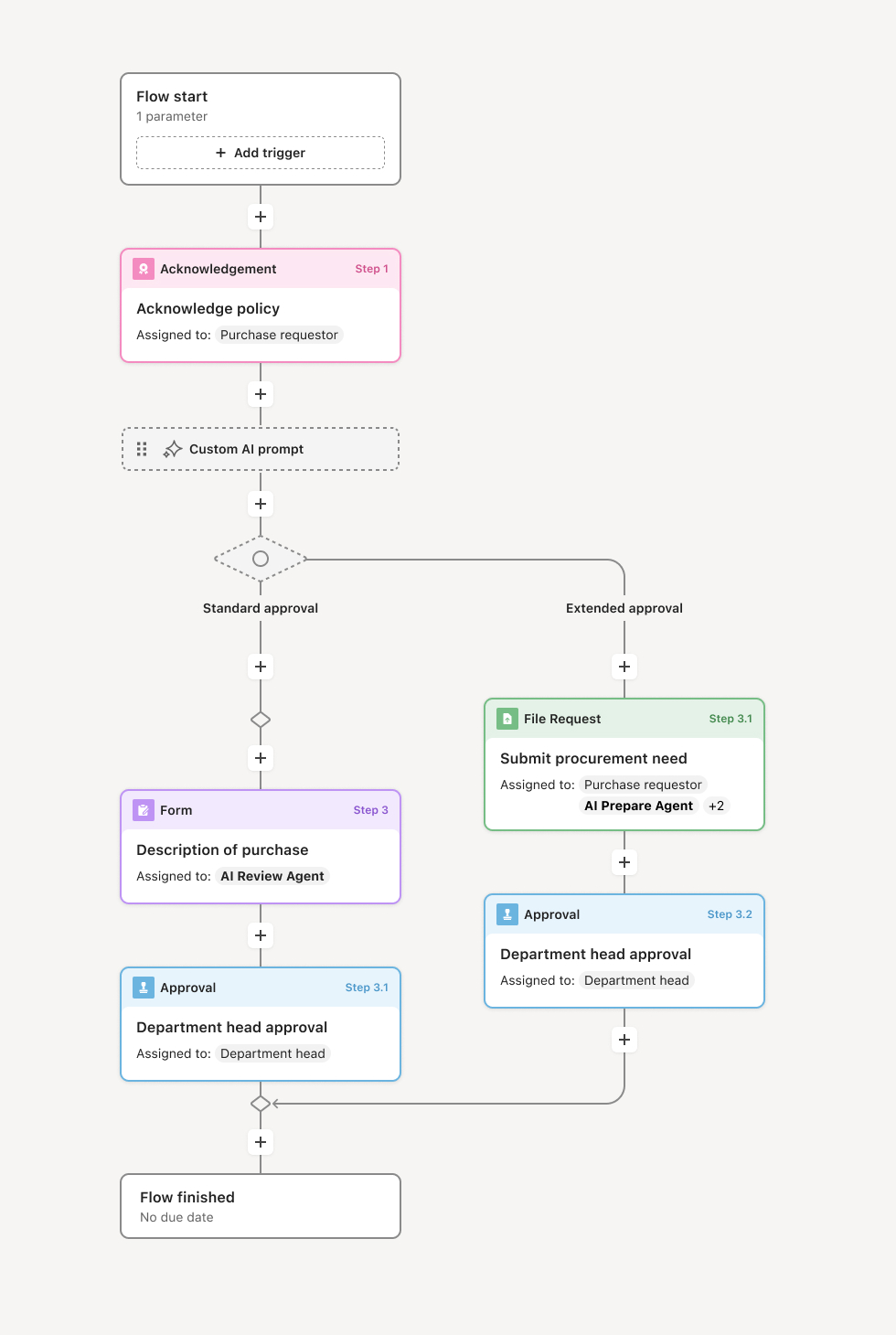
Your version of this process may vary based on roles, systems, data, and approval paths. Moxo's flow builder can be configured with AI agents, conditional branching, dynamic data references, and sophisticated logic to match how your organization runs this workflow. The steps below illustrate one example.
Change request initiation
The process begins when a business stakeholder or finance team member submits a chart of accounts change request, typically through a structured form capturing the proposed modification, business justification, and expected implementation timeline. AI agents validate the completeness of the request and flag any missing required information such as account codes, descriptions, or impact assessments. The system routes the request to the appropriate finance lead based on the scope and complexity of the proposed change.
Impact assessment and analysis
Finance teams conduct a comprehensive impact analysis, evaluating how the proposed change affects existing financial reports, budgets, and downstream processes. AI agents assist by pulling historical transaction data for similar accounts and identifying potential conflicts with existing account structures. If the change impacts multiple business units, the workflow branches to include controllers from affected departments who provide input on operational implications and reporting requirements.
Technical feasibility review
System administrators evaluate the technical requirements for implementing the change across ERP systems, reporting tools, and integrated applications. They assess mapping requirements, data migration needs, and potential system conflicts. If complex system changes are required, the workflow may branch to include IT security review and change management processes to ensure proper implementation protocols.
Compliance and regulatory review
Compliance managers review proposed changes against accounting standards, regulatory requirements, and internal policies to ensure adherence to financial reporting obligations. AI agents flag potential compliance issues by comparing proposed changes against regulatory databases and internal compliance rules. If external audit approval is required, the workflow routes to designated auditors with complete documentation packages.
Executive approval and authorization
Senior finance leadership reviews the complete change package, including impact analysis, technical assessment, and compliance validation. The CFO or designated approver makes the final authorization decision based on business justification, risk assessment, and implementation readiness. If changes exceed predetermined thresholds or affect critical financial processes, additional executive approval may be required.
Implementation coordination
Once approved, system administrators coordinate the technical implementation across all affected systems, working with business stakeholders to schedule deployment during appropriate maintenance windows. AI agents monitor implementation progress and flag any issues or delays that could impact financial reporting deadlines. The workflow ensures all stakeholders receive timely updates on implementation status and any required follow-up actions.
Validation and closure
After implementation, finance teams validate that changes have been properly applied across all systems and that financial reports reflect the new account structure accurately. Testing includes verification of account mappings, report generation, and data integrity checks. Once validation is complete, all stakeholders are notified of successful implementation, and the change is documented in the organization's financial systems governance records.
This process typically integrates with ERP systems (SAP, Oracle Financials, NetSuite), financial reporting platforms (Hyperion, Cognos, Tableau), and budgeting tools (Adaptive Insights, Anaplan). Common triggers include new business requirements, regulatory changes, or system upgrade requirements. Key inputs include proposed account structures, business justifications, impact assessments, compliance documentation, and technical implementation plans.
Critical decision points include determining whether the proposed change meets business justification thresholds, assessing if additional compliance review is required, and evaluating whether technical complexity warrants extended implementation timelines. If changes impact external reporting requirements, additional regulatory approval may be necessary. If system integration complexity exceeds normal parameters, the workflow may require enhanced testing and validation procedures.
Incomplete impact analysis leading to unexpected downstream effects on financial reporting and business processes. Insufficient stakeholder coordination causing implementation delays when business units are unprepared for account structure changes. Technical implementation errors from inadequate system testing or mapping validation before deployment. Compliance oversights resulting in regulatory issues when changes don't align with accounting standards or reporting requirements. Poor timing coordination disrupting financial close processes or critical reporting periods.
AI agents validate change requests by checking completeness of documentation and flagging potential conflicts with existing account structures before review begins.
Conditional routing ensures proper approval paths based on change complexity, financial impact thresholds, and regulatory requirements specific to each modification.
Parallel coordination enables simultaneous review by finance, compliance, and technical teams, reducing overall approval cycle time while maintaining thorough evaluation.
Integration with ERP and financial systems provides real-time access to current chart structures and historical data for comprehensive impact analysis.
Automated escalation triggers surface delayed approvals before they impact financial reporting deadlines or business operations.
Comprehensive audit trail captures all approval decisions, impact assessments, and implementation steps for regulatory compliance and internal governance requirements.