
This process activates when customer success teams identify at-risk accounts requiring retention intervention. It's triggered when churn risk scores exceed thresholds, contract renewal dates approach with negative signals, or customers explicitly indicate intent to cancel. The process becomes critical when retention offers involve significant discounts, service credits, or contract modifications that require financial approval. Ideal for SaaS companies, subscription services, and B2B organizations where customer lifetime value justifies structured retention investments.
Customer success managers initiate requests and provide account context, while finance teams evaluate discount impacts and budget implications. Revenue operations leaders assess strategic value and competitive positioning, with senior management providing final approval for high-value offers. Legal teams may review contract modifications, and sales leadership often weighs in on competitive retention strategies.
Faster retention response times as offers move through approval chains without manual coordination delays. Consistent offer guidelines applied across all at-risk accounts regardless of account manager. Reduced revenue leakage from customers lost during lengthy approval processes. Better retention ROI visibility through structured tracking of offer performance and approval patterns. Improved customer experience during retention conversations with timely, authorized responses.
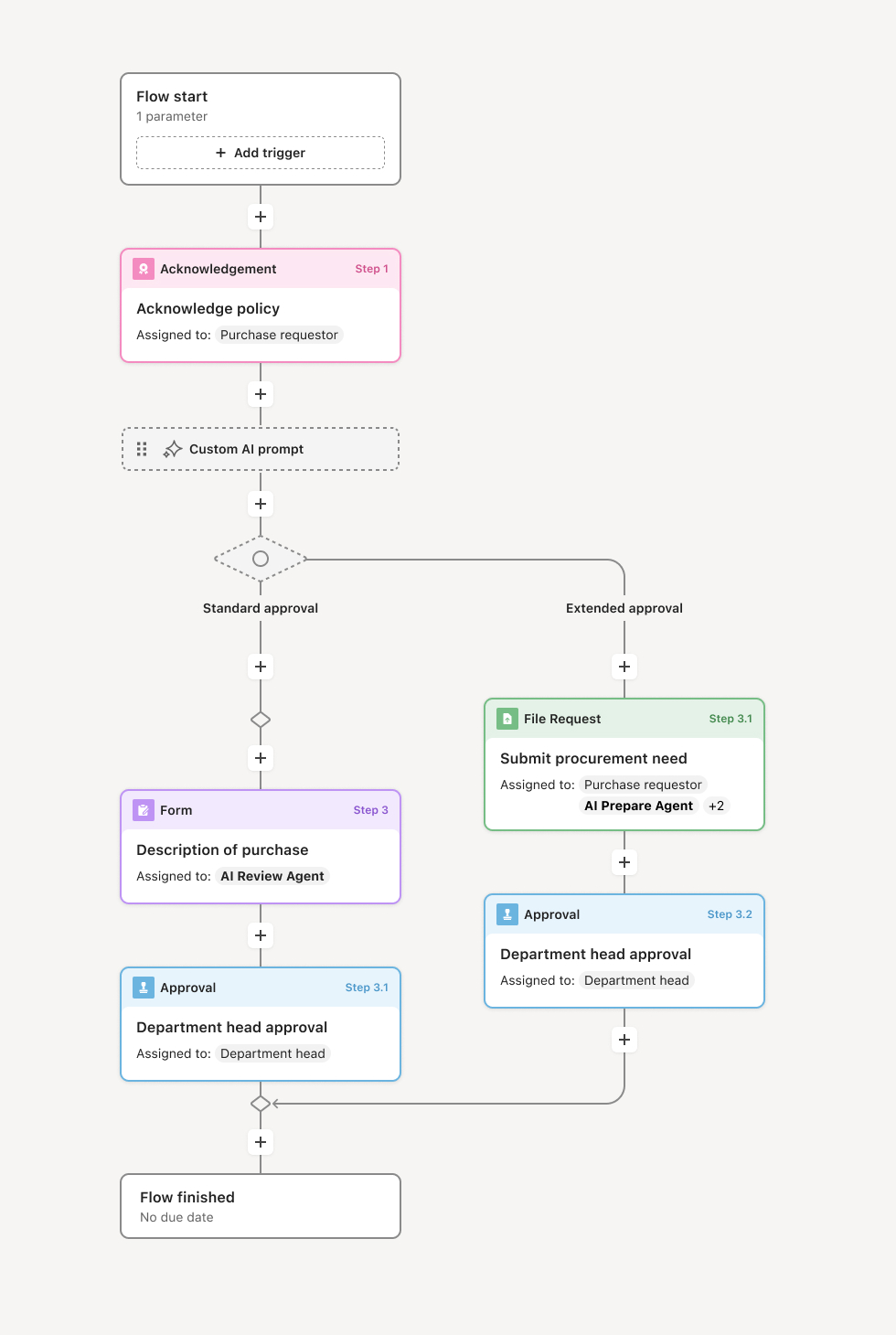
Your version of this process may vary based on roles, systems, data, and approval paths. Moxo's flow builder can be configured with AI agents, conditional branching, dynamic data references, and sophisticated logic to match how your organization runs this workflow. The steps below illustrate one example.
Retention opportunity identification
The process begins when customer success systems flag at-risk accounts through churn prediction models, contract renewal alerts, or direct customer feedback. AI agents analyze customer health scores, usage patterns, and historical retention data to prepare comprehensive account summaries. The customer success manager reviews the analysis and determines whether a retention offer is warranted based on account value and churn probability.
Offer strategy development
Customer success teams develop proposed retention offers based on account history, competitive intelligence, and available retention tools. AI agents validate offer parameters against established guidelines and flag any proposals that exceed standard discount thresholds or require special approval. The system routes requests through appropriate approval chains based on offer value, discount percentage, and account tier.
Financial impact assessment
Finance teams review the revenue impact of proposed offers, analyzing short-term discount costs against projected lifetime value retention. AI agents calculate financial metrics and compare proposals against budget allocations and historical retention spend. If the offer exceeds predefined financial thresholds, additional executive approval is triggered automatically.
Strategic review and approval
Revenue operations or senior management evaluate offers within broader retention strategy and competitive context. AI agents provide market intelligence and retention benchmarks to inform approval decisions. If approved, the system generates authorized offer parameters and notifies the customer success team. If modifications are required, the request loops back with specific guidance for revision.
Offer execution and tracking
Approved offers are communicated to customers through coordinated outreach, with contract modifications processed through integrated systems. AI agents monitor customer responses and track offer acceptance rates. The system maintains a complete record of retention decisions, offer performance, and customer outcomes for future strategy refinement.
This process typically pulls customer health data from success platforms (Gainsight, ChurnZero, Totango), financial information from billing systems (Stripe, Zuora, NetSuite), and contract details from CRM systems. It is triggered when churn risk scores exceed thresholds, renewal dates approach with negative indicators, or customer success managers submit retention requests. Key inputs include customer usage metrics, payment history, support ticket volume, contract terms, and competitive intelligence reports.
Key decision points include determining whether the account qualifies for retention investment based on lifetime value calculations, whether proposed discounts fall within approved guidelines or require escalation, and whether offer terms require legal review for contract modifications. Additional decisions involve timing coordination with renewal cycles and competitive response strategies.
Approval delays during critical retention windows allowing competitors to capture departing customers. Inconsistent offer guidelines creating unfair treatment across similar accounts and customer confusion. Insufficient financial context provided to approvers, leading to poorly informed retention investment decisions. Lack of coordination between customer success and finance resulting in offers that exceed budget or margin requirements. Poor tracking of offer outcomes preventing optimization of future retention strategies.
AI agents analyze customer data and automatically prepare retention summaries with health scores, usage trends, and financial impact projections before human review.
Conditional approval routing directs offers through appropriate chains based on discount levels, account value, and risk thresholds without manual coordination.
Parallel review processes allow finance and strategic teams to evaluate offers simultaneously, reducing approval cycle time during critical retention windows.
Integration with CRM and billing systems ensures approvers have complete customer context and real-time contract information.
Automated escalation triggers surface time-sensitive retention opportunities before customers complete churn processes.
Real-time offer tracking provides visibility into approval status and enables proactive follow-up with at-risk accounts.