Client success manager
Account manager
Customer support lead
Operations manager
Service delivery director
VP of client services

This process is triggered when a client issue cannot be resolved at the frontline level, when a complaint exceeds defined severity thresholds, when response times have lapsed beyond acceptable limits, or when the client explicitly requests escalation. It is also used when issues involve contractual disputes, service failures, or situations that may impact client retention. Client escalation workflows are common in professional services, financial services, technology, healthcare, and any organization where client relationships carry significant value.
Participants typically include the frontline account manager or support representative who initiates the escalation, the escalation owner or manager responsible for review and resolution, and senior leaders or executives who may need to intervene in high-severity cases. Depending on the issue, legal, compliance, or finance teams may also be involved when contractual or financial implications exist.
Faster resolution of high-priority issues by routing escalations immediately to decision-makers with authority to act. Preserved client relationships through timely intervention before issues compound or trust erodes. Complete context at every level so escalation owners understand the issue history without redundant investigation. Clear accountability with defined ownership at each escalation tier. Reduced escalation volume over time as patterns are identified and addressed at their root.
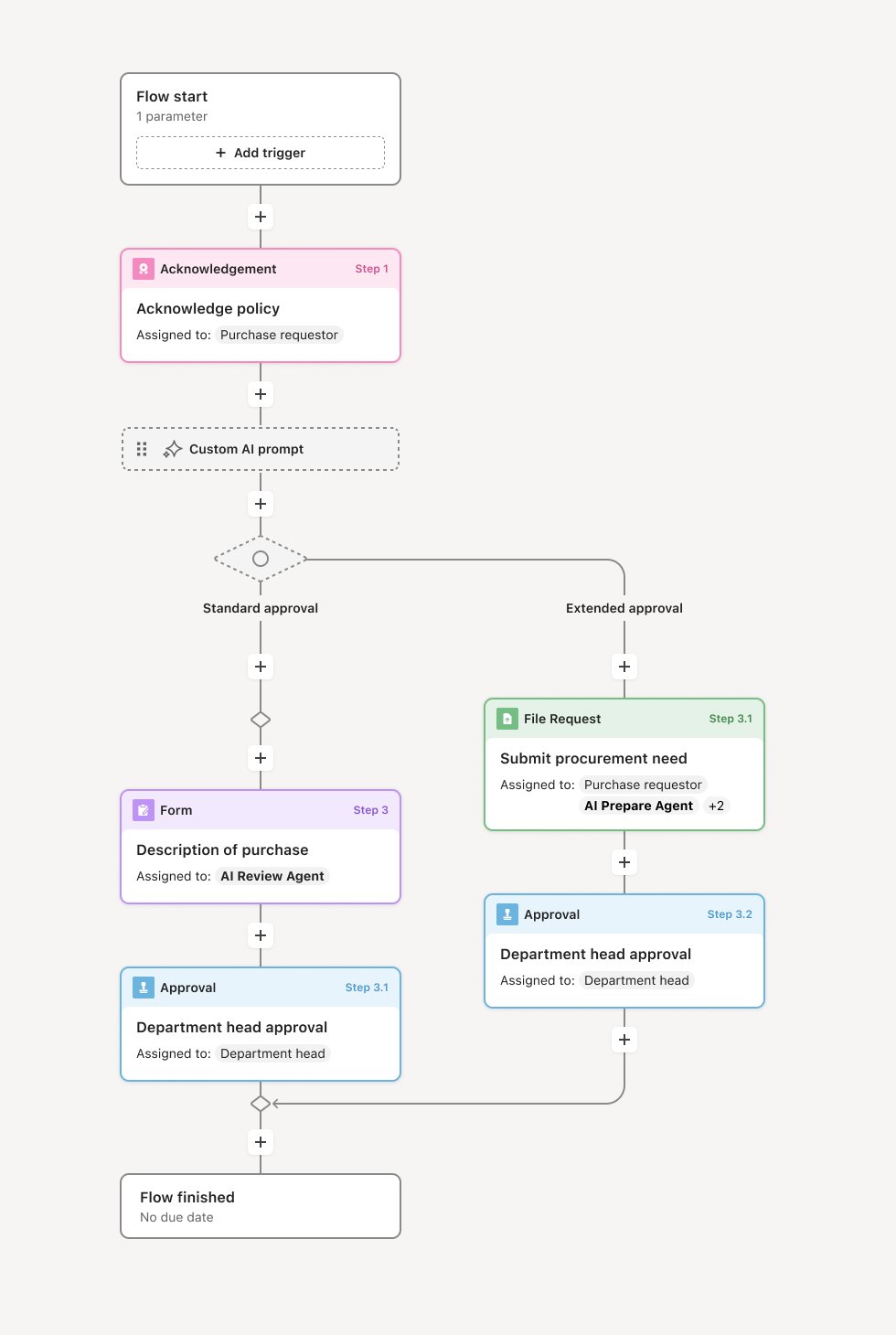
Your version of this process may vary based on roles, systems, data, and approval paths. Moxo's flow builder can be configured with AI agents, conditional branching, dynamic data references, and sophisticated logic to match how your organization runs this workflow. The steps below illustrate one example.
Issue identification and initial assessment
The process begins when a frontline team member determines that an issue cannot be resolved through standard channels or has exceeded defined thresholds for severity, duration, or client impact. An AI agent may assist by flagging overdue issues, analyzing sentiment from prior communications, or identifying patterns that suggest escalation is warranted.
Escalation submission
The initiating team member submits the escalation with all relevant context, including issue history, prior resolution attempts, client communications, and any supporting documentation. The submission is structured to ensure the escalation owner receives a complete picture without needing to request additional information.
Routing and assignment
Based on the escalation type, severity, or client tier, the workflow routes the issue to the appropriate escalation owner. Routing may follow predefined rules or be adjusted dynamically based on availability, expertise, or workload. The assigned owner is notified immediately with full context attached.
Review and resolution
The escalation owner reviews the issue, engages with the client or internal teams as needed, and determines the appropriate resolution path. If the issue requires higher authority, the escalation can be elevated further with all accumulated context intact. AI agents may suggest resolution options based on similar past cases or flag compliance considerations.
Client communication and closure
Once a resolution is reached, the client is notified with a clear explanation of the outcome and any next steps. The escalation is closed with a documented resolution summary, timestamps, and participant actions. If follow-up is required, downstream tasks are triggered automatically.
This process commonly relies on inputs such as issue descriptions, client communication history, service records, and prior resolution attempts. It may be triggered by events like SLA breaches, client complaints logged in a CRM such as Salesforce or Zendesk, or manual submission by a frontline team member. Supporting systems might include ticketing platforms, client databases, or communication tools that capture the issue history.
Key decision points include determining whether the issue meets escalation criteria, which escalation tier is appropriate, whether additional information is needed before resolution, and whether the proposed resolution satisfies the client. If the client rejects the resolution or the issue remains unresolved, the workflow may branch to a higher escalation tier or trigger executive involvement.
Escalations triggered too late after client frustration has already compounded. Insufficient context provided forcing escalation owners to investigate from scratch. Unclear escalation paths causing confusion about who has authority to resolve the issue. Lack of follow-through when resolutions are reached but not communicated back to the client.
Captures complete issue context so escalation owners receive history, documents, and prior communications in one view.
Routes escalations dynamically based on severity, client tier, issue type, or team availability.
AI agents assist with triage by flagging high-risk issues, suggesting escalation paths, and summarizing prior interactions.
Automates notifications and reminders to ensure escalations receive timely attention.
Maintains accountability at every tier with clear ownership and documented handoffs.
Integrates with CRMs and support platforms so escalation workflows connect to existing client records and ticketing systems.