Collections manager
Accounts receivable lead
Credit manager
Finance operations director
Controller
VP of finance

This process is triggered when an account remains overdue beyond standard collection timeframes, when payment disputes cannot be resolved at the frontline level, when the outstanding balance exceeds risk thresholds, or when the customer relationship requires senior involvement to preserve. It also applies when accounts approach write-off consideration or when legal action may be warranted. Collections escalation workflows are common in financial services, B2B enterprises, healthcare, and any organization with significant receivables portfolios.
Participants typically include the collections specialist who initiates the escalation, the collections or credit manager responsible for reviewing escalated accounts, and senior finance leaders who may authorize settlement terms, write-offs, or legal action. Depending on the situation, sales or account management may be involved when customer relationship considerations are significant.
Faster resolution of aging receivables by routing difficult accounts to decision-makers with authority to negotiate or act. Preserved customer relationships through appropriate escalation rather than aggressive collection tactics. Complete account context at every level so escalation owners understand payment history, disputes, and prior communications. Clear decision authority with defined ownership for settlement, write-off, or legal referral decisions. Reduced DSO as escalation processes prevent accounts from aging indefinitely without action.
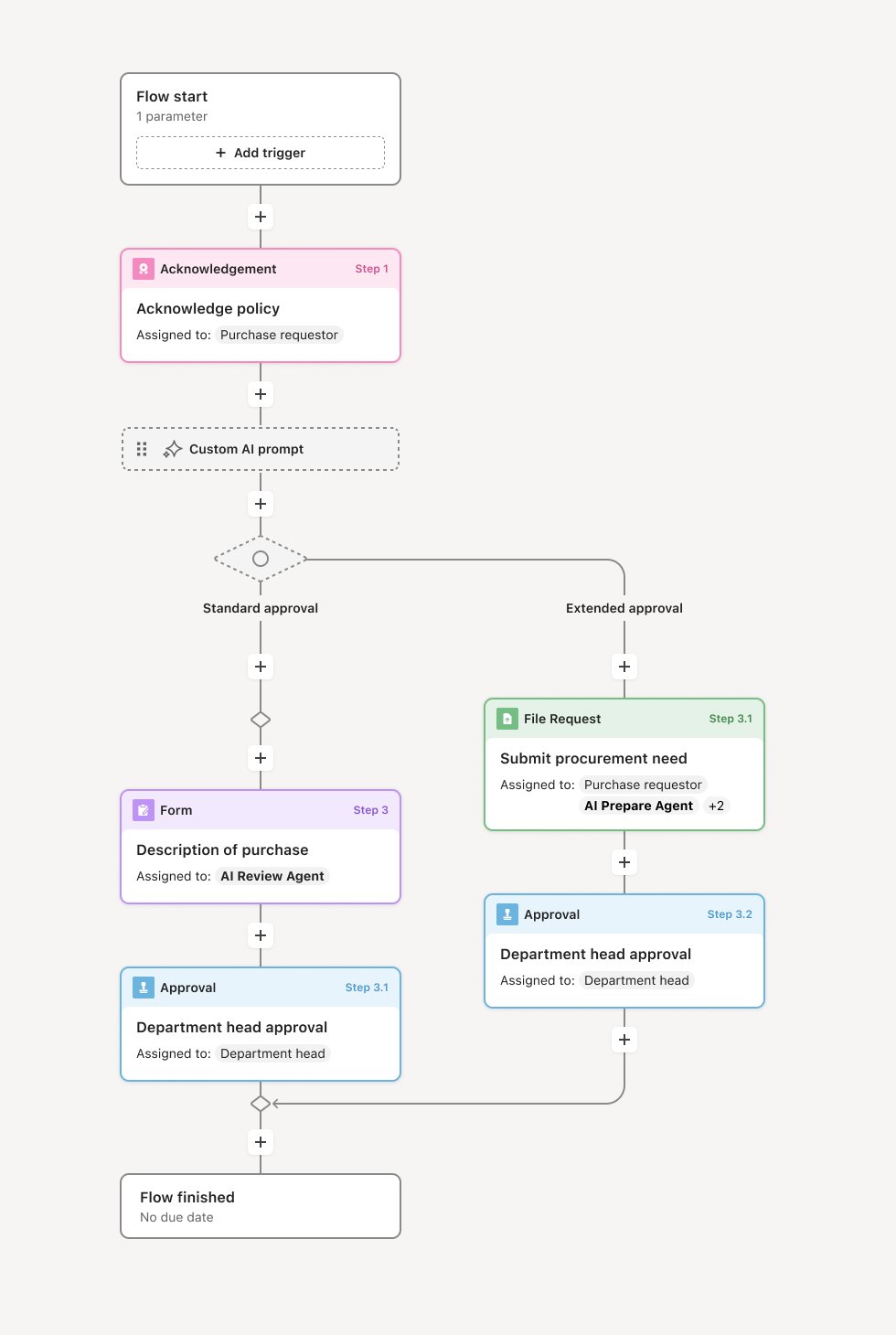
Your version of this process may vary based on roles, systems, data, and approval paths. Moxo's flow builder can be configured with AI agents, conditional branching, dynamic data references, and sophisticated logic to match how your organization runs this workflow. The steps below illustrate one example.
Account identification and threshold assessment
The process begins when a collections specialist identifies an account that has exceeded standard collection timeframes or meets escalation criteria based on balance, age, or risk score. An AI agent may assist by flagging accounts that match escalation rules, analyzing payment patterns, or scoring accounts based on likelihood of collection.
Escalation submission
The specialist submits the escalation with complete account context, including outstanding balance, aging details, payment history, prior collection attempts, and any dispute information. Supporting documents such as invoices, contracts, or correspondence are attached to provide the escalation owner with a full picture.
Routing and assignment
Based on the account tier, balance threshold, or escalation type, the workflow routes the account to the appropriate escalation owner. Routing may consider customer relationship value, dispute complexity, or required decision authority. The assigned owner receives immediate notification with all context attached.
Review and resolution options
The escalation owner reviews the account, engages with the customer or internal teams as needed, and determines the appropriate resolution path. Options may include extended payment terms, settlement offers, write-off recommendations, or legal referral. AI agents may suggest resolution approaches based on similar past accounts or flag compliance considerations.
Decision execution and closure
Once a resolution path is selected, the workflow triggers the appropriate downstream actions, such as generating settlement agreements, updating payment terms in the ERP, or initiating legal workflows. The account is closed with documented resolution, timestamps, and approval records. If follow-up is required, monitoring tasks are scheduled automatically.
This process commonly relies on inputs such as account aging reports, payment history, invoice records, customer communications, and dispute documentation. It may be triggered by events like aging thresholds in an ERP such as NetSuite or SAP, automated flags from collections software, or manual submission by a collections specialist. Supporting systems might include ERPs, CRMs, and collections platforms that track account status and payment activity.
Key decision points include determining whether the account meets escalation criteria, which escalation tier is appropriate based on balance and risk, what resolution options are available given the account history, and whether settlement, write-off, or legal action is warranted. If the customer disputes the balance or proposes alternative terms, the workflow branches to negotiation or dispute resolution paths.
Escalations triggered too late after accounts have aged beyond reasonable collection likelihood. Incomplete account context forcing escalation owners to investigate payment history and disputes from scratch. Unclear decision authority causing delays when escalation owners lack authorization to approve settlements or write-offs. No follow-through on resolutions when agreed payment terms are not monitored for compliance.
Captures complete account context including aging, payment history, disputes, and prior communications in one view. Routes escalations dynamically based on balance thresholds, account tier, or risk scores. AI agents assist with analysis by scoring accounts, flagging high-risk situations, and suggesting resolution approaches. Orchestrates decision workflows for settlements, write-offs, or legal referrals with appropriate approvals. Automates monitoring and follow-up to ensure agreed payment terms are tracked and exceptions flagged. Integrates with ERPs and collections platforms to pull account data and push resolution updates to financial systems.