HR business partner
Compensation analyst
People operations manager
Finance business partner
Department head
Chief people officer

This process is used when existing employee compensation requires modification outside of standard annual review cycles. It applies when promotions warrant salary adjustments, when market corrections are needed to maintain competitive positioning, when retention offers are being made to at-risk employees, or when role changes justify pay modifications. Compensation change approval is common during off-cycle requests, reorganizations, or when addressing internal equity concerns.
Participants typically include the manager who initiates the change request with justification, the HR business partner who validates against policy and assesses internal equity impact, the finance partner who confirms budget capacity, and senior leaders who authorize changes above defined thresholds. In some cases, compensation committees may review significant adjustments or those involving equity compensation.
Controlled pay modifications with verification that changes align with policy, budget, and internal equity standards. Timely retention actions by streamlining approval workflows when speed matters for at-risk employees. Documented justification creating clear records of why changes were made for compliance and future reference. Budget discipline by confirming financial capacity before changes are communicated. Consistent application of compensation philosophy regardless of manager or department.
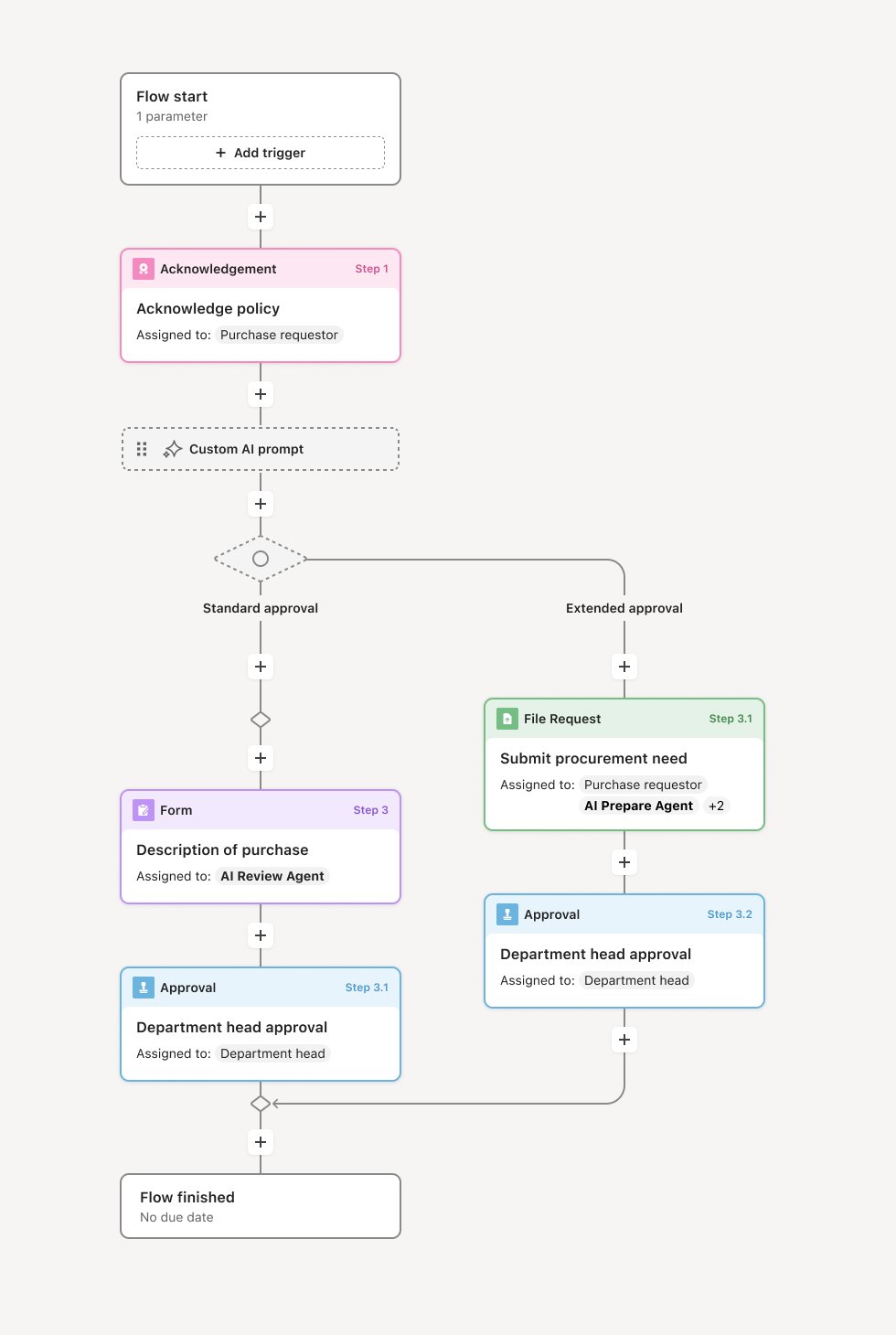
Your version of this process may vary based on roles, systems, data, and approval paths. Moxo's flow builder can be configured with AI agents, conditional branching, dynamic data references, and sophisticated logic to match how your organization runs this workflow. The steps below illustrate one example.
Change request submission
The process begins when a manager submits a compensation change request, specifying the proposed adjustment amount, effective date, and business justification. The request may be for a promotion, market adjustment, retention increase, or role change. An AI agent may assist by pre-populating current compensation data, flagging recent changes for the same employee, or comparing the proposal against pay band midpoints.
HR policy review
The request is routed to HR for policy validation. The HR partner reviews the proposal against pay bands, recent change history, internal equity considerations, and any applicable guidelines for the change type. If the request falls outside policy parameters, the reviewer documents the exception and assesses whether it warrants approval.
Internal equity assessment
HR evaluates the impact of the proposed change on internal equity, considering compensation for comparable roles, team members, and recent adjustments in the same department. If equity concerns are identified, they are flagged for discussion with the requesting manager before approval proceeds.
Budget and finance review
Finance validates that budget exists for the proposed change and assesses impact on departmental compensation spend. This includes checking against headcount plans, merit pools, or discretionary budgets depending on the change type. Budget concerns are documented and resolved before final approval.
Final approval and execution
The validated request is routed to the appropriate approver based on the change amount or type. The approver reviews the complete package, including justification, policy validation, equity assessment, and budget confirmation. Upon approval, the change is recorded and routed to HR systems for processing. The employee and manager are notified according to organizational communication protocols.
This process commonly relies on inputs such as current compensation records, pay band documentation, performance history, market salary data, and budget reports. It may be triggered by events like a promotion workflow in an HRIS such as Workday or ADP, a manager request through an HR portal, or an escalation from a retention conversation. Supporting systems might include HRIS platforms, compensation management tools, and financial planning systems.
Key decision points include determining whether the proposed change falls within policy guidelines, whether internal equity concerns exist that need addressing, whether budget is available for the change, and whether the justification supports the requested amount. If the change exceeds thresholds or involves exceptions, the workflow routes to higher approval authority.
Inconsistent application when similar situations receive different outcomes due to lack of structured review. Equity blind spots when changes are approved without considering impact on comparable employees. Budget surprises when changes are communicated before financial validation is complete. Missing documentation when justification is not captured, creating compliance risk for pay decisions.
Structures change requests so reviewers see current compensation, proposed change, and justification in context.
Routes approvals based on change type and amount ensuring appropriate oversight for significant adjustments.
AI agents assist with validation by checking pay bands, recent change history, and flagging equity considerations.
Captures complete approval rationale so decisions are documented for compliance, audit, and employee questions.
Orchestrates multi-stakeholder workflows across HR, finance, and management with clear accountability.
Integrates with HRIS platforms to pull current employee data and push approved changes for payroll processing.