Project manager
Construction manager
Owner's representative
General contractor
Architect
Facilities director

This process is used when construction project conditions require modifications to the original contract scope, budget, or timeline. It applies when site conditions differ from plans, when owner-requested changes alter scope, when design modifications are required, when material substitutions are proposed, or when unforeseen circumstances impact the project. Change order approval is essential in commercial construction, residential development, infrastructure projects, and facility renovations where contract terms must be formally modified.
Participants typically include the party requesting the change (contractor, owner, or architect), the project manager who evaluates impact and coordinates review, cost estimators who assess financial implications, the architect or engineer who reviews design impacts, and authorized signatories from each contracting party who approve the modification. On complex projects, legal counsel may review significant changes.
Controlled scope modifications with documented agreement before work proceeds outside original contract terms. Clear cost accountability with itemized pricing and approval before additional expenses are incurred. Schedule impact visibility by assessing timeline implications before changes are implemented. Reduced disputes through documented authorization that prevents disagreements about what was approved. Maintained project records with complete change order history for closeout and future reference.
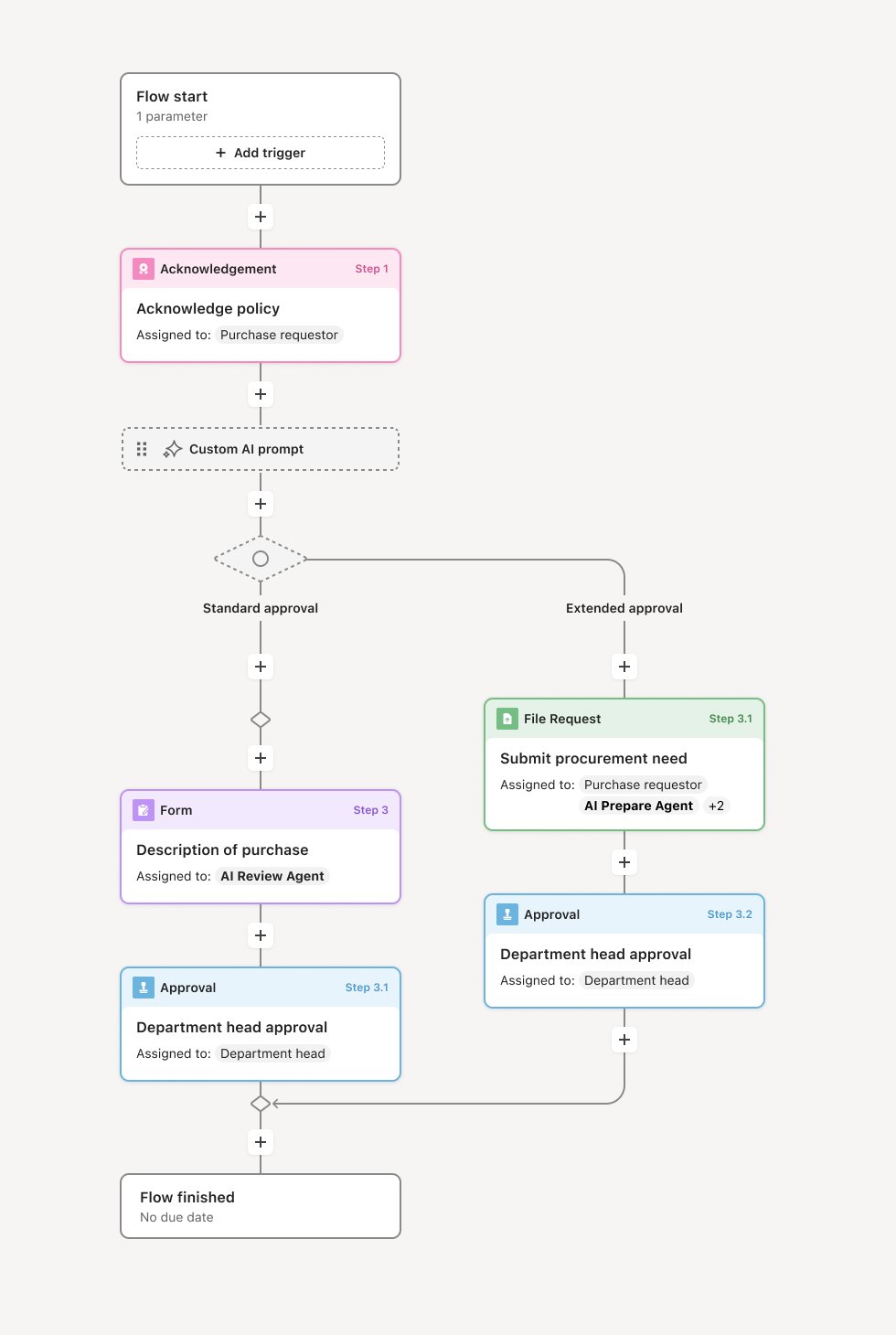
Your version of this process may vary based on roles, systems, data, and approval paths. Moxo's flow builder can be configured with AI agents, conditional branching, dynamic data references, and sophisticated logic to match how your organization runs this workflow. The steps below illustrate one example.
Change identification and request
The process begins when a condition arises that requires contract modification. The requesting party documents the change, including description of the modification, reason for the change, and any supporting evidence such as site photos, RFIs, or design revisions. An AI agent may assist by extracting relevant details from uploaded documents or comparing the request against original contract scope.
Impact assessment
The project team evaluates the change request across cost, schedule, and scope dimensions. The contractor provides detailed pricing including labor, materials, equipment, and markup. The architect or engineer reviews any design implications. The project manager assesses schedule impact and identifies any downstream effects on other work.
Review and negotiation
The owner or owner's representative reviews the proposed change and supporting documentation. If the cost or scope is disputed, negotiation occurs to reach agreement. Questions are addressed, alternative approaches may be considered, and the final terms are documented. AI agents may assist by summarizing change order history or flagging items that deviate from typical pricing.
Authorization and execution
Once terms are agreed, the change order is routed for formal approval. Depending on the change value and contract requirements, multiple signatories may be required. Each party reviews and signs the change order document, creating binding authorization for the modified work.
Documentation and integration
The approved change order is recorded in project documentation, updating the contract sum, schedule, and scope records. The project management system reflects the modification, and the change is incorporated into progress tracking and payment applications. Downstream teams are notified of any impacts to their work.
This process commonly relies on inputs such as original contract documents, architectural drawings, site condition reports, RFI responses, cost estimates, and schedule analyses. It may be triggered by events like field condition discoveries, owner change requests, design clarifications, or regulatory requirements. Supporting systems might include project management platforms like Procore or Autodesk Construction Cloud, estimating software, document management systems, and accounting platforms.
Key decision points include determining whether the change is within scope or constitutes additional work, whether proposed pricing is fair and reasonable, whether schedule impact is acceptable, and whether the change should proceed given project constraints. If parties disagree on terms, the workflow branches to negotiation or dispute resolution. If the change exceeds authority limits, escalation to senior leadership occurs.
Work proceeding without approval when contractors begin changes before authorization, creating payment disputes. Incomplete documentation when change requests lack sufficient detail for informed decisions. Delayed approvals that hold up dependent work and compound schedule impacts. Poor cost tracking when approved changes are not properly incorporated into budget and payment records.
Structures change order submissions so all parties receive complete documentation including scope, cost, and schedule impact.
Routes reviews to appropriate stakeholders based on change value, type, or contract requirements.
AI agents assist with documentation review by extracting key details, comparing against contract terms, and flagging inconsistencies.
Orchestrates multi-party approval with clear sequence for owner, contractor, and architect sign-off.
Maintains complete change order records with timestamps, approvals, and supporting documentation for project closeout.
Integrates with project management systems to update budgets, schedules, and contract records upon approval.