Contract manager
Legal counsel
Sales operations manager
Procurement manager
Risk manager
General counsel

This process is used when a proposed contract requires terms that deviate from organizational standards, approved templates, or established policies. It applies when counterparties require modified liability provisions, non-standard payment terms, unusual intellectual property arrangements, extended warranties, or other deviations from the norm. Contract exception approval is common in enterprise sales, strategic procurement, partnership agreements, and any negotiation where standard terms cannot accommodate the business situation.
Participants typically include the contract owner who requests the exception with business justification, legal counsel who assesses risk and provides recommendations, the exception approver who has authority to authorize deviations based on type and risk level, and potentially senior leadership for significant exceptions. Risk management or compliance may be involved when exceptions implicate regulatory or policy considerations.
Controlled flexibility allowing business needs to be met while maintaining appropriate oversight of non-standard terms. Risk-aware decisions with documented assessment of exception implications before approval. Clear audit trail showing what was approved, by whom, and why for compliance and future reference. Consistent exception handling ensuring similar situations receive similar treatment across the organization. Faster deal closure by providing a clear path for handling non-standard requests rather than ad-hoc negotiation.
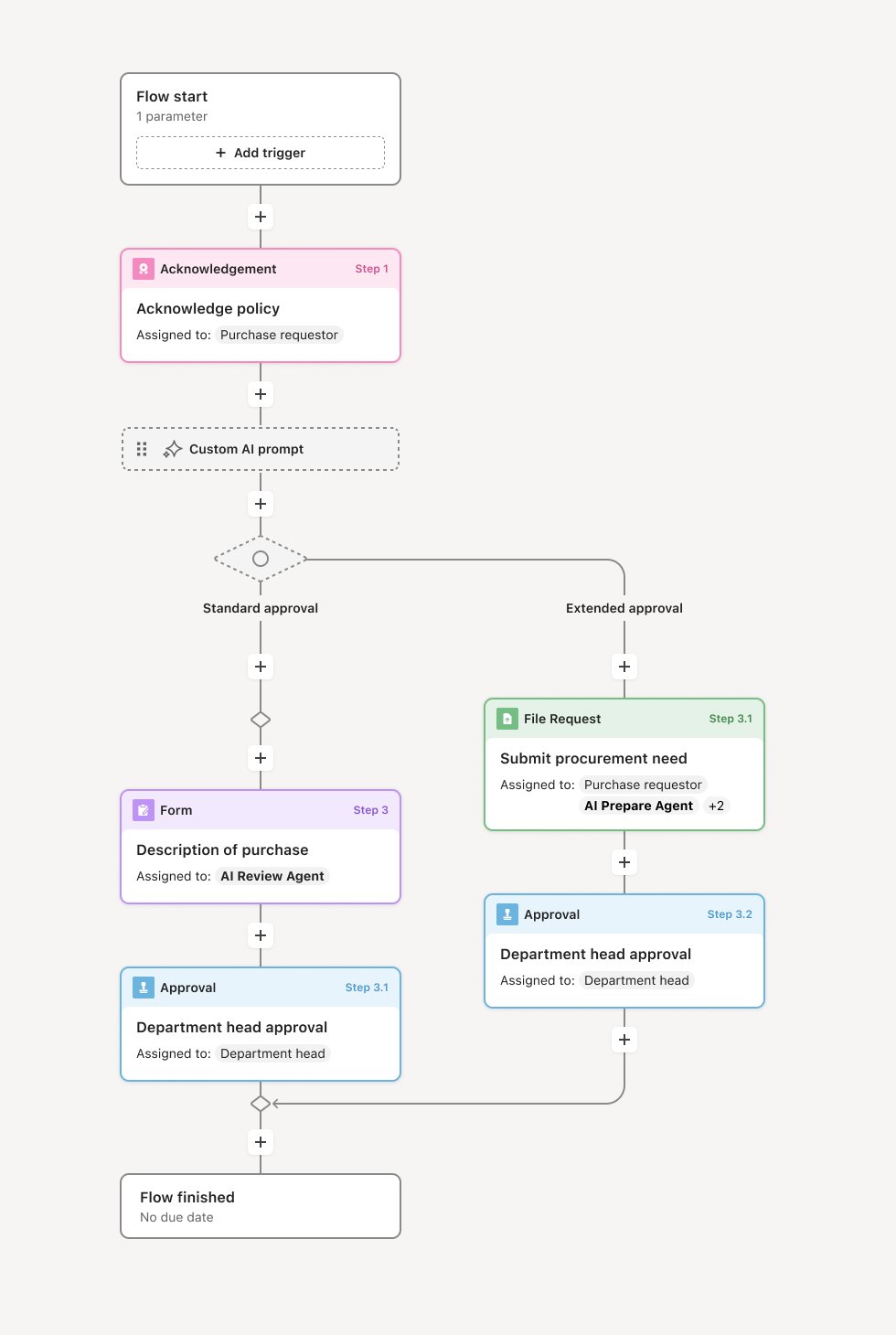
Your version of this process may vary based on roles, systems, data, and approval paths. Moxo's flow builder can be configured with AI agents, conditional branching, dynamic data references, and sophisticated logic to match how your organization runs this workflow. The steps below illustrate one example.
Exception identification and request
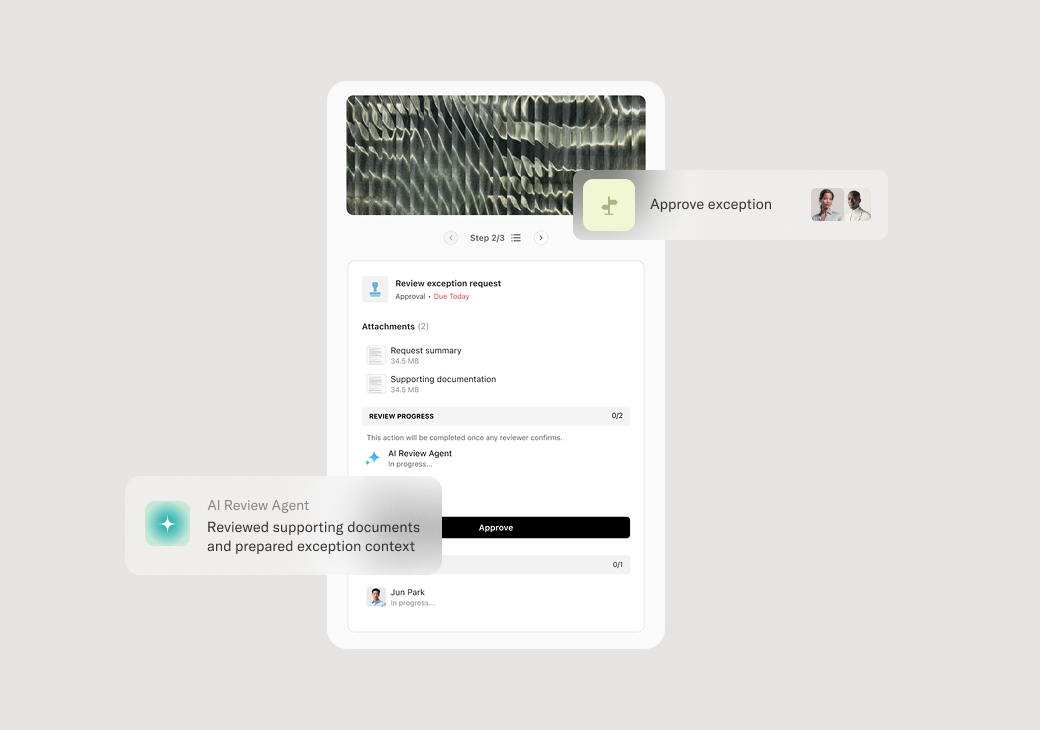
The process begins when a contract owner identifies that proposed terms deviate from organizational standards. The exception request includes the specific deviation, business rationale, counterparty requirements, and any relevant deal context. An AI agent may assist by comparing proposed terms against standard templates, categorizing the exception type, and routing to appropriate reviewers based on deviation severity.
Risk assessment and analysis
Legal reviews the requested exception to assess risk exposure, potential precedent implications, and alignment with organizational risk tolerance. The analysis considers worst-case scenarios, likelihood of issues arising, and mitigation options. If the exception involves financial terms, finance provides impact assessment. Recommendations are documented for the approver.
Business justification review
The exception approver evaluates the business case for the deviation, weighing the commercial value of the deal against the risk of the non-standard terms. This includes considering whether the exception is truly necessary, whether alternatives exist, and whether the deal merits the requested accommodation.
Approval decision
Based on risk assessment and business justification, the approver either authorizes the exception, rejects it with explanation, or approves with conditions or modifications. If the exception exceeds the approver's authority, it escalates to higher-level decision-makers. The decision is documented with rationale.
Implementation and tracking
Upon approval, the exception authorization is recorded and the contract workflow proceeds with the non-standard terms permitted. The exception is logged for tracking purposes, enabling the organization to monitor exception patterns and assess whether standards should be updated. Audit records are maintained for compliance purposes.
This process commonly relies on inputs such as draft contract language, standard term templates, exception request forms, risk assessment frameworks, and deal summaries. It may be triggered by events like redline reviews, counterparty requests, or contract owner submissions. Supporting systems might include contract lifecycle management platforms, policy databases, and approval workflow tools.
Key decision points include determining whether the deviation truly requires exception approval or can be addressed within standard flexibility, whether the risk exposure is acceptable given the business value, whether conditions should be attached to the approval, and whether the exception should inform updates to standard terms. If risk is deemed unacceptable, the workflow branches to rejection or alternative negotiation approaches.
Unclear exception thresholds causing confusion about which deviations require formal approval. Inadequate risk assessment when exceptions are approved without understanding potential exposure. Approval bottlenecks when exception requests queue and delay deal progress. Lost precedent value when approved exceptions are not tracked to inform future decisions or policy updates.
Structures exception requests so reviewers receive complete information including deviation, rationale, and deal context.
Routes approvals based on exception type and risk ensuring appropriate authority reviews each request.
AI agents assist with comparison and categorization by identifying deviations from standards and classifying exception severity.
Captures risk assessment and recommendations so approvers make informed decisions with expert input.
Tracks exception patterns enabling analysis of common deviations and potential policy updates.
Maintains audit records documenting approvals, rationale, and conditions for compliance and reference.