Travel manager
Department manager
Finance manager
Executive assistant
HR business partner
Operations manager

This process is used when employees need to travel for business purposes and organizational policy requires pre-approval before booking. It applies to domestic and international travel, conferences and events, client visits, internal meetings requiring travel, and any trip that involves airfare, lodging, or significant expense. Corporate travel approval is common in organizations with travel policies, budget controls, or duty of care requirements for traveling employees.
Participants typically include the employee requesting travel approval, the manager who validates business necessity and budget availability, the travel coordinator or admin who may assist with booking, and finance or travel management who verify policy compliance. For international travel or trips exceeding thresholds, additional approvers such as senior leadership or security may be required.
Controlled travel spend with validation that trips are necessary and within budget before booking. Policy compliance ensuring travel arrangements meet organizational standards and requirements. Faster booking authorization through streamlined approval that doesn't delay necessary travel. Duty of care fulfillment with visibility into employee travel for safety and communication purposes. Clear audit trails documenting who approved travel and the business justification.
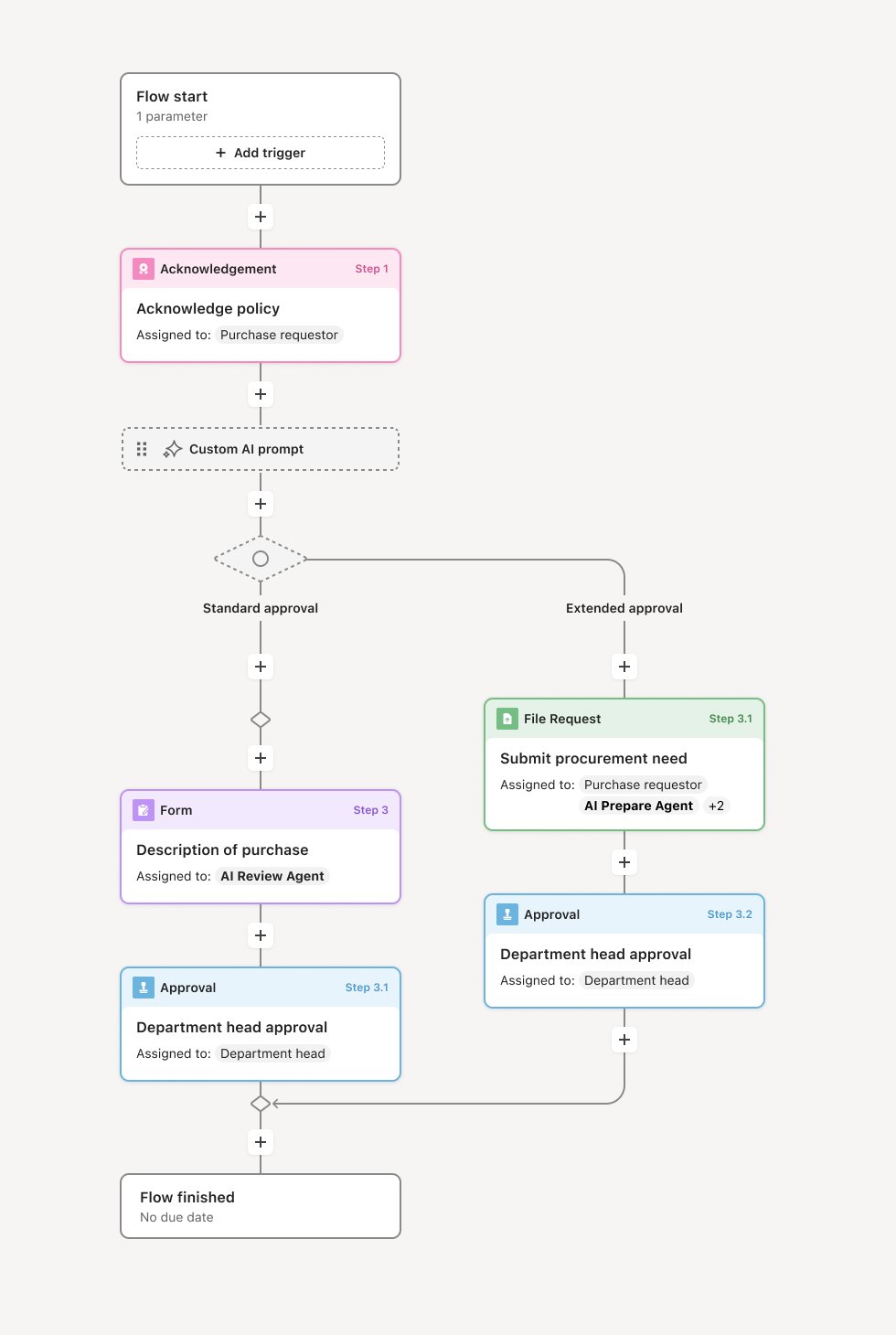
Your version of this process may vary based on roles, systems, data, and approval paths. Moxo's flow builder can be configured with AI agents, conditional branching, dynamic data references, and sophisticated logic to match how your organization runs this workflow. The steps below illustrate one example.
Travel request submission
The process begins when an employee submits a travel request including destination, dates, purpose, estimated costs, and business justification. For international travel, additional information such as visa requirements or security considerations may be required. An AI agent may assist by validating request completeness, checking against policy limits, and flagging potential issues such as blackout dates or restricted destinations.
Manager review and necessity validation
The employee's manager reviews the request to validate that the travel is necessary for business purposes and that the timing is appropriate. The manager considers whether alternatives such as video conferencing could accomplish the objective, whether budget exists for the trip, and whether the employee's absence can be accommodated.
Policy and budget verification
The request is checked against travel policy requirements including advance booking windows, preferred vendors, class of service limits, and per diem rates. Budget verification confirms that departmental or project funds are available for the estimated costs. If the request exceeds policy limits, it may require additional justification or higher-level approval.
Additional approvals if required
For travel that exceeds thresholds, involves international destinations, or requires exceptions to policy, additional approvers are engaged. This may include finance for budget exceptions, security for high-risk destinations, or senior leadership for significant trips. Each approver reviews relevant aspects of the request.
Authorization and booking
Upon approval, the travel request is authorized and the employee can proceed with booking. The approval record is maintained with the request details, approvers, and any conditions. If the organization uses managed travel services, the approved request may be routed directly to the booking system or travel coordinator.
This process commonly relies on inputs such as travel request details, cost estimates, calendar availability, policy documents, and budget reports. It may be triggered by employee submissions through travel management systems, expense platforms, or HR portals. Supporting systems might include travel management platforms like Concur or Egencia, expense management systems, and calendar integrations.
Key decision points include determining whether the travel is necessary and appropriately justified, whether budget is available for the estimated costs, whether the request complies with policy requirements, and whether any exceptions are warranted. If the request does not meet approval criteria, it may be rejected, modified, or escalated for exception handling.
Last-minute requests that force expensive bookings or bypass approval processes due to time pressure. Incomplete justification when business purpose is unclear and approvers lack context for decisions. Policy workarounds when travelers book outside managed channels to avoid approval requirements. Approval delays that cause travelers to miss booking windows and incur higher costs.
Structures travel requests so approvers receive complete information including destination, purpose, dates, and cost estimates.
Routes approvals based on trip type and value ensuring appropriate oversight for international or high-cost travel.
AI agents assist with policy validation by checking requests against limits, preferred vendors, and advance booking requirements.
Tracks request status and deadlines with automated reminders to prevent approval delays.
Maintains approval records documenting authorization and business justification for expense reconciliation.
Integrates with travel management systems to streamline booking once approval is obtained.