Chief credit officer
Credit committee chair
Risk management director
CFO
Commercial banking leader
Credit operations manager

When credit requests exceed individual authority limits and require committee review. When credit terms involve exceptions to standard policy. When complex credit structures require multi-disciplinary evaluation. Ideal for banks, commercial lenders, large manufacturers, and organizations with tiered credit authority.
Credit analysts prepare packages for committee review. Committee coordinators schedule meetings and distribute materials. Committee members review packages and participate in deliberation. The committee chair facilitates discussion and records the collective decision. Implementation teams execute approved terms.
Structured committee deliberation with all members reviewing consistent materials before decisions Faster committee cycles through advance preparation and clear scheduling Documented rationale for every committee decision supporting audit and regulatory requirements Consistent application of credit policy across all committee-level requests
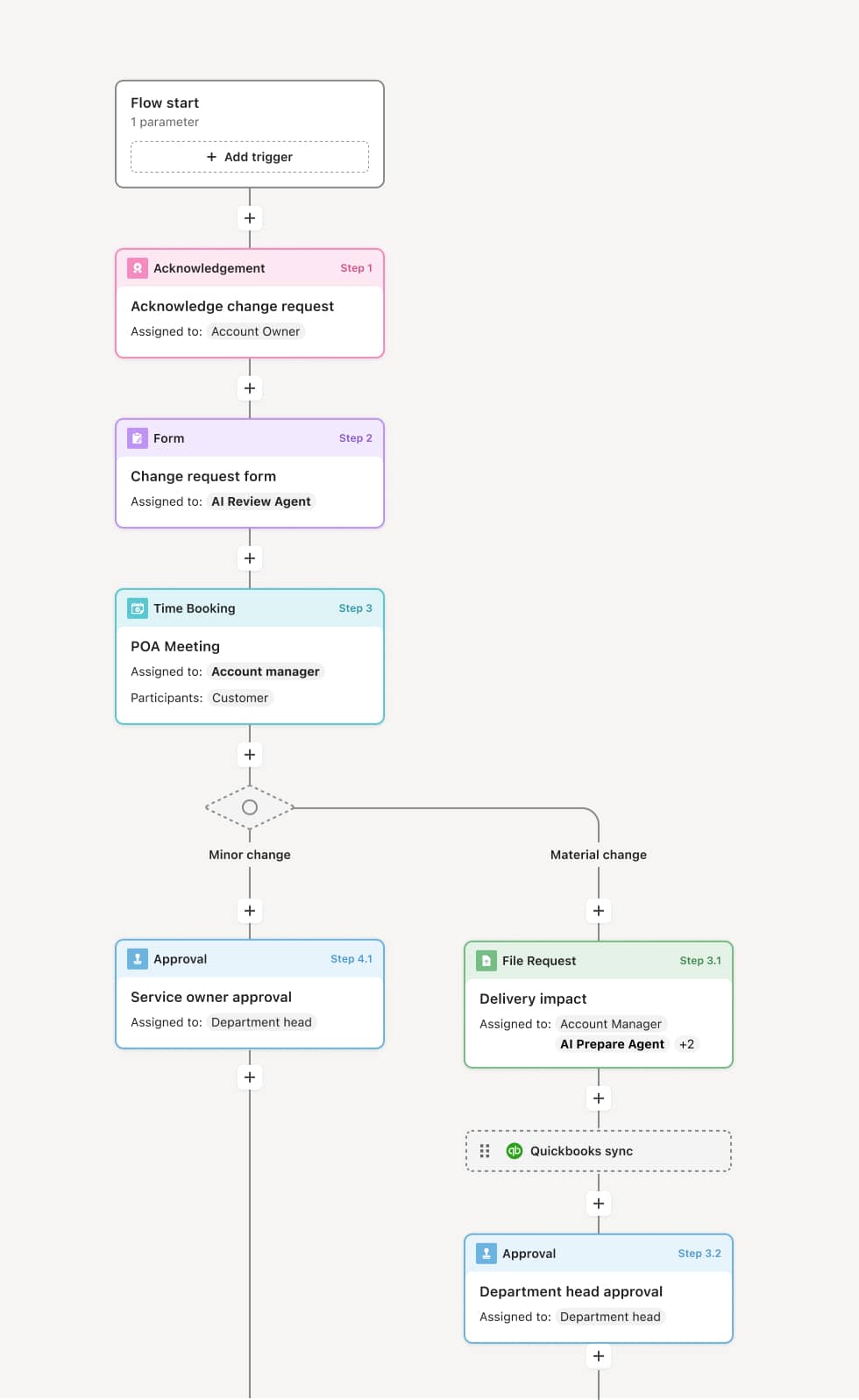
Your version of this process may vary based on roles, systems, data, and approval paths. Moxo's flow builder can be configured with AI agents, conditional branching, dynamic data references, and sophisticated logic to match how your organization runs this workflow. The steps below illustrate one example.
Package preparation
Credit analysts compile a comprehensive package including the credit application, financial analysis, risk assessment, and recommended terms. AI agents may summarize key findings or flag issues requiring committee attention. The package is submitted for committee scheduling.
Committee scheduling and distribution
The committee coordinator schedules the review, distributes materials to all members, and confirms attendance. Members receive advance access to review packages before the meeting. Reminders ensure members are prepared for deliberation.
Committee review and deliberation
Committee members review the package, ask questions, and deliberate on the appropriate decision. The presenting analyst may provide additional context. Discussion is documented to capture the rationale behind the decision.
Voting and decision recording
Committee members formally vote to approve, modify, or decline the request. The decision, including any conditions or modifications, is recorded along with the vote tally. If the committee requests additional information, the workflow returns the request to the analyst.
Communication and implementation
The committee decision is communicated to all relevant stakeholders including the applicant, sales team, and implementation teams. Approved terms are implemented in credit systems. The complete record of deliberation and decision is preserved for audit.
This process relies on credit packages, financial analyses, risk assessments, policy documentation, and historical credit data. Triggers include escalation from individual credit approval workflows or direct submission for committee-level requests. Integration with credit systems, document management platforms, and scheduling tools like Microsoft Outlook or Google Calendar supports coordination.
Key decision points include determining whether the package is complete enough for committee review, whether to approve, modify terms, or decline the request, and whether conditions should be attached to approval.
Incomplete packages causing committee delays or deferrals. Committee members unprepared due to late material distribution. Inconsistent documentation of deliberation rationale. Approved terms not communicated accurately to implementation teams.
Orchestrates package preparation, scheduling, and distribution across analysts and committee members
AI agents summarize key findings and flag issues for committee attention
Captures committee decisions and rationale with full audit trail for compliance
Coordinates communication to stakeholders once decisions are finalized