Accounts receivable manager
Finance controller
Customer service manager
Sales operations lead
Revenue accountant
Credit manager

When customers return goods and require account credits. When billing errors are identified and corrections are needed. When pricing disputes result in negotiated adjustments. When goodwill credits are offered to resolve customer issues. Ideal for distributors, manufacturers, retailers, and service organizations.
Customer service or sales representatives initiate credit requests. AR specialists validate supporting documentation. Finance reviewers assess appropriateness and policy compliance. Approvers authorize credits based on amount and reason thresholds. Accounting teams post approved credits to the general ledger.
Controlled credit issuance preventing unauthorized or fraudulent adjustments Faster dispute resolution by streamlining the approval path for valid credits Accurate financial records with properly documented and authorized adjustments Reduced revenue leakage through consistent review of credit requests
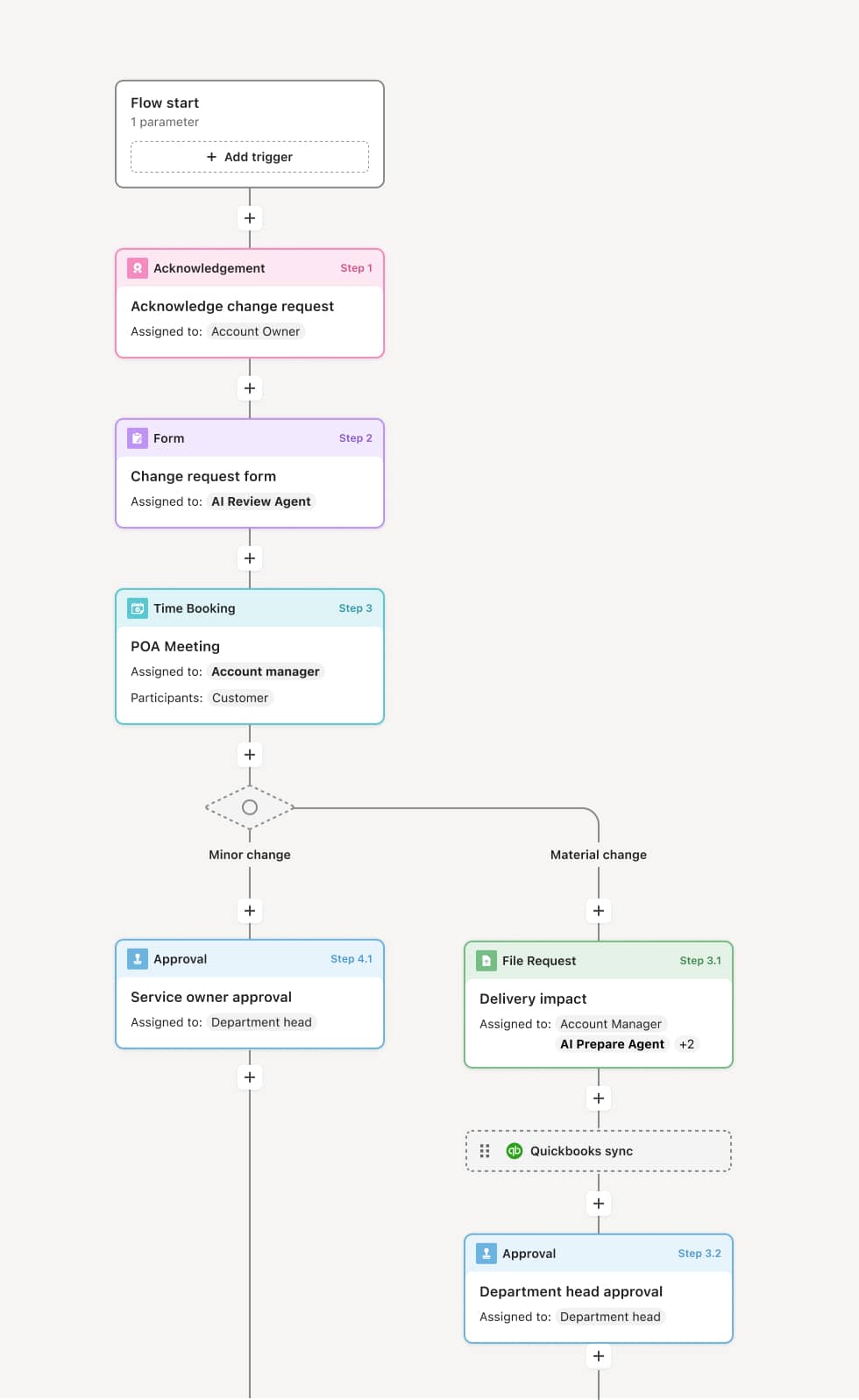
Your version of this process may vary based on roles, systems, data, and approval paths. Moxo's flow builder can be configured with AI agents, conditional branching, dynamic data references, and sophisticated logic to match how your organization runs this workflow. The steps below illustrate one example.
Credit request submission
The process begins when a credit memo request is submitted with the reason for adjustment, amount, supporting documentation, and customer information. An AI agent may validate completeness and flag requests that appear unusual based on historical patterns.
Documentation review
Supporting documentation such as return receipts, delivery confirmations, or pricing agreements is reviewed. If documentation is incomplete, the workflow requests additional materials from the submitter. The reviewer confirms the request aligns with documented evidence.
Policy compliance check
The request is evaluated against credit policies, including reason codes, maximum amounts, and customer eligibility. Requests outside policy parameters are flagged for exception review or escalation.
Approval decision
Based on the amount and reason code, the request is routed to an approver with appropriate authority. Approvers may approve, modify the amount, or reject with explanation. If amounts exceed single-approver limits, additional authorization is required.
Posting and notification
Approved credit memos are posted to the customer account and general ledger. The customer receives notification of the credit. All documentation and approvals are preserved in the workflow record for audit purposes.
This process relies on credit requests, supporting documentation, customer account data, and policy guidelines. Triggers include customer service submissions, sales requests, or return processing events. Integration with ERP systems like NetSuite or SAP, CRM platforms, and accounting systems ensures accurate posting and record-keeping.
Key decision points include determining whether documentation supports the requested credit, whether the request complies with credit policies, and whether the amount requires escalation to higher approval authority.
Credits issued without adequate documentation creating audit risk. Inconsistent application of credit policies across similar requests. Approved credits not posted accurately to customer accounts. Lack of visibility into credit patterns allowing abuse to go undetected.
Orchestrates credit requests through review and approval with clear handoffs between roles
AI agents validate request completeness and flag unusual patterns for attention
Routes approvals based on amount and reason thresholds ensuring appropriate authorization
Maintains complete audit trail of all credits, documentation, and approvals