Revenue operations manager
Customer success director
Sales operations lead
Account management head
Business development manager
Service delivery manager

When customer interactions reveal needs beyond current products or services. When usage patterns indicate readiness for expansion. When contract renewals present upsell opportunities. Ideal for SaaS companies, financial services, professional services, and any organization with multiple product lines.
Service or support representatives identify cross-sell signals during customer interactions. Customer success managers validate opportunity quality. Sales representatives pursue qualified opportunities. Account managers coordinate overall relationship strategy. Operations teams track conversion and attribution.
Captured revenue opportunities that might otherwise be missed during service interactions Faster opportunity handoff from identification to sales follow-up Improved customer experience through coordinated outreach rather than separate contacts Clear attribution tracking connecting service interactions to sales outcomes
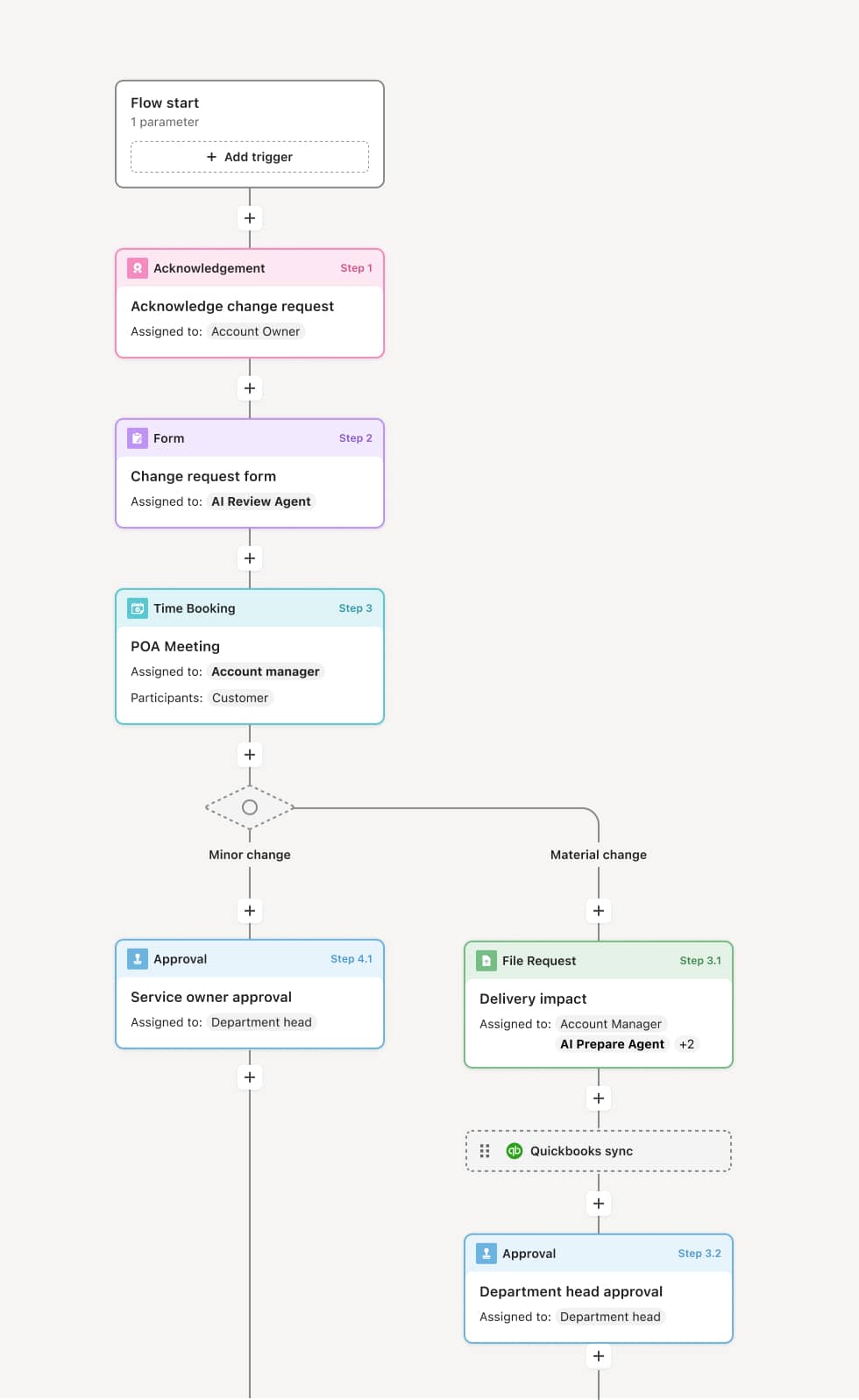
Your version of this process may vary based on roles, systems, data, and approval paths. Moxo's flow builder can be configured with AI agents, conditional branching, dynamic data references, and sophisticated logic to match how your organization runs this workflow. The steps below illustrate one example.
Opportunity identification
The process begins when a cross-sell opportunity is identified, either through direct customer conversation, usage analysis, or system triggers. The identifier captures relevant context including the customer need, current products, and conversation notes. AI agents may enrich records with additional customer data.
Opportunity qualification
A customer success manager or designated reviewer evaluates the opportunity for quality and timing. They confirm the customer's readiness, validate the fit with available offerings, and assess any relationship considerations. Unqualified opportunities are closed with feedback to the identifier.
Sales routing
Qualified opportunities are routed to the appropriate sales representative or account manager based on territory, product specialty, or existing relationships. The workflow includes all relevant context so the recipient can engage without re-discovery.
Sales follow-up
The assigned sales representative reviews the opportunity and initiates contact with the customer. They update the workflow with engagement status, next steps, and any additional information gathered. If the customer is not ready, the opportunity may be scheduled for future follow-up.
Outcome tracking
The workflow tracks the opportunity through to resolution, whether closed-won, closed-lost, or deferred. Conversion data is recorded for attribution and process improvement. Feedback loops inform service teams about which types of escalations convert most effectively.
This process relies on customer interaction data, product usage analytics, account profiles, and opportunity details. Triggers include service ticket submissions, usage threshold alerts, or renewal events. Integration with CRM platforms like Salesforce or HubSpot, customer success tools, and billing systems provides comprehensive context.
Key decision points include determining whether the identified opportunity is qualified, which sales resource should receive the handoff, and whether timing is appropriate for outreach or the opportunity should be deferred.
Opportunities identified but never escalated due to unclear process. Qualified opportunities lost in handoff because sales teams lack context. Duplicate outreach when multiple teams contact the same customer. No feedback loop to inform service teams about opportunity quality.
Orchestrates handoffs from service teams to sales with complete context preserved
AI agents enrich opportunity records with customer data and usage patterns
Routes opportunities to the right sales resources based on territory, product, or relationship
Tracks outcomes and attribution connecting service interactions to revenue results