Customer service director
Operations manager
Quality assurance manager
Customer experience lead
Compliance officer
Service delivery manager

When initial service attempts fail to resolve customer complaints. When complaints involve regulatory, legal, or safety concerns. When customers explicitly request escalation to management. When complaint patterns indicate systemic issues. Ideal for service organizations, financial services, healthcare, and any customer-facing business.
Frontline service agents identify escalation triggers. Escalation coordinators route complaints to appropriate handlers. Specialist teams address complex or technical complaints. Management handles executive escalations and sensitive situations. Quality teams analyze patterns and drive process improvements.
Faster resolution of complex complaints by routing to appropriate expertise Reduced customer churn through effective handling of serious concerns Pattern identification revealing systemic issues that require broader fixes Regulatory compliance with documented handling of escalated complaints
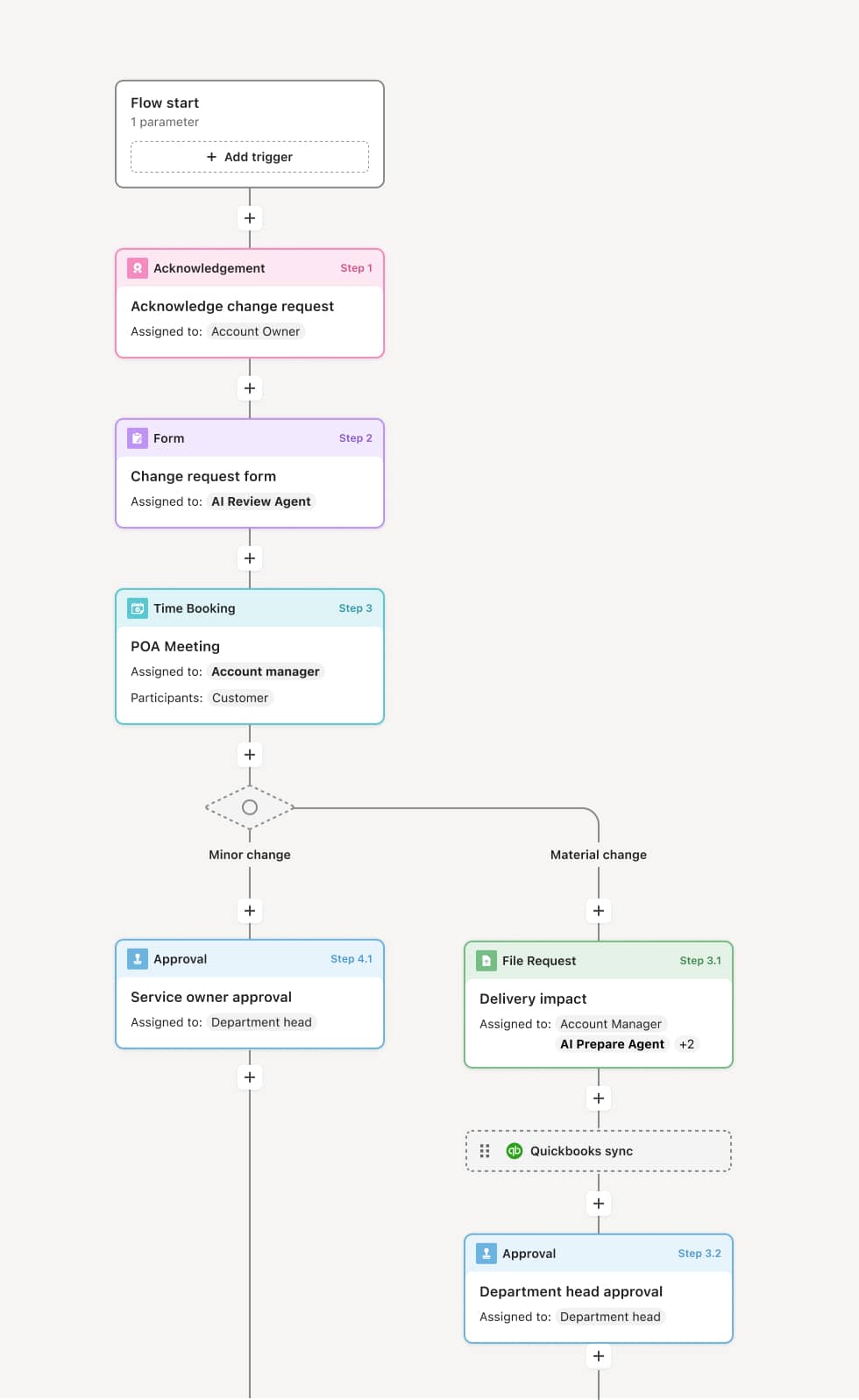
Your version of this process may vary based on roles, systems, data, and approval paths. Moxo's flow builder can be configured with AI agents, conditional branching, dynamic data references, and sophisticated logic to match how your organization runs this workflow. The steps below illustrate one example.
Escalation trigger identification
The process begins when an escalation trigger is identified, such as unresolved complaints after multiple attempts, customer request for management, or severity indicators. The originating agent documents the complaint history, attempted resolutions, and reason for escalation. AI agents may flag complaints meeting escalation criteria automatically.
Escalation routing
Based on complaint type, severity, and customer characteristics, the workflow routes the escalation to the appropriate handler. Routing considers expertise requirements, authority levels, and workload balance. The recipient receives full complaint context and history.
Investigation and response
The escalation handler reviews the complaint, investigates underlying causes, and determines appropriate resolution. They may engage additional resources, coordinate with other departments, or authorize remedies beyond standard limits.
Customer communication
The handler communicates with the customer to understand their concerns fully, explain findings, and propose resolution. If the customer is not satisfied, further escalation options are available. All communication is documented within the workflow.
Resolution and closure
Once resolution is achieved and the customer acknowledges satisfaction, the escalation is closed. The complete record, including root cause and resolution, is preserved. Escalation patterns are analyzed to identify systemic improvements.
This process relies on complaint details, customer history, prior resolution attempts, and escalation criteria. Triggers include service agent escalation submissions, customer escalation requests, or automated detection of escalation criteria. Integration with CRM platforms like Salesforce or Zendesk, case management systems, and customer data platforms provides comprehensive context.
Key decision points include determining whether the complaint meets escalation criteria, which handler or team should receive the escalation, and what resolution authority the handler can exercise.
Escalations triggered too late after customer frustration has compounded. Insufficient context transferred causing handlers to restart investigation. Unclear authority limits causing resolution delays. Escalation patterns not analyzed for systemic improvement opportunities.
Orchestrates escalation routing from frontline to specialists to management
AI agents identify escalation triggers and ensure complete context is captured
Maintains complete complaint history accessible to all handlers in the escalation path
Tracks escalation patterns for quality improvement and regulatory compliance