Customer service manager
Operations director
Account management lead
Service delivery manager
Customer success director
Regional manager

When standard service processes cannot resolve customer issues. When customers request management attention. When issues involve strategic accounts or high-value relationships. When urgency or complexity exceeds frontline capacity. Ideal for service organizations, B2B companies, and any business where customer relationships require coordinated attention.
Service agents identify escalation needs. Escalation managers assess and route escalations. Specialists handle technical or complex issues. Management addresses relationship and strategic concerns. Account teams coordinate ongoing customer communication.
Appropriate issue handling matching complexity to capability Protected customer relationships through responsive escalation handling Clear accountability at each escalation level Reduced resolution time for complex issues through efficient routing
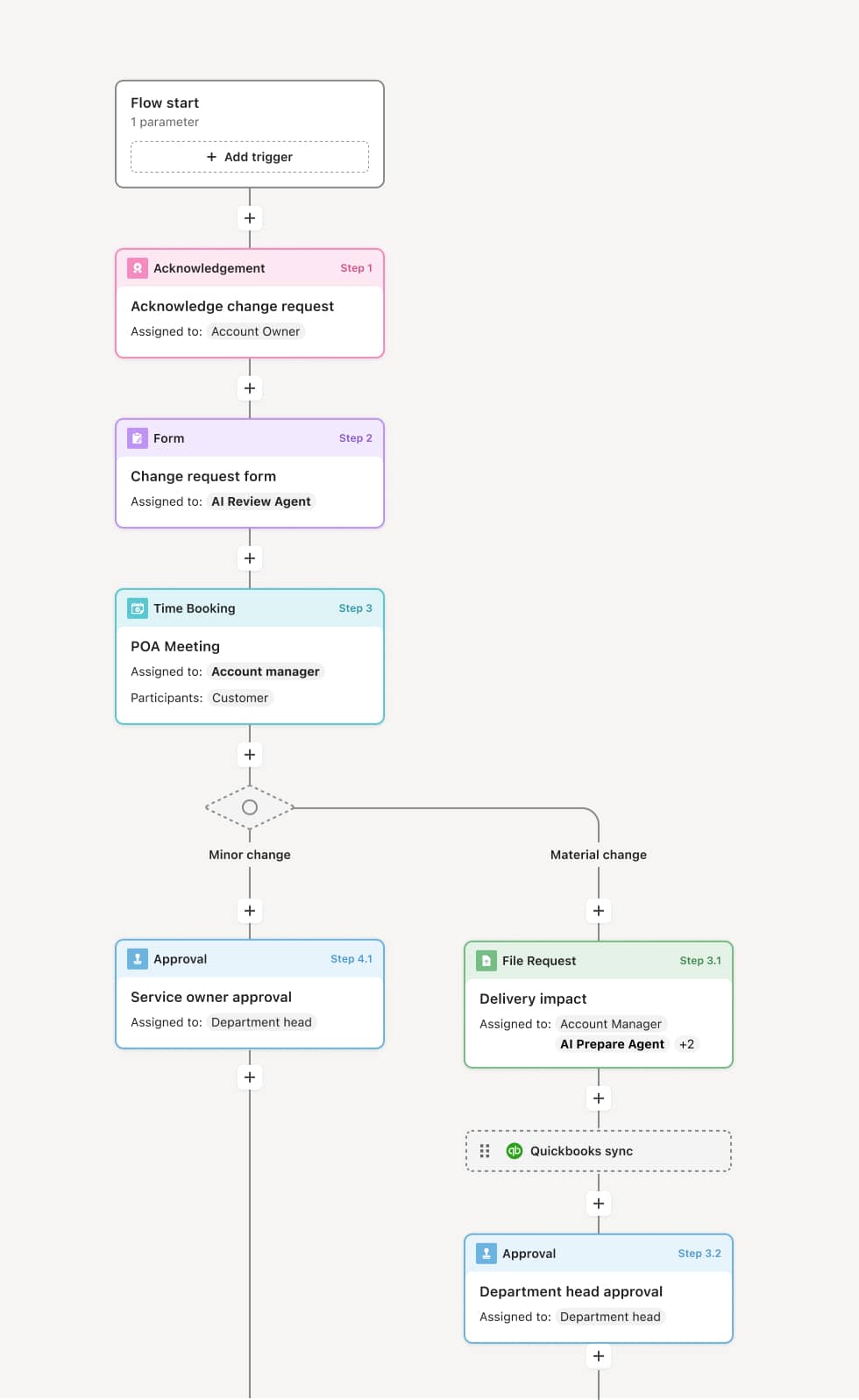
Your version of this process may vary based on roles, systems, data, and approval paths. Moxo's flow builder can be configured with AI agents, conditional branching, dynamic data references, and sophisticated logic to match how your organization runs this workflow. The steps below illustrate one example.
Escalation initiation
The process begins when an escalation is initiated by a service agent, triggered by system criteria, or requested by the customer. The initiator documents the issue, prior actions, and reason for escalation. AI agents may enrich the escalation with customer context and history.
Assessment and routing
An escalation manager or automated logic assesses the escalation type and routes to the appropriate handler. Routing considers issue type, customer tier, required expertise, and current workload. Urgent escalations are flagged for immediate attention.
Issue handling
The assigned handler investigates the issue, engages necessary resources, and develops a resolution plan. They have authority appropriate to their level and can further escalate if needed. Progress is tracked and the customer is kept informed.
Resolution delivery
The handler communicates the resolution to the customer and confirms satisfaction. If additional follow-up is needed, it is scheduled and tracked. If the customer remains unsatisfied, further escalation options are available.
Closure and learning
The escalation is closed with complete documentation of the issue, investigation, and resolution. Data is captured for analysis of escalation patterns, handling effectiveness, and improvement opportunities.
This process relies on customer issue details, account information, service history, and escalation criteria. Triggers include agent submissions, customer requests, or automated detection of escalation conditions. Integration with service platforms like Zendesk or ServiceNow, CRM systems, and communication tools enables efficient handling.
Key decision points include determining whether escalation is warranted, which handler or team should receive the escalation, and what resolution approach is appropriate given the customer and issue.
Escalations not initiated when appropriate due to unclear criteria. Incomplete information causing handlers to restart investigation. Escalation handlers lacking authority to resolve, causing further delays. Resolution not communicated clearly to originating teams.
Orchestrates escalation from initiation through resolution with clear accountability
AI agents enrich escalations with customer context and surface relevant history
Routes to appropriate handlers based on issue type, urgency, and customer tier
Captures complete escalation records for analysis and improvement