VP of customer service
Operations director
Service excellence manager
Process improvement lead
Customer experience director
Quality assurance manager

When organizations need structured escalation paths for customer issues. When service levels require defined response times at each tier. When regulatory or contractual requirements mandate escalation procedures. When operational scale demands consistent escalation handling. Ideal for enterprises, regulated industries, and high-volume service operations.
Process owners define escalation tiers and criteria. Frontline agents handle initial issues and initiate escalations. Tier-specific handlers resolve issues within their authority. Escalation managers oversee the process and handle exceptions. Leadership addresses executive-level escalations.
Consistent escalation handling across all customer issues and teams Clear tier definitions with specific criteria, authority, and SLAs at each level Reduced time-to-resolution through efficient progression between tiers Measurable escalation performance with data on volume, timing, and outcomes by tier
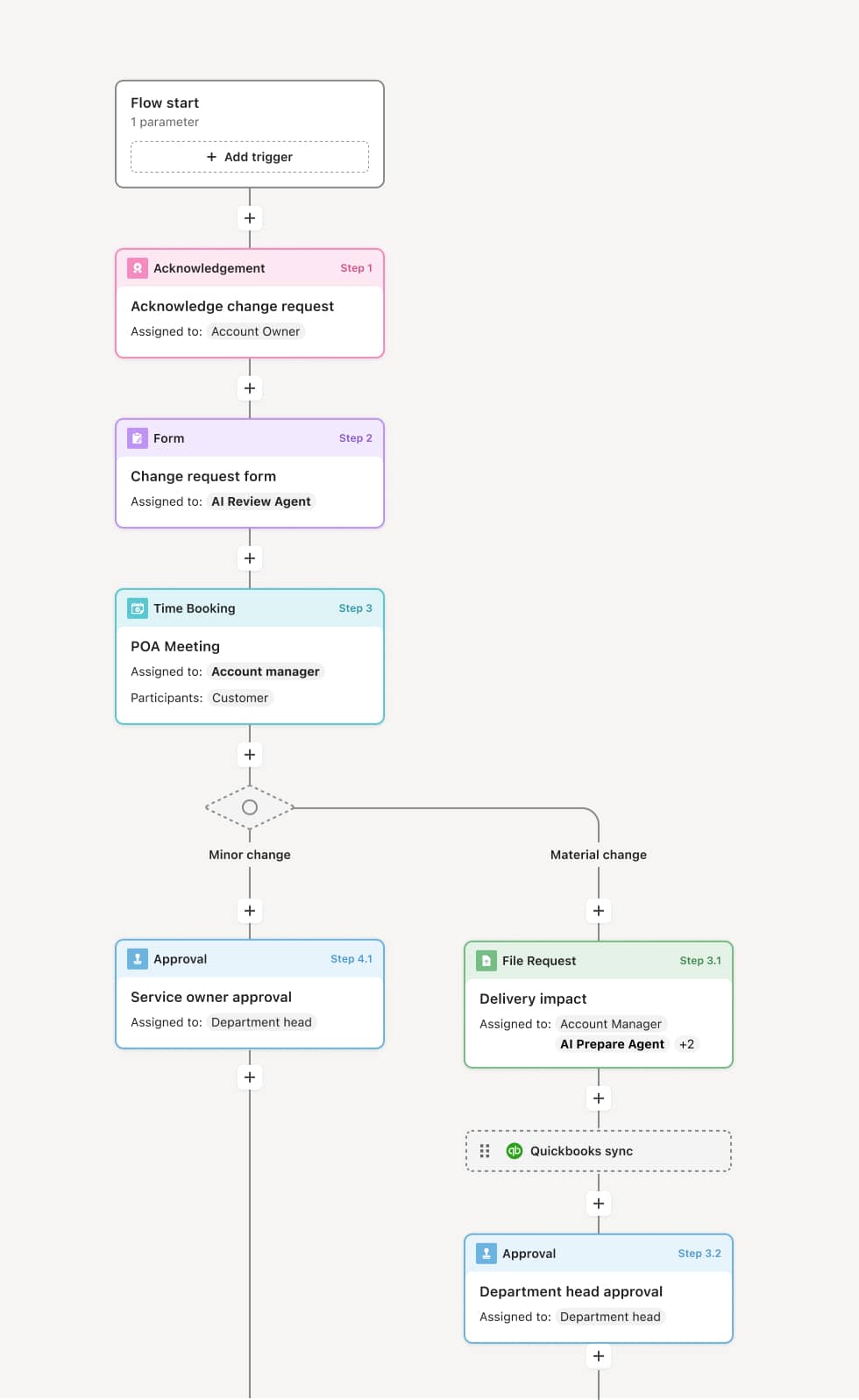
Your version of this process may vary based on roles, systems, data, and approval paths. Moxo's flow builder can be configured with AI agents, conditional branching, dynamic data references, and sophisticated logic to match how your organization runs this workflow. The steps below illustrate one example.
Initial issue intake
The process begins when a customer issue is received through any channel. The issue is captured with complete details and initial assessment. AI agents may classify the issue and suggest initial routing based on type and severity.
Tier 1 handling
Standard issues are handled at Tier 1 using established procedures and knowledge resources. Agents work within defined authority limits. If resolution is not achieved within criteria, the issue advances to Tier 2.
Tier 2 escalation
Issues requiring specialized expertise or additional authority advance to Tier 2 handlers. These specialists investigate more deeply and have broader resolution options. Unresolved issues or those requiring management attention advance further.
Management escalation
Complex, sensitive, or strategic issues are escalated to management. Managers engage necessary resources, authorize exceptional remedies, and ensure customer satisfaction. Critical issues may escalate to executive leadership.
Resolution and process feedback
Issues are resolved and closed with complete documentation at whichever tier achieves resolution. Escalation data informs process improvement, including criteria adjustment, training needs, and resource allocation.
This process relies on issue details, escalation criteria definitions, authority matrices, and SLA parameters. Triggers include new issue receipt, tier resolution failure, SLA breach, or explicit escalation requests. Integration with service management platforms, CRM systems, and communication tools supports the full escalation lifecycle.
Key decision points include determining which tier should initially receive an issue, when tier advancement is required, and what resolution authority applies at each level.
Tier criteria unclear causing inconsistent escalation decisions. Issues stuck at tiers without advancement when criteria are met. Authority limits preventing resolution, requiring unnecessary escalation. Lack of data preventing process optimization.
Defines escalation tiers with clear criteria and routing logic within configurable workflows
AI agents assist with initial classification and tier routing recommendations
Enforces SLAs and triggers advancement when tier criteria are met
Captures tier-level data for performance analysis and process improvement