Escalation manager
Service operations lead
Customer care supervisor
Triage team lead
Quality manager
Service delivery coordinator

When escalation volume requires structured intake and routing. When multiple handler types or teams receive different escalation categories. When consistent triage criteria must be applied across escalations. Ideal for contact centers, service organizations, and any operation with significant escalation volume.
Triage specialists assess incoming escalations. Classification logic or AI determines initial routing recommendations. Triage managers handle ambiguous or complex routing decisions. Receiving handlers accept assigned escalations. Operations teams monitor triage effectiveness and queue health.
Accurate escalation routing matching issues to appropriate handlers Reduced triage time through structured assessment criteria Balanced workload distribution across handler teams and individuals Consistent classification enabling reliable escalation analytics
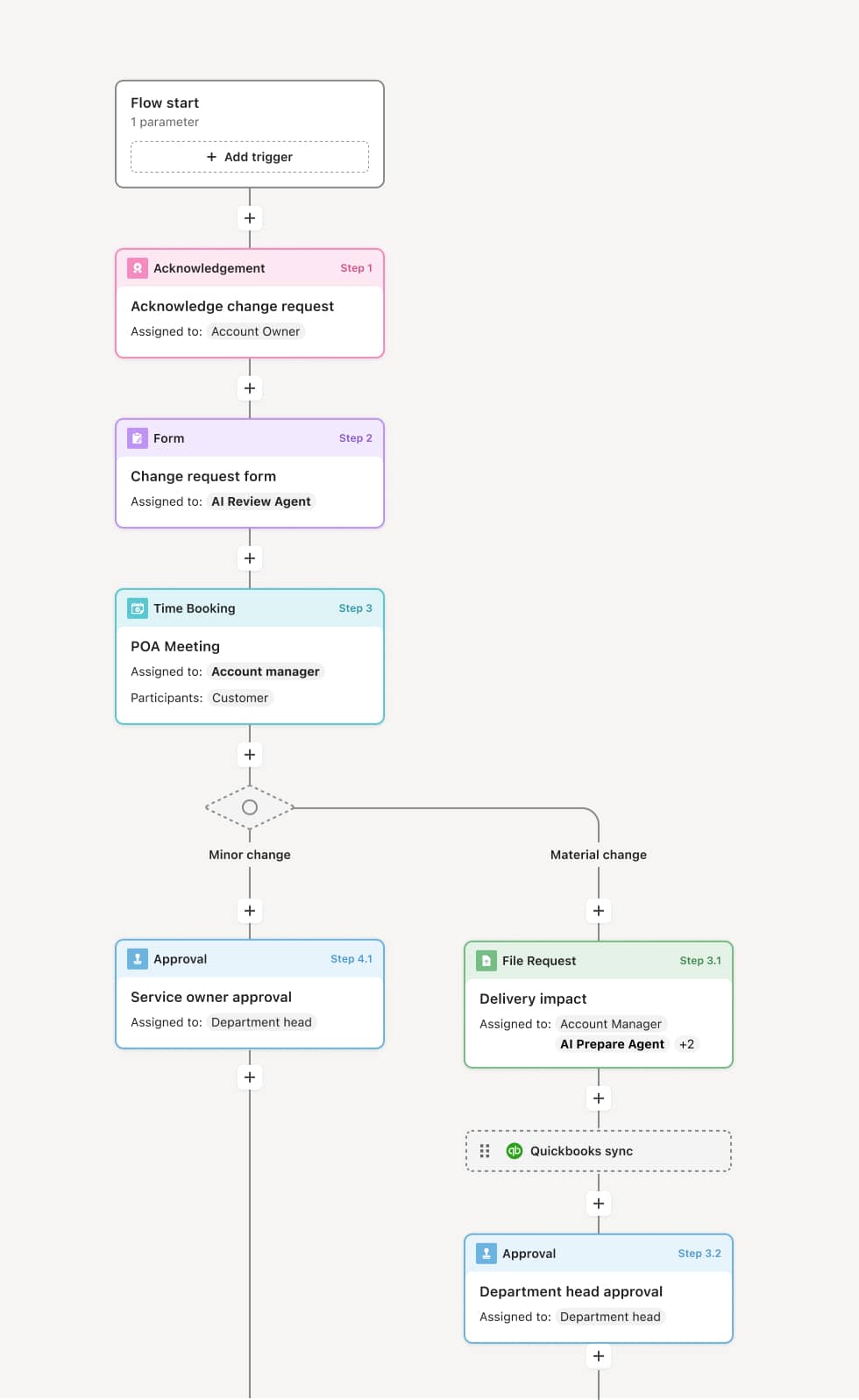
Your version of this process may vary based on roles, systems, data, and approval paths. Moxo's flow builder can be configured with AI agents, conditional branching, dynamic data references, and sophisticated logic to match how your organization runs this workflow. The steps below illustrate one example.
Escalation intake
The process begins when an escalation arrives in the triage queue. Essential information including issue description, customer details, and escalation reason is captured. AI agents may perform initial classification and suggest routing.
Assessment and classification
Triage specialists review the escalation to confirm or refine classification. They assess severity, urgency, and required expertise. If information is incomplete, they request additional details before routing.
Routing decision
Based on assessment, the escalation is routed to the appropriate handler or team. Routing considers handler expertise, current workload, and any customer-specific requirements. Complex or ambiguous cases are reviewed by triage managers.
Handoff to handler
The assigned handler receives the escalation with complete context and triage notes. Acceptance is confirmed and the escalation moves to active handling. If the handler identifies a routing error, the escalation returns to triage.
Triage effectiveness tracking
Triage decisions are tracked and analyzed for accuracy and efficiency. Misrouted escalations inform criteria refinement. Triage timing and queue health are monitored to maintain service levels.
This process relies on escalation details, classification criteria, handler capabilities, and workload data. Triggers include new escalation arrival or re-triage requests. Integration with service platforms, skill routing systems, and workforce management tools supports effective triage.
Key decision points include determining the appropriate classification for each escalation, which handler or team should receive it, and whether urgency warrants priority handling.
Incomplete information preventing accurate classification. Misrouted escalations causing delays and rework. Triage bottlenecks when volume exceeds capacity. Classification criteria too rigid for edge cases.
Structures triage assessment with clear criteria and routing logic
AI agents perform initial classification and suggest routing for human review
Routes to handlers based on expertise and workload with confirmation of acceptance
Tracks triage effectiveness for ongoing optimization