Chief operating officer
Governance committee chair
Compliance director
Risk management officer
Finance director
Legal counsel

This process is used when a proposed business decision exceeds defined thresholds for financial commitment, risk exposure, strategic impact, or policy exception and must be routed through the organization’s decision governance framework rather than approved at the operational level. It applies when the decision requires supporting analysis, cross-functional review, and authorization from a governance body or senior executive according to the organization’s delegation of authority matrix. Ideal for enterprises managing investment decisions, strategic commitments, policy exceptions, risk acceptance decisions, and any significant organizational action requiring governance oversight.
The decision governance process typically involves decision requestors who propose and prepare the business case, subject matter reviewers who evaluate the proposal from financial, legal, risk, and operational perspectives, governance committee members who deliberate and authorize the decision, executive sponsors who advocate for the proposal, and compliance or risk officers who confirm alignment with organizational policies.
Consistent decision authority applied across the organization through a documented delegation of authority matrix. Informed decision-making because proposals include the required financial, risk, legal, and operational analysis before reaching the decision authority. Clear accountability with every significant decision documented including the proposer, reviewers, approver, rationale, and conditions. Reduced unauthorized commitments because decisions above defined thresholds are routed through governance before execution. Audit-ready decision records that demonstrate the organization’s governance discipline for regulatory, board, and stakeholder review.
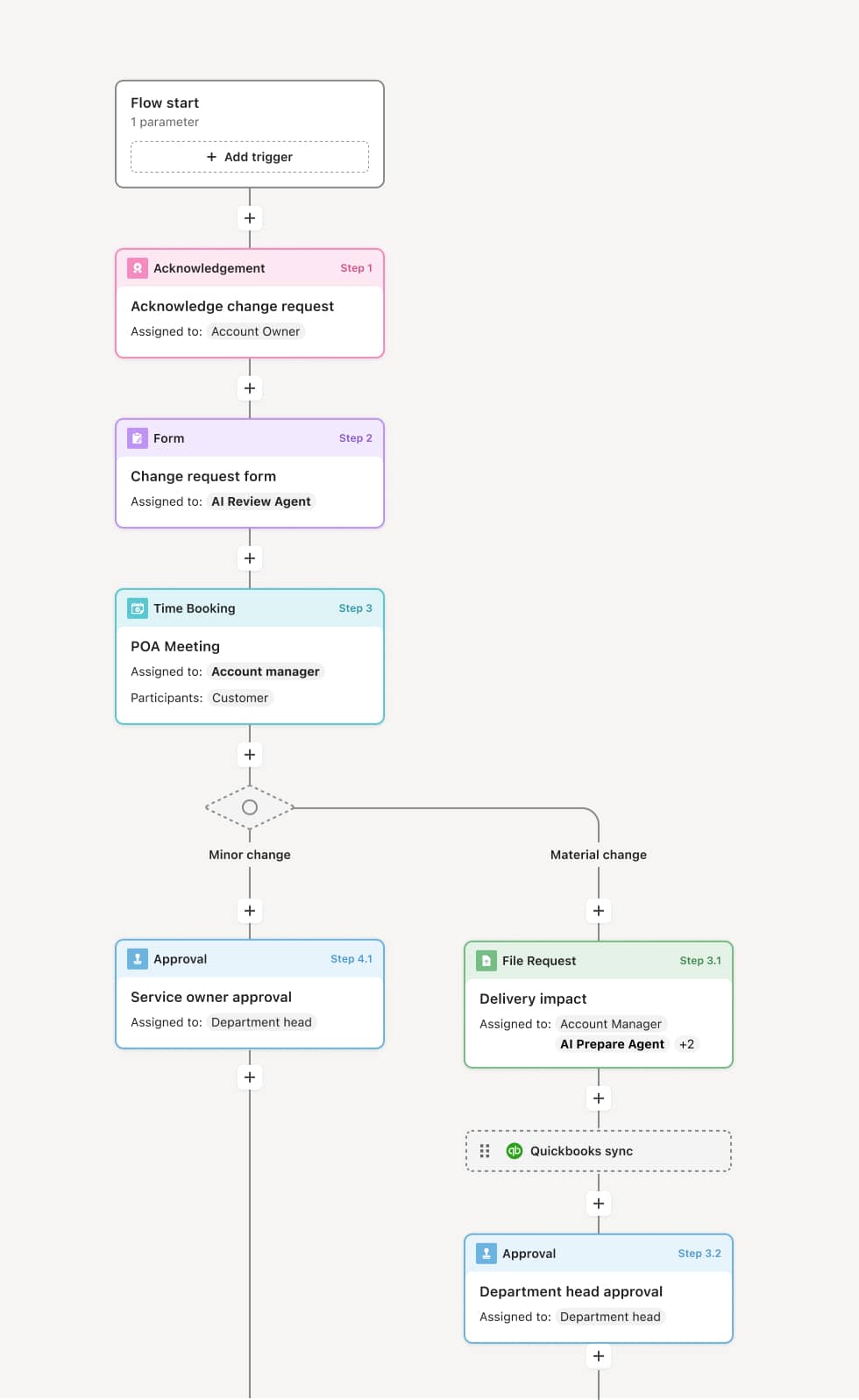
Your version of this process may vary based on roles, systems, data, and approval paths. Moxo’s flow builder can be configured with AI agents, conditional branching, dynamic data references, and sophisticated logic to match how your organization runs this workflow. The steps below illustrate one example.
Decision proposal and classification
The process begins when a decision requestor submits a proposal for a decision that exceeds operational authority limits. The proposal includes the business case, financial impact, risk assessment, alternatives considered, and the recommended course of action. An AI Agent can assist by classifying the decision based on the delegation of authority matrix and identifying the required review and approval path.
Cross-functional review
The proposal is routed to relevant subject matter reviewers — finance, legal, risk, operations, and compliance as applicable — for their analysis and input. Each reviewer evaluates the proposal from their perspective and provides their assessment, including any concerns, conditions, or alternative recommendations.
Governance committee deliberation
If the decision requires committee authorization, the proposal and supporting reviews are presented to the governance committee. The committee deliberates, asks questions, and may request additional information or analysis before making a determination. An AI Agent may compile the complete proposal package including all reviewer assessments for committee preparation.
Authorization and conditions
The authorized decision-maker — the governance committee, executive, or designated authority — approves the decision, approves with conditions, defers for additional analysis, or declines. The authorization, rationale, and any conditions are documented.
Execution and condition tracking
If approved, the decision moves to execution. Any conditions attached to the approval — such as reporting requirements, risk monitoring, or milestone reviews — are tracked within the workflow to ensure compliance.
Decision record and governance reporting
The complete decision record is preserved, including the proposal, reviews, deliberation notes, authorization, conditions, and execution status. Decision records are available for governance reporting, audit, and organizational learning.
This process commonly relies on inputs such as the decision proposal, financial analysis, risk assessment, legal review, the delegation of authority matrix, and prior governance decisions for reference. It may be triggered by a decision request exceeding operational authority limits or a policy exception request. Connected systems often include GRC platforms, financial planning systems, contract management systems, and governance reporting tools.
Key decision points include whether the proposed decision exceeds the threshold requiring governance review, whether the supporting analysis is complete and addresses the required financial, risk, legal, and operational dimensions, whether the governance body approves, approves with conditions, or declines the proposal, and whether conditions attached to approved decisions are tracked and satisfied.
Decisions made without governance review because the requestor did not recognize that the decision exceeded their authority or the governance process was too slow. Proposals submitted without adequate analysis, requiring the governance body to defer or request additional work, delaying the decision. Cross-functional reviewers not engaged, resulting in governance decisions made without legal, risk, or financial input. Approval conditions not tracked, allowing approved decisions to proceed without required monitoring or milestone reviews. Decision records incomplete, making it impossible to reconstruct the rationale and approval chain during audit or investigation.
Orchestrates the decision governance process from proposal through authorization and condition tracking across requestors, reviewers, governance committees, and executive approvers in a single coordinated flow.
AI Agents classify decisions against the delegation of authority matrix and route proposals to the correct review and approval path.
Routes cross-functional review to finance, legal, risk, and operations within the workflow, collecting assessments with clear deadlines.
Compiles the complete proposal package for governance committee deliberation, including all reviewer inputs and supporting analysis.
Tracks approval conditions within the workflow to ensure post-decision monitoring and milestone reviews are completed as required.
Preserves the complete decision record including proposal, reviews, authorization, rationale, conditions, and execution status for governance reporting and audit.