Trade compliance manager
Export control officer
Logistics director
General counsel
Engineering director
Sales operations lead

This process is used when the organization plans to export products, technology, software, or technical data outside the country, or when technical information will be disclosed to foreign nationals (deemed export). It applies when the item must be classified under the applicable control list, the end user and destination must be screened against denied and restricted party lists, and a determination must be made whether the export qualifies for an exemption or requires a license. Ideal for manufacturers, technology companies, defense contractors, research institutions, and any organization shipping controlled items or sharing controlled technical data internationally.
The export control review process typically involves trade compliance analysts who conduct the screening and classification, export control officers who make licensing determinations, engineering or product teams who provide technical classification data, sales and logistics teams who initiate the export request, and legal counsel who advises on complex classification or licensing questions.
Compliant exports with every controlled item properly classified, screened, and authorized before shipment or disclosure. Prevented violations by screening all end users, consignees, and destinations against denied and restricted party lists before the transaction proceeds. Timely license applications when export licenses are required, with complete applications that reduce processing delays. Protected technology through deemed export controls that screen disclosures of controlled technical data to foreign nationals. Documented compliance with classification records, screening results, license determinations, and authorization documentation for audit and regulatory review.
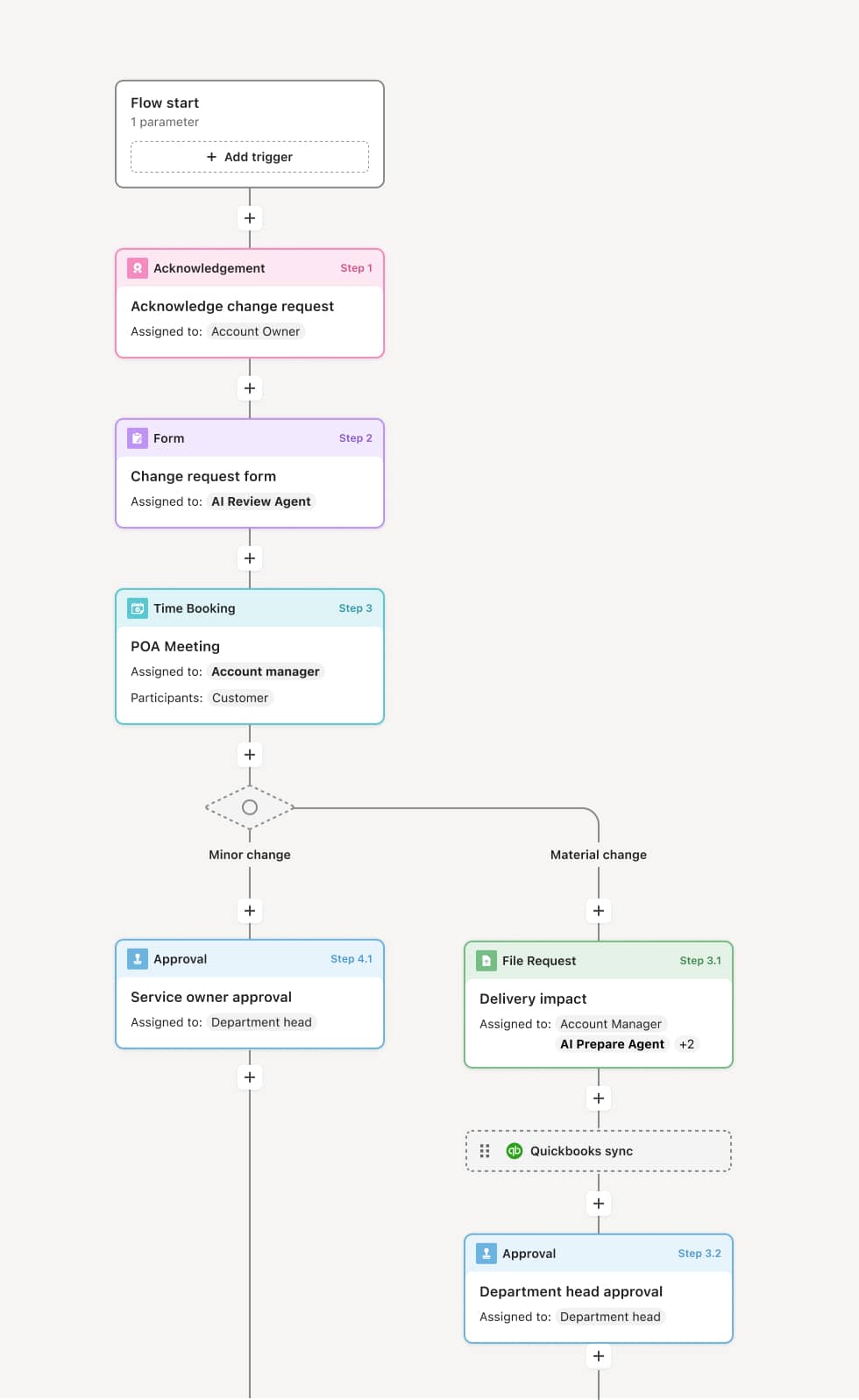
Your version of this process may vary based on roles, systems, data, and approval paths. Moxo’s flow builder can be configured with AI agents, conditional branching, dynamic data references, and sophisticated logic to match how your organization runs this workflow. The steps below illustrate one example.
Export request and initial screening
The process begins when a sales, logistics, or engineering team member initiates an export request for a product, technology, or technical data transfer. The trade compliance team receives the request and conducts initial screening of the end user, consignee, and destination against denied and restricted party lists. An AI Agent can assist by running the screening automatically against consolidated watchlists and flagging potential matches for analyst review.
Item classification
The compliance analyst determines the export classification of the item under the applicable control list — the Commerce Control List (CCL) for EAR items or the United States Munitions List (USML) for ITAR items. Engineering or product teams provide technical specifications needed for accurate classification. The classification determines what controls apply and whether a license is required.
License determination
Based on the item classification, destination, end user, and end use, the analyst determines whether the export qualifies for a license exception or exemption, or whether an export license must be obtained. If a license is required, the compliance team prepares and submits the license application to the appropriate agency (BIS for EAR, DDTC for ITAR). An AI Agent may check the classification against applicable license exceptions to identify available authorization paths.
License application and tracking (if required)
If a license is required, the application is submitted with supporting documentation including the item classification, end-user statement, and technical description. The license status is tracked through approval. If the license is denied or returned without action, the export does not proceed.
Authorization and release
Once the export is authorized — either through a license exception, an approved license, or a determination that no license is required — the compliance team issues the release authorization to logistics or the disclosing team. The authorization includes any conditions, reporting requirements, or provisos attached to the license.
Record retention and compliance documentation
The complete export control record — including the request, screening results, classification, license determination, license documentation (if applicable), and release authorization — is preserved for the regulatory retention period, typically five years.
This process commonly relies on inputs such as the export request, product technical specifications, end-user and consignee information, destination country, end-use statement, and denied party screening results. It may be triggered by a sales order, a shipment request, or a planned disclosure of technical data. Connected systems often include denied party screening tools like Visual Compliance or Descartes, ERP systems for order and shipment data, classification databases, and government licensing portals (BIS SNAP-R, DDTC D-Trade).
Key decision points include whether the item is controlled under EAR, ITAR, or other export control regimes, whether any party to the transaction appears on a denied or restricted party list, whether a license exception or exemption applies or a license must be obtained, and whether any conditions on the license or authorization affect the shipment or disclosure.
Screening not performed on all parties to the transaction, including intermediate consignees and freight forwarders. Item classification incorrect because engineering did not provide accurate technical specifications. License requirement not identified, resulting in an unauthorized export. License applications delayed because supporting documentation was incomplete. Export records not retained for the required period, creating compliance gaps during audit or investigation.
Orchestrates export control review from request through authorization across trade compliance, legal, engineering, sales, and logistics in a single coordinated flow.
AI Agents run denied party screening at request initiation and flag potential matches for analyst review, preventing delays from manual screening.
Engages engineering within the workflow for technical classification data, ensuring accurate item classification drives the license determination.
Tracks license applications through government processing within the workflow, alerting the team to status changes and additional information requests.
Connects to screening tools, ERP, and government licensing portals like Visual Compliance, SAP, and BIS SNAP-R so screening data, order information, and license status are synchronized.
Preserves the complete export control record including screening results, classification, license determination, authorization, and conditions for the regulatory retention period.