Quality assurance manager
Manufacturing engineer
Supplier quality engineer
Production manager
Procurement lead
Engineering director

This process is used when a new part, component, or product is being manufactured for the first time, when a design change has been implemented, when a new supplier or production facility is being qualified, or when production tooling has been modified. It is triggered when the initial production sample is available for inspection and the manufacturing process must be validated against engineering requirements. This process is common in aerospace, automotive, medical devices, electronics, and other industries where part conformity to specification is critical before volume production proceeds.
The first article approval process typically involves the supplier or manufacturing team who produces and submits the first article sample with documentation, quality assurance inspectors who perform dimensional and functional inspections, manufacturing or design engineers who evaluate specification conformance, supplier quality engineers who assess the supplier’s production capability, and engineering or program managers who provide final acceptance authorization.
Production confidence by validating that the manufacturing process produces parts that meet design intent before full-volume production begins. Reduced scrap and rework by identifying specification or process deviations at the earliest possible stage. Clear supplier accountability through documented inspection results and disposition decisions tied to specific production runs. Faster production ramp-up because first article issues are identified and resolved in a structured process rather than discovered during volume production.
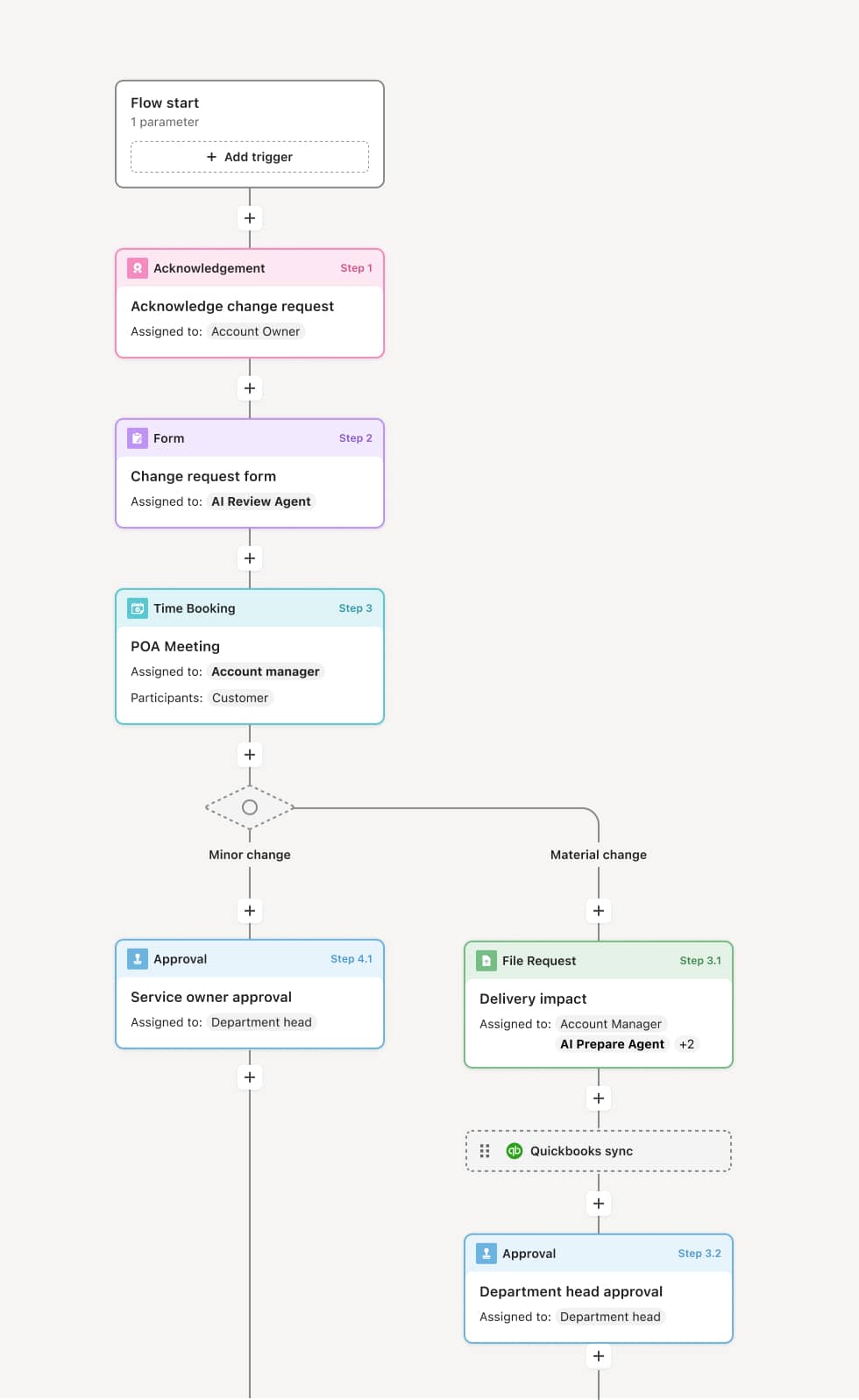
Your version of this process may vary based on roles, systems, data, and approval paths. Moxo’s flow builder can be configured with AI agents, conditional branching, dynamic data references, and sophisticated logic to match how your organization runs this workflow. The steps below illustrate one example.
First article submission
The process begins when the supplier or manufacturing team produces the initial sample and submits it along with supporting documentation, which typically includes dimensional inspection reports, material certifications, process documentation, and any required test results. An AI Agent may assist by verifying that all required documents are included and that the submission package is complete before routing to the inspection team.
Quality inspection and measurement
The quality assurance team performs detailed inspection of the first article against engineering drawings and specifications. This includes dimensional measurements, surface finish evaluation, material verification, and functional testing where applicable. Inspection results are documented and compared against acceptance criteria. The AI Agent may flag measurements that fall near tolerance boundaries for additional engineering review.
Engineering review and specification evaluation
Engineering reviews the inspection results to confirm that the first article meets design intent. If deviations are identified, engineering evaluates whether they are within acceptable limits, require a design change, or indicate a manufacturing process issue that must be corrected. This step requires human judgment to assess the significance of any non-conformances.
Disposition decision
Based on the combined inspection and engineering review, the first article is dispositioned as accepted, conditionally accepted with noted deviations, or rejected. If conditionally accepted, the conditions and required corrective actions are documented. If rejected, the supplier or manufacturing team receives detailed feedback on the non-conformances and the corrective actions required before a new sample is submitted.
Corrective action and resubmission (if applicable)
If the first article is rejected or conditionally accepted, the supplier implements corrective actions and submits a new sample. The inspection and review cycle repeats until the article is fully accepted. The workflow tracks each submission cycle and the resolution of each identified issue.
Acceptance and production authorization
Once the first article is accepted, the acceptance record is formalized, and the manufacturing process is authorized for volume production. All inspection data, engineering evaluations, disposition decisions, and corrective action records are stored as part of the quality record for the part.
This process commonly relies on inputs such as engineering drawings, specifications, dimensional inspection reports, material certifications, process documentation, and test results. It may be triggered by a supplier’s notification of sample availability, a production milestone, or a new product introduction schedule. Systems commonly connected include PLM platforms for engineering data, quality management systems for inspection records, and ERP systems like SAP or NetSuite for part and supplier master data.
Key decision points include whether the submission package is complete, whether the first article meets dimensional and functional specifications, whether identified deviations are acceptable or require corrective action, and whether the manufacturing process is qualified for volume production. If the article is rejected, the workflow determines whether the issue is a design problem, a process problem, or a material problem, which influences the corrective action path.
Incomplete submission packages missing material certifications or process documentation, delaying the start of inspection. Inspection results recorded without clear traceability to specific drawing requirements, making engineering review difficult. Borderline measurements not flagged for engineering evaluation, allowing potential issues to be missed. Corrective action cycles not tracked systematically, leading to repeated submissions without addressing root causes. First article acceptance not formally communicated to production planning, causing delays in volume production startup.
AI Agents verify submission completeness by checking that all required documents, certifications, and test results are included before routing to the inspection team.
Orchestrates parallel reviews across quality, engineering, and supplier quality teams so evaluations happen concurrently rather than sequentially.
Supports iterative review and resubmission cycles with complete traceability of each inspection round, non-conformance, and corrective action.
Connects to PLM and quality management systems to pull engineering specifications and store inspection results within the process record.
Routes the disposition decision to the appropriate authority based on the nature and severity of any identified deviations, ensuring the right level of engineering judgment is applied.