Internal investigations director
Chief compliance officer
General counsel
HR director
Internal audit manager
Corporate security lead

This process is used when the organization receives an allegation or identifies indicators of internal fraud, including suspected embezzlement, expense fraud, procurement fraud, conflicts of interest, data theft, or material policy violations. It applies when the allegation requires a formal investigation with evidence collection, witness interviews, financial analysis, and a determination of facts before the organization can take corrective or legal action. Ideal for organizations of all sizes managing internal investigations across corporate, financial, operational, and IT functions.
The fraud case investigation process typically involves internal investigators who conduct the investigation, legal counsel who advises on legal exposure, evidence preservation, and employment law, HR who coordinates disciplinary proceedings, finance or internal audit who perform financial analysis of the suspected fraud, and management who receives findings and authorizes corrective action.
Fact-based determination of whether the alleged fraud occurred, its scope, and the individuals involved. Preserved evidence collected and documented to a standard that supports disciplinary action, legal proceedings, or regulatory reporting. Confidential investigation conducted with appropriate information barriers to protect the integrity of the process and the rights of involved parties. Defensible organizational action based on documented investigation findings, legal review, and consistent application of policy. Root cause identification that informs control improvements to prevent recurrence.
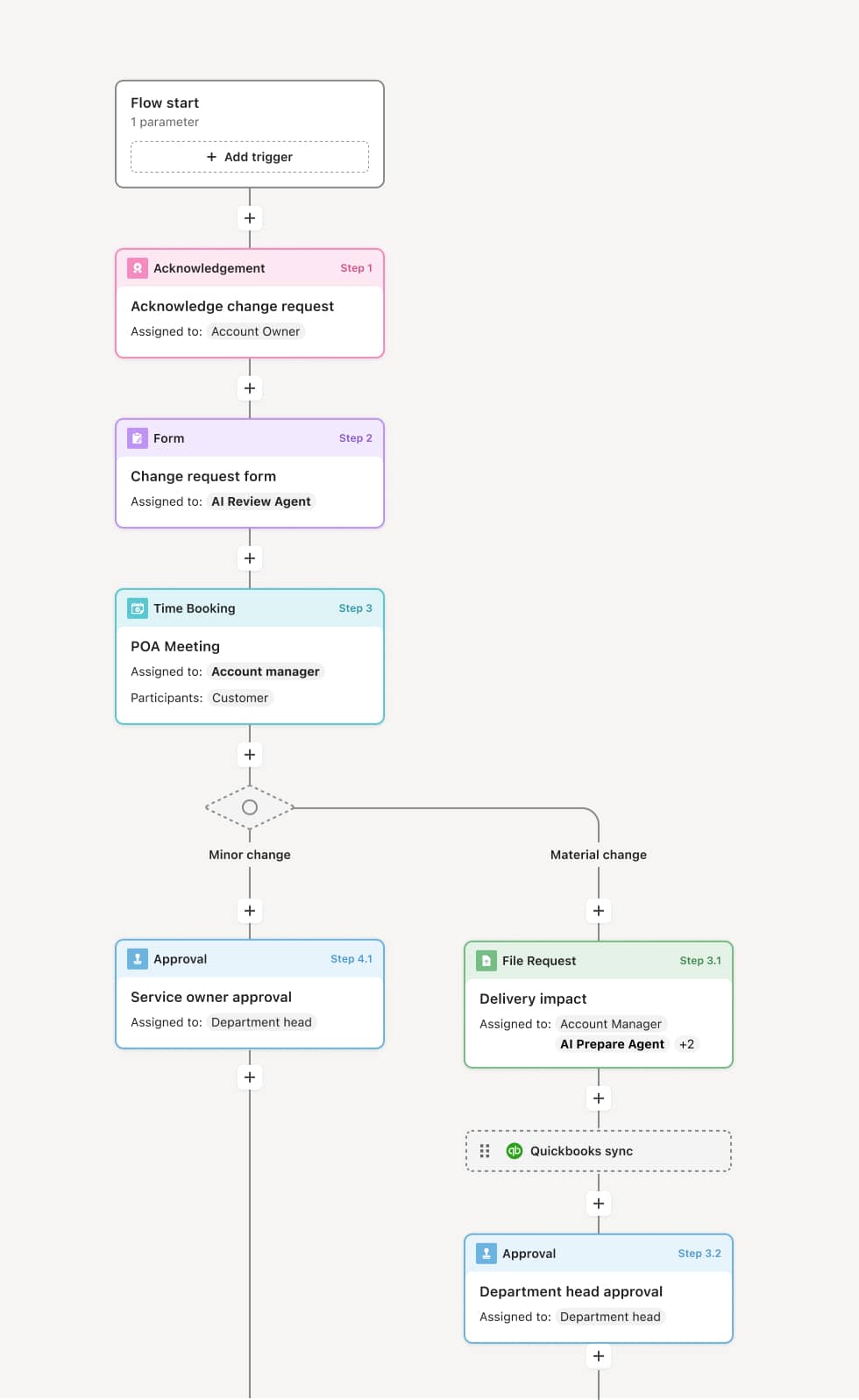
Your version of this process may vary based on roles, systems, data, and approval paths. Moxo’s flow builder can be configured with AI agents, conditional branching, dynamic data references, and sophisticated logic to match how your organization runs this workflow. The steps below illustrate one example.
Allegation intake and preliminary assessment
The process begins when an allegation of fraud is received through an ethics hotline, management report, audit finding, or system alert. The investigations team conducts a preliminary assessment to determine whether the allegation is credible and warrants a formal investigation. An AI Agent can assist by compiling relevant employee records, financial data, and system access logs for the preliminary review.
Investigation planning and evidence preservation
If a formal investigation is warranted, the lead investigator develops an investigation plan covering the scope, methodology, witness list, and evidence sources. Legal counsel issues a litigation hold if applicable. Evidence preservation instructions are issued for relevant documents, systems, and communications.
Evidence collection and financial analysis
The investigation team collects documentary evidence including financial records, expense reports, procurement documents, system logs, email communications, and physical evidence as applicable. Finance or internal audit performs financial analysis to quantify the suspected fraud, trace funds, and identify patterns.
Witness interviews
The investigator conducts interviews with relevant witnesses, the subject of the investigation, and any other individuals with pertinent knowledge. Interviews are conducted according to organizational protocol and legal counsel’s guidance. Interview notes or recordings are documented and preserved.
Findings and determination
The investigator analyzes all evidence and prepares a written report documenting the allegations, the evidence gathered, the analysis performed, the factual findings, and the investigator’s conclusions. Legal counsel reviews the report for legal exposure and advises on appropriate organizational action.
Corrective action and case closure
Based on the findings, management authorizes corrective action which may include disciplinary measures, termination, restitution demands, law enforcement referral, or control improvements. HR implements any employment actions. The case is closed with a complete record preserved for legal, regulatory, and organizational reference.
This process commonly relies on inputs such as the allegation or referral, employee records, financial data, expense reports, procurement records, system access logs, and email communications. It may be triggered by an ethics hotline report, a management referral, an audit finding, or a system alert. Connected systems often include case management platforms, HRIS like Workday or ADP, financial systems like NetSuite or SAP, email and communication archives, and access management systems.
Key decision points include whether the allegation is credible enough to warrant a formal investigation, what evidence sources and investigation methodology are appropriate for the type of suspected fraud, whether the evidence supports the allegation and to what extent, and what corrective or legal action is appropriate based on the findings and legal counsel’s advice.
Allegations not assessed promptly, allowing evidence to be altered or destroyed before preservation measures are in place. Investigation scope too narrow, missing related misconduct or additional subjects connected to the same scheme. Witness interviews not conducted with appropriate protocol, compromising the integrity of the testimony. Findings report not sufficiently detailed to support the organization’s action if challenged in litigation or regulatory proceedings. Control improvements not implemented after the investigation, leaving the vulnerability that enabled the fraud in place.
Orchestrates the fraud case investigation from allegation through corrective action across investigators, legal, HR, finance, and management in a single confidential workflow.
AI Agents compile preliminary case data including employee records, financial data, and system access logs at case opening to accelerate the initial assessment.
Manages evidence collection and preservation within the workflow with clear chain-of-custody documentation and litigation hold tracking.
Coordinates witness interviews with scheduling, preparation materials, and documentation captured in the investigation record.
Connects to HRIS, financial, and case management systems like Workday, NetSuite, and SAP so investigation data is gathered in context.
Preserves the complete investigation record including the allegation, evidence, analysis, witness documentation, findings, legal review, and corrective actions for legal, regulatory, and organizational reference.