Project manager
Engineering director
IT operations manager
Release manager
Compliance officer
VP of operations

This process is used when a new system, feature, product, or service is approaching production deployment and requires formal authorization that all readiness criteria have been satisfied. It is triggered when development and testing milestones are complete, when the implementation has passed user acceptance testing, or when a scheduled release date is approaching. It applies when multiple teams must confirm their respective readiness areas before the organization commits to a production launch. This process is common in technology companies, financial services, healthcare, and any organization where production deployments carry operational, regulatory, or customer-facing risk.
The go-live approval process typically involves the project or release manager who coordinates the readiness assessment, engineering and QA leads who confirm technical readiness, IT operations teams who validate infrastructure and deployment readiness, business stakeholders who confirm operational preparedness, compliance or risk officers who verify regulatory requirements, and a senior decision-maker who provides final go-live authorization.
Reduced deployment risk by ensuring all readiness areas are verified before production launch. Coordinated go/no-go decisions with clear visibility into which teams have confirmed readiness and which have outstanding items. Faster time to production by running readiness assessments in parallel rather than sequentially through email. Clear accountability for launch decisions with documented sign-offs from each responsible team. Fewer post-launch incidents because technical, operational, and compliance gaps are identified before rather than after deployment.
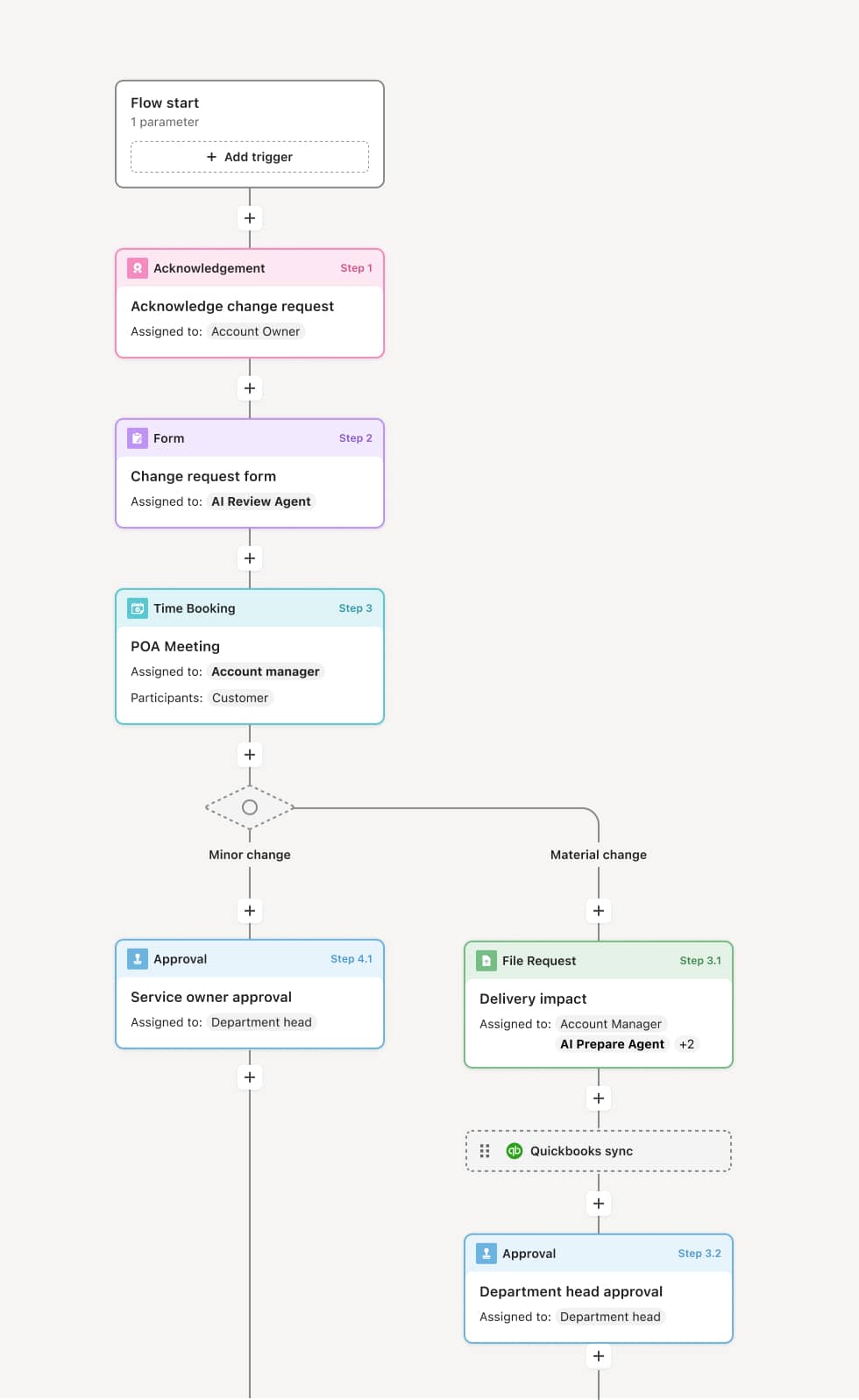
Your version of this process may vary based on roles, systems, data, and approval paths. Moxo’s flow builder can be configured with AI agents, conditional branching, dynamic data references, and sophisticated logic to match how your organization runs this workflow. The steps below illustrate one example.
Readiness assessment initiation
The process begins when the project or release manager initiates the go-live readiness assessment, typically a defined period before the target launch date. Each functional area receives a readiness checklist tailored to their domain, including technical, operational, compliance, and business readiness criteria. An AI Agent may pre-populate checklist items based on the project type and pull status data from connected project management or testing systems.
Parallel readiness reviews
Each responsible team completes their readiness assessment in parallel. Engineering and QA confirm that all tests have passed, known defects are resolved or documented, and performance criteria are met. IT operations confirms infrastructure readiness, monitoring, and rollback procedures. Business teams verify training, documentation, and support preparedness. Compliance confirms that regulatory requirements are addressed. The AI Agent may consolidate status updates and flag incomplete or overdue assessments.
Issue resolution and risk mitigation
If any readiness area identifies outstanding issues, those items are documented and routed for resolution. The team responsible for the issue works to resolve it or documents a mitigation plan. Critical issues may trigger a delay recommendation. Non-critical issues may be accepted with documented risk acknowledgment. The workflow tracks the resolution status of every identified issue.
Go/no-go decision
Once all readiness assessments are complete, the consolidated status is presented to the senior decision-maker. The decision-maker reviews all sign-offs, outstanding issues, and risk mitigations, and makes the go/no-go call. If the decision is go, the deployment proceeds on schedule. If no-go, the workflow documents the reasons and triggers a rescheduling process with updated readiness criteria.
Launch execution and post-go-live monitoring
Upon go-live authorization, the deployment proceeds according to the release plan. Post-launch monitoring confirms that the system is performing as expected. Any post-launch issues are captured and routed through the appropriate incident or exception process. The complete go-live record, including all readiness assessments, issue resolutions, and the authorization decision, is stored for project history and future reference.
This process commonly relies on inputs such as testing reports, readiness checklists, deployment plans, risk assessments, compliance documentation, and infrastructure configuration records. It may be triggered by a project milestone, a scheduled release date, or the completion of user acceptance testing. Systems commonly connected include project management tools like Jira for testing status, monitoring platforms for infrastructure readiness, and compliance management systems for regulatory checklists.
Key decision points include whether each functional area has confirmed readiness, whether outstanding issues are critical enough to delay launch, whether risk mitigations are acceptable for non-critical issues, and the final go/no-go decision by the authorized senior leader. If the decision is no-go, the workflow captures the reasons and initiates a rescheduling and remediation process.
Readiness assessments completed superficially without verifying underlying criteria, leading to undetected gaps. Outstanding issues not resolved or documented before the go/no-go decision, leaving the decision-maker without complete information. Go-live authorization given without all required sign-offs, bypassing teams whose readiness has not been confirmed. Rollback procedures not validated before deployment, increasing risk if post-launch issues arise. Post-launch monitoring not connected to incident management, delaying response to production issues.
Orchestrates parallel readiness assessments across all functional areas, giving the project manager real-time visibility into which teams have confirmed readiness and which have outstanding items.
AI Agents consolidate readiness status and flag overdue or incomplete assessments, ensuring the go/no-go decision is based on complete information.
Tracks issue resolution within the workflow, so outstanding items are documented and resolved before the decision point.
Routes the go/no-go decision to the authorized leader with a consolidated summary of all readiness inputs, sign-offs, and risk mitigations.
Connects to project management and monitoring systems to pull testing results and infrastructure status into the readiness workflow.