Project manager
Implementation lead
Client success manager
Technical lead
Delivery director
VP of professional services

This process is used at predefined stages of a product or service implementation when deliverables must be reviewed and accepted before the project proceeds. It is triggered when a milestone deliverable is completed and ready for review, when the project plan reaches a phase gate, or when a client or stakeholder requires formal sign-off before subsequent work can begin. It applies when the implementation spans multiple teams, involves client-facing deliverables, or requires acceptance from both internal and external stakeholders. This process is common in technology implementations, professional services engagements, consulting projects, and any multi-phase delivery where formal milestone acceptance governs project progression.
The implementation milestone approval process typically involves the project or implementation manager who coordinates the milestone review, technical leads who prepare and present the deliverable, quality assurance reviewers who validate deliverable completeness and quality, client stakeholders or sponsors who review and accept the milestone, and delivery directors or senior leaders who oversee milestone governance across the project portfolio.
Controlled project progression where each phase is validated before subsequent work begins, reducing rework from premature advancement. Clear acceptance criteria applied consistently at every milestone rather than subjective or informal sign-offs. Improved client confidence through structured milestone reviews that demonstrate progress and create formal acceptance records. Earlier identification of issues because deliverables are evaluated against criteria before downstream work depends on them. Stronger project governance with documented milestone acceptance decisions supporting contract compliance and project accounting.
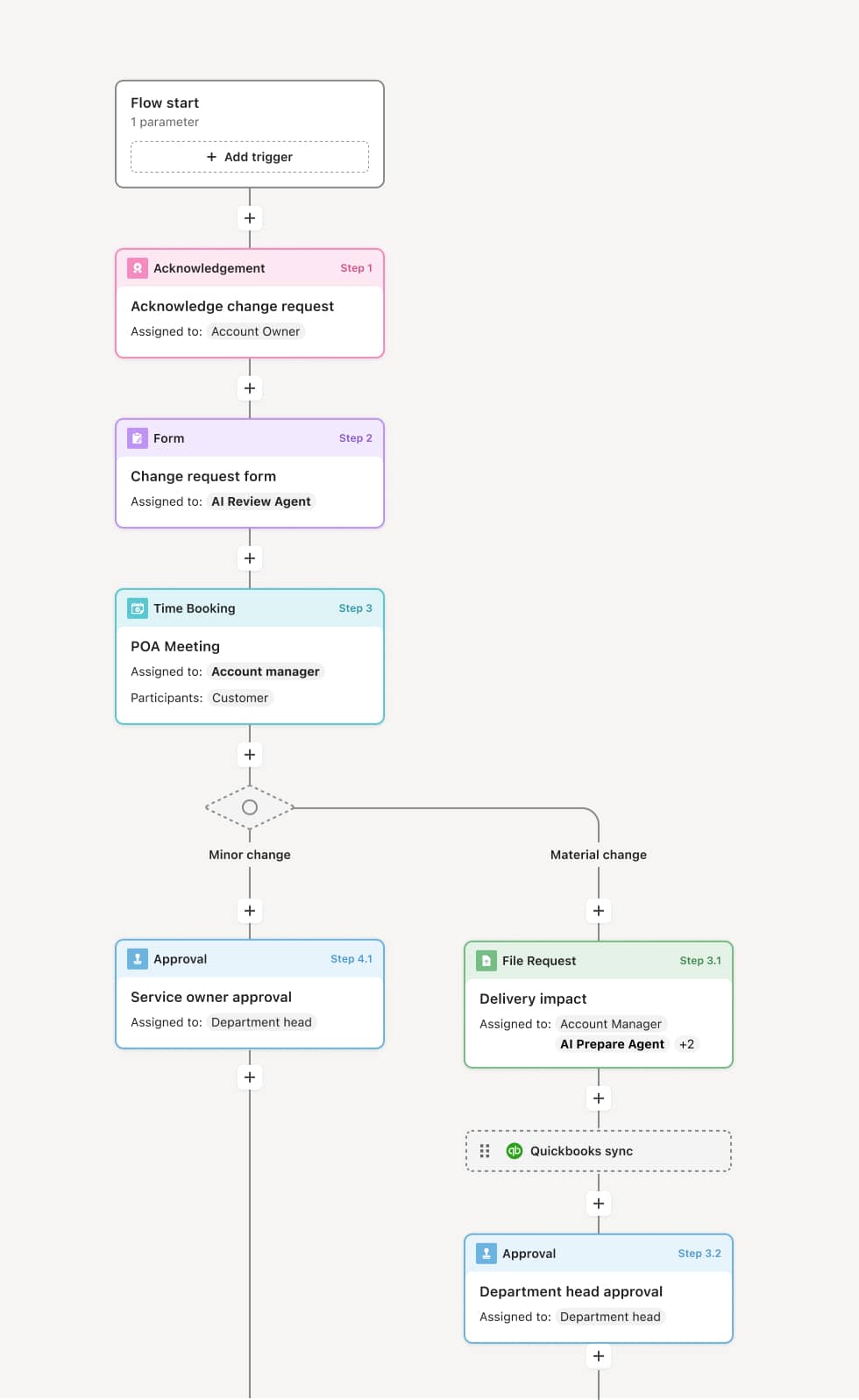
Your version of this process may vary based on roles, systems, data, and approval paths. Moxo’s flow builder can be configured with AI agents, conditional branching, dynamic data references, and sophisticated logic to match how your organization runs this workflow. The steps below illustrate one example.
Milestone deliverable preparation
The process begins when the implementation team completes a milestone deliverable and prepares it for review. This includes compiling the deliverable, supporting documentation, and any evidence that acceptance criteria have been met. An AI Agent may assist by pulling acceptance criteria from the project plan, checking that required artifacts are included, and notifying reviewers that the milestone is ready for evaluation.
Internal quality review
Before the milestone is presented to the client or external stakeholder, an internal quality review is conducted. Technical leads and QA reviewers evaluate the deliverable against specifications and quality standards. Issues identified during internal review are documented and resolved before the deliverable proceeds to client review. The AI Agent may track resolution of internal review items and confirm completeness.
Client or stakeholder review
The milestone deliverable is presented to the client or designated stakeholder for evaluation. The reviewer assesses the deliverable against the agreed acceptance criteria and either accepts, requests modifications, or raises concerns. Feedback is captured directly within the workflow, ensuring questions and clarifications are tied to the specific milestone.
Revision and resubmission (if required)
If the client requests modifications, the implementation team addresses the feedback and resubmits the deliverable. The review cycle repeats until the acceptance criteria are met. The workflow tracks each revision cycle, documenting what changed and what was resolved.
Milestone acceptance and project progression
Once the milestone is accepted, the acceptance is formally recorded, and the project advances to the next phase. Downstream activities, dependencies, and resource allocations are activated based on the acceptance. The complete milestone record, including all review feedback, revision history, and acceptance confirmations, is stored for project governance, contract compliance, and portfolio reporting.
This process commonly relies on inputs such as milestone deliverables, acceptance criteria, project plans, testing reports, and client feedback. It may be triggered by a project schedule milestone, the completion of a deliverable, or a client review request. Systems commonly connected include project management platforms like Jira or Asana for project tracking, CRM tools like Salesforce for client engagement context, and document management systems for deliverable storage.
Key decision points include whether the deliverable passes internal quality review, whether the client accepts the milestone against agreed criteria, whether modifications are required before acceptance, and whether the project can proceed to the next phase. If the client rejects the milestone, the workflow determines whether the issue is a scope dispute, a quality gap, or a misalignment in acceptance criteria.
Milestone deliverables submitted for review without verifying acceptance criteria, leading to rejection and rework. Internal quality review skipped under schedule pressure, allowing issues to reach the client. Client feedback captured outside the workflow, creating ambiguity about what was requested and what was resolved. Revision cycles not tracked, making it difficult to determine how many iterations were required and why. Milestone acceptance not formally documented, creating contract compliance risk when deliverable sign-off is disputed later.
AI Agents verify deliverable completeness by checking submitted materials against acceptance criteria from the project plan before routing to reviewers.
Orchestrates internal quality review and client review as distinct phases within a single workflow, ensuring internal standards are met before external presentation.
Supports iterative review and revision cycles with complete traceability of feedback, changes, and resolution at each iteration.
Routes milestone acceptance to both internal and external stakeholders, ensuring formal sign-off is captured from all required parties.
Connects to project management systems to update project status and activate downstream dependencies upon milestone acceptance.