Chief financial officer
Investment committee member
Portfolio manager
Risk officer
Compliance officer
Finance director

This process is used when a proposed investment, capital expenditure, or strategic allocation requires formal evaluation and authorization before funds are committed. It is triggered when an investment proposal is submitted, when a capital expenditure exceeds defined approval thresholds, when a new asset class or counterparty is being considered, or when regulatory requirements mandate documented investment authorization. It applies when the decision requires input from multiple disciplines including finance, risk management, compliance, and executive leadership. This process is common in financial services, private equity, corporate treasury, institutional investment, and any organization that manages significant capital allocation decisions.
The investment approval process typically involves the investment analyst or portfolio manager who submits the proposal, finance leaders who evaluate the financial merit and return projections, risk officers who assess the risk profile and exposure implications, compliance officers who verify regulatory requirements and investment policy adherence, and the investment committee or senior executive who provides final authorization.
Disciplined capital allocation with every investment evaluated against consistent financial, risk, and compliance criteria. Faster decision cycles by routing analysis to all required reviewers in parallel rather than sequentially. Comprehensive risk visibility because risk assessment is embedded in the approval process rather than conducted as a separate exercise. Regulatory compliance with documented evaluation, authorization, and rationale for every investment decision. Clear investment governance with a complete record of who proposed, evaluated, and authorized each investment.
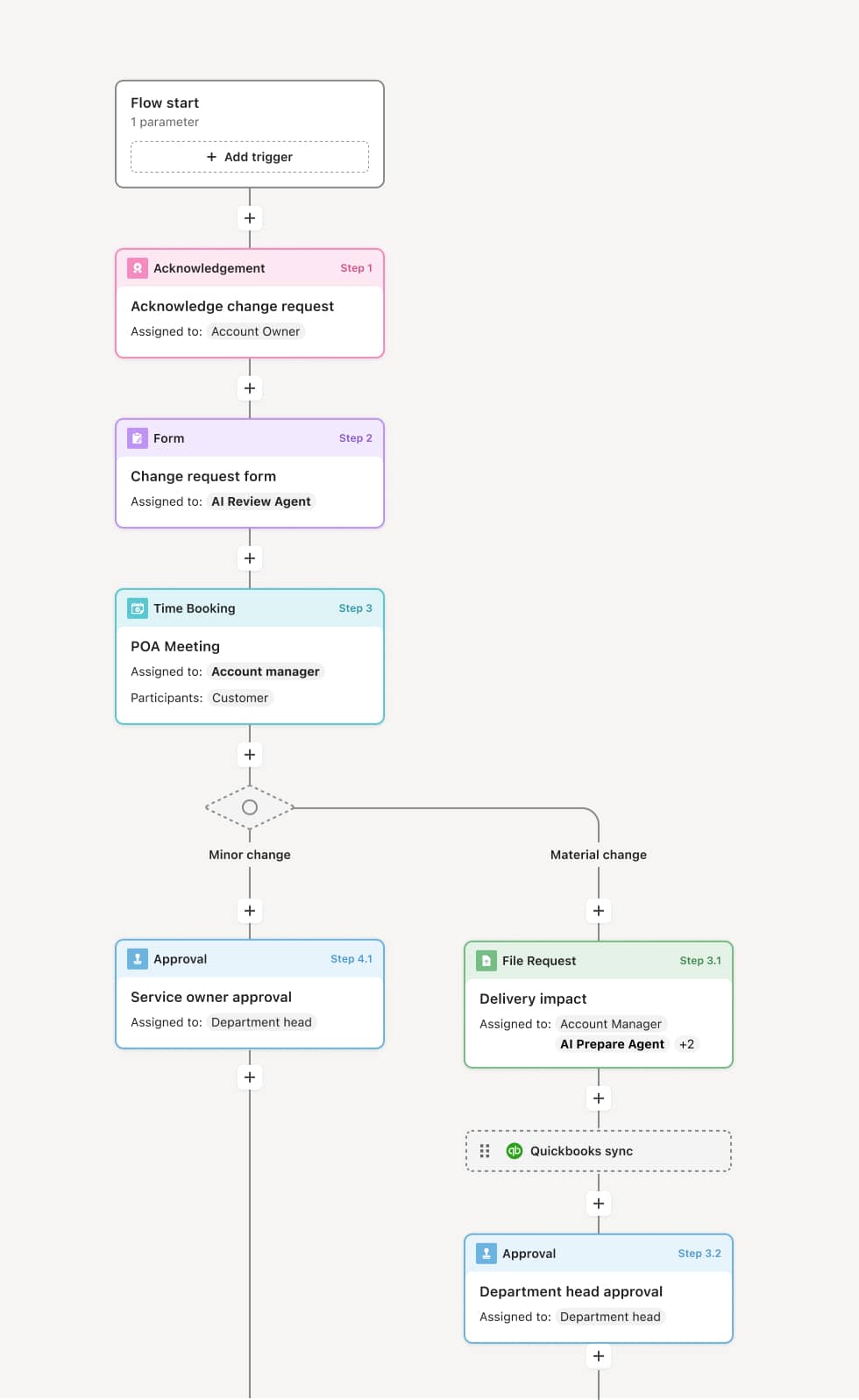
Your version of this process may vary based on roles, systems, data, and approval paths. Moxo’s flow builder can be configured with AI agents, conditional branching, dynamic data references, and sophisticated logic to match how your organization runs this workflow. The steps below illustrate one example.
Investment proposal submission
The process begins when an analyst, portfolio manager, or business leader submits an investment proposal with supporting details such as the investment thesis, expected returns, risk profile, time horizon, capital requirements, and alignment with the organization’s investment strategy. An AI Agent may assist by pulling relevant market data, portfolio exposure data, and prior investment outcomes from connected systems.
Financial analysis and return evaluation
The finance team evaluates the proposal’s financial merit, including projected returns, cash flow impact, valuation assumptions, and sensitivity analysis. The review assesses whether the investment meets the organization’s return thresholds and fits within available capital. The AI Agent may compile comparable investment data and performance benchmarks to support the evaluation.
Risk assessment
The risk team evaluates the proposal’s risk profile, including market risk, credit risk, liquidity risk, concentration risk, and any operational risks associated with the investment. The assessment considers the impact on the overall portfolio and whether the investment falls within approved risk limits.
Compliance review
Compliance verifies that the proposed investment adheres to all applicable regulations, investment policy guidelines, and any mandate-specific restrictions. This includes evaluating counterparty eligibility, jurisdictional requirements, and documentation standards. If the investment raises compliance concerns, additional review or policy exception approval may be required.
Investment committee or executive authorization
The proposal, along with all supporting analysis and reviews, is presented to the investment committee or designated senior executive for final authorization. The decision-maker evaluates the consolidated assessment and either approves, approves with conditions, requests additional analysis, or declines the investment. For particularly significant or novel investments, the committee may convene a discussion before rendering a decision.
Execution authorization and record closure
Upon approval, the investment is authorized for execution and the relevant trading, legal, or operations teams are notified. The complete investment approval record, including the proposal, all analyses, review commentary, and the authorization decision with rationale, is stored for governance, regulatory reporting, and portfolio management purposes.
This process commonly relies on inputs such as investment proposals, financial models, market data, risk assessments, portfolio exposure reports, and compliance policy references. It may be triggered by a proposal submission, a periodic investment review cycle, or a market opportunity. Systems commonly connected include portfolio management platforms for exposure data, risk management systems for risk analytics, ERP or treasury systems like SAP for capital availability, and compliance platforms for regulatory reference.
Key decision points include whether the investment meets return thresholds and financial criteria, whether the risk profile is acceptable within portfolio limits, whether the investment complies with all regulatory and policy requirements, and whether the investment committee or executive authorizes the allocation. If additional analysis is requested, the workflow routes back to the submitter or analyst before the decision is finalized.
Investment proposals submitted without complete financial analysis, delaying committee review while additional modeling is prepared. Risk assessment conducted in isolation from portfolio context, missing concentration or correlation risks. Compliance review not completed before the authorization decision, creating regulatory exposure. Investment committee decisions not documented with rationale, making it difficult to demonstrate governance in audits or regulatory examinations. Approved investments not communicated to execution teams in time, causing missed market windows or delayed capital deployment.
Orchestrates parallel reviews across finance, risk, and compliance so investment proposals are evaluated comprehensively without sequential bottlenecks.
AI Agents compile market data, portfolio exposure, and prior investment outcomes from connected systems, providing reviewers with immediate analytical context.
Routes proposals to the investment committee or designated executive with a consolidated package of all analysis and review commentary, reducing preparation overhead.
Tracks conditional approvals and execution timelines to ensure authorized investments are deployed within approved windows and conditions.
Maintains a complete governance record for every investment decision, supporting regulatory reporting, audit, and portfolio performance analysis.