Portfolio manager
Trader
Chief investment officer
Risk officer
Compliance officer
Operations manager

This process is used when a proposed trade requires formal authorization before it can be submitted for execution. It is triggered when a portfolio manager or trader proposes a transaction that exceeds pre-defined thresholds, involves a restricted security or counterparty, requires compliance sign-off under regulatory mandates, or when the trade’s risk impact on the portfolio requires risk officer review. It applies when the organization manages fiduciary assets, operates under regulatory oversight, or maintains investment policy guidelines that require documented pre-trade approval. This process is common in asset management, wealth management, hedge funds, insurance companies, pension funds, and corporate treasury operations.
The investment trade approval process typically involves the portfolio manager who proposes the trade and provides the investment rationale, traders who prepare execution details and venue selection, risk officers who evaluate the trade’s impact on portfolio risk limits, compliance officers who verify the trade against regulatory rules and investment policy restrictions, and the chief investment officer or senior portfolio leader who provides final authorization for trades above defined thresholds.
Pre-trade risk control with every proposed transaction evaluated against portfolio limits and risk parameters before execution. Regulatory compliance through documented pre-trade compliance checks and authorization records for every trade. Faster trade execution by routing validation steps in parallel and delivering complete decision context to the authorizer. Reduced trade errors because compliance, risk, and guideline violations are caught before execution rather than identified post-trade. Clear fiduciary governance with a complete pre-trade approval record supporting audit, regulatory examination, and client reporting.
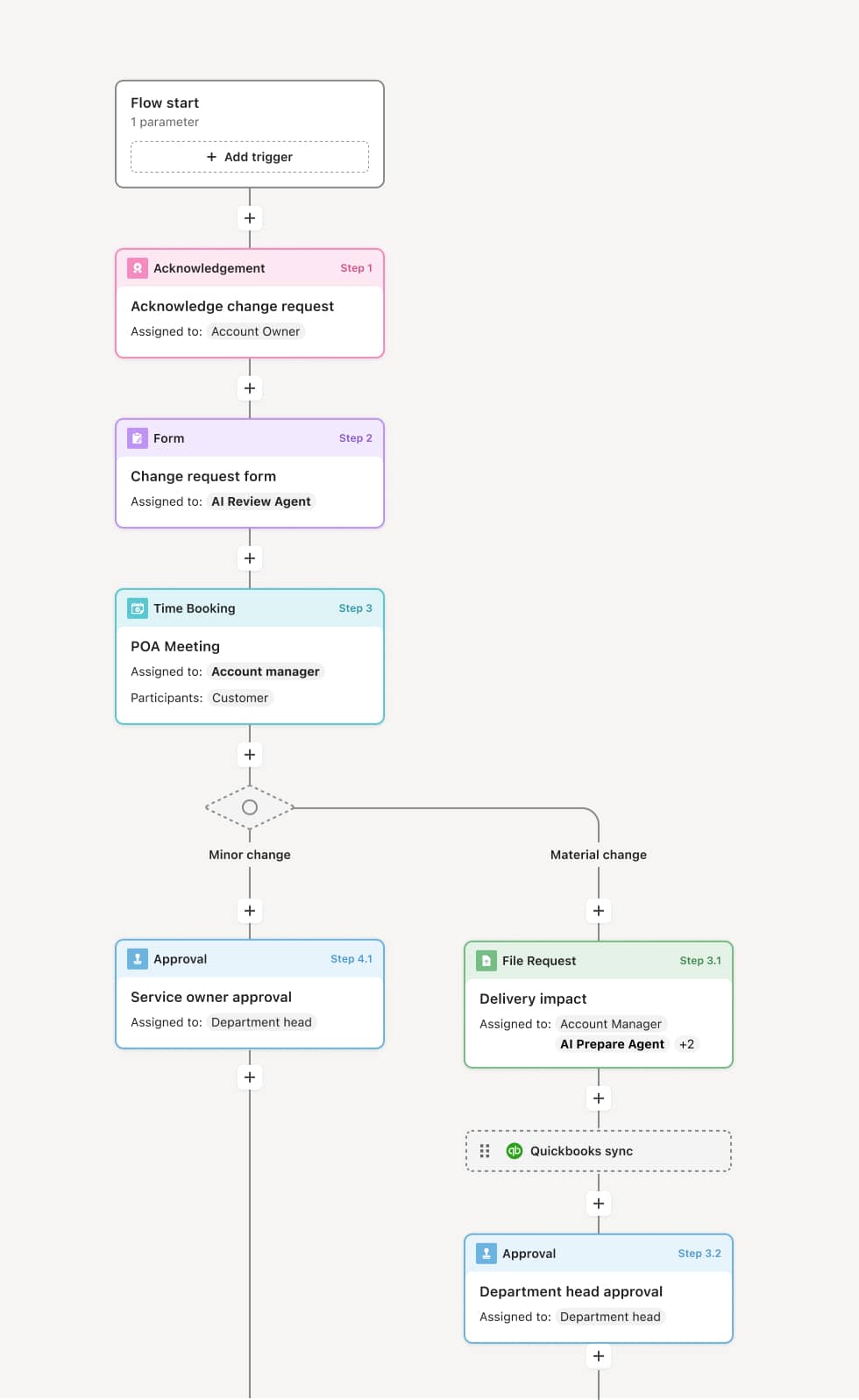
Your version of this process may vary based on roles, systems, data, and approval paths. Moxo’s flow builder can be configured with AI agents, conditional branching, dynamic data references, and sophisticated logic to match how your organization runs this workflow. The steps below illustrate one example.
Trade proposal and rationale submission
The process begins when a portfolio manager submits a proposed trade, including the security, quantity, direction, proposed price or limit, target account or fund, and the investment rationale. An AI Agent may assist by pulling current portfolio positions, exposure data, and recent market information to enrich the submission context.
Pre-trade compliance check
The proposed trade is evaluated against investment policy guidelines, regulatory restrictions, restricted security lists, and any client mandate-specific rules. The AI Agent may perform automated checks against these parameters and flag any violations or warnings. If the trade violates a hard restriction, it is blocked and returned to the portfolio manager with the specific rule that was triggered. Soft warnings are documented and presented to the compliance officer for review.
Risk limit evaluation
The risk team evaluates the trade’s impact on portfolio-level risk metrics, including position concentration, sector exposure, liquidity, duration, and any other relevant risk parameters. If the trade would cause a breach of approved risk limits, it is flagged for risk officer review and potential modification. The AI Agent may calculate the projected impact on key risk metrics based on the proposed trade.
Authorization decision
For trades that pass compliance and risk validation, the authorization routes to the designated approver based on the trade’s size, type, or risk impact. Standard trades within policy may be approved by the portfolio manager or a senior trader. Trades that exceed thresholds, trigger warnings, or involve restricted categories route to the chief investment officer or investment committee for authorization. The approver reviews the complete package and either authorizes, requests modifications, or declines the trade.
Execution release and record closure
Upon authorization, the trade is released for execution. The approved trade details flow to the trading desk and order management system. The complete pre-trade approval record, including the proposal, compliance checks, risk evaluation, and authorization decision, is stored for regulatory reporting, audit, and fiduciary governance purposes.
This process commonly relies on inputs such as trade proposals, portfolio position data, investment policy guidelines, restricted security lists, risk limit parameters, and market data. It may be triggered by a trade proposal from a portfolio manager, a rebalancing event, or a client instruction. Systems commonly connected include order management systems for trade execution, portfolio management platforms for position data, risk management systems for limit monitoring, and compliance platforms for restriction checking.
Key decision points include whether the trade passes automated compliance checks or triggers restrictions, whether the risk impact is within approved limits, whether flagged items require risk officer or compliance officer judgment, and whether the trade requires senior authorization based on size or type thresholds. If the trade is modified based on compliance or risk feedback, the revised proposal cycles through validation again before authorization.
Automated compliance checks not updated to reflect current restricted lists or policy changes, allowing restricted trades to pass validation. Risk limit evaluation based on stale position data, leading to inaccurate impact assessments. Trade authorization delayed because the required approver is unavailable, missing optimal execution windows. Pre-trade approval records not linked to the executed trade, creating governance gaps during audit or regulatory examination. Soft compliance warnings dismissed without documented rationale, undermining the integrity of the pre-trade review process.
AI Agents perform automated pre-trade compliance and risk limit checks against current policy guidelines, restricted lists, and portfolio positions, accelerating the validation cycle.
Routes trade authorizations to the correct approver based on trade size, type, risk impact, and organizational policy, ensuring the right authority level is engaged.
Orchestrates parallel compliance and risk evaluations so both assessments complete simultaneously rather than sequentially delaying execution.
Connects to order management and portfolio management systems to pull real-time position data and push authorized trades directly to execution.
Maintains a complete, auditable pre-trade approval record for every transaction, supporting regulatory examination, fiduciary governance, and client reporting.