Operations manager
Service delivery lead
Customer success manager
Department head
Quality assurance manager
VP of operations

This process is used when an operational issue—whether customer-facing, internal, or cross-functional—exceeds the resolution capacity, authority, or expertise of the current owner and requires engagement from additional resources or leadership. It is triggered when resolution timelines are at risk, when the issue’s impact expands beyond the original scope, when a customer or stakeholder relationship is at risk, or when the issue requires a decision that exceeds the current owner’s authority. This process is common across service delivery, project management, account management, and operations teams in any organization where unresolved issues carry business, financial, or reputational consequences.
The issue escalation process typically involves the frontline owner who identifies the need for escalation and documents the issue context, functional leads or subject matter experts who are engaged for additional expertise, managers who evaluate the issue’s business impact and authorize response actions, senior leadership who handle issues with significant financial, customer, or strategic implications, and customer-facing teams who manage stakeholder communication throughout the escalation.
Faster issue resolution by engaging the right expertise and authority level before the situation deteriorates. Reduced business impact through structured severity assessment that triggers additional resources proportional to the risk. Clear ownership at every level so issues do not fall between teams or stall waiting for someone to take responsibility. Consistent escalation standards that ensure similar issues receive similar levels of attention and response. Better stakeholder communication because escalation status and next steps are tracked and communicated within a defined process.
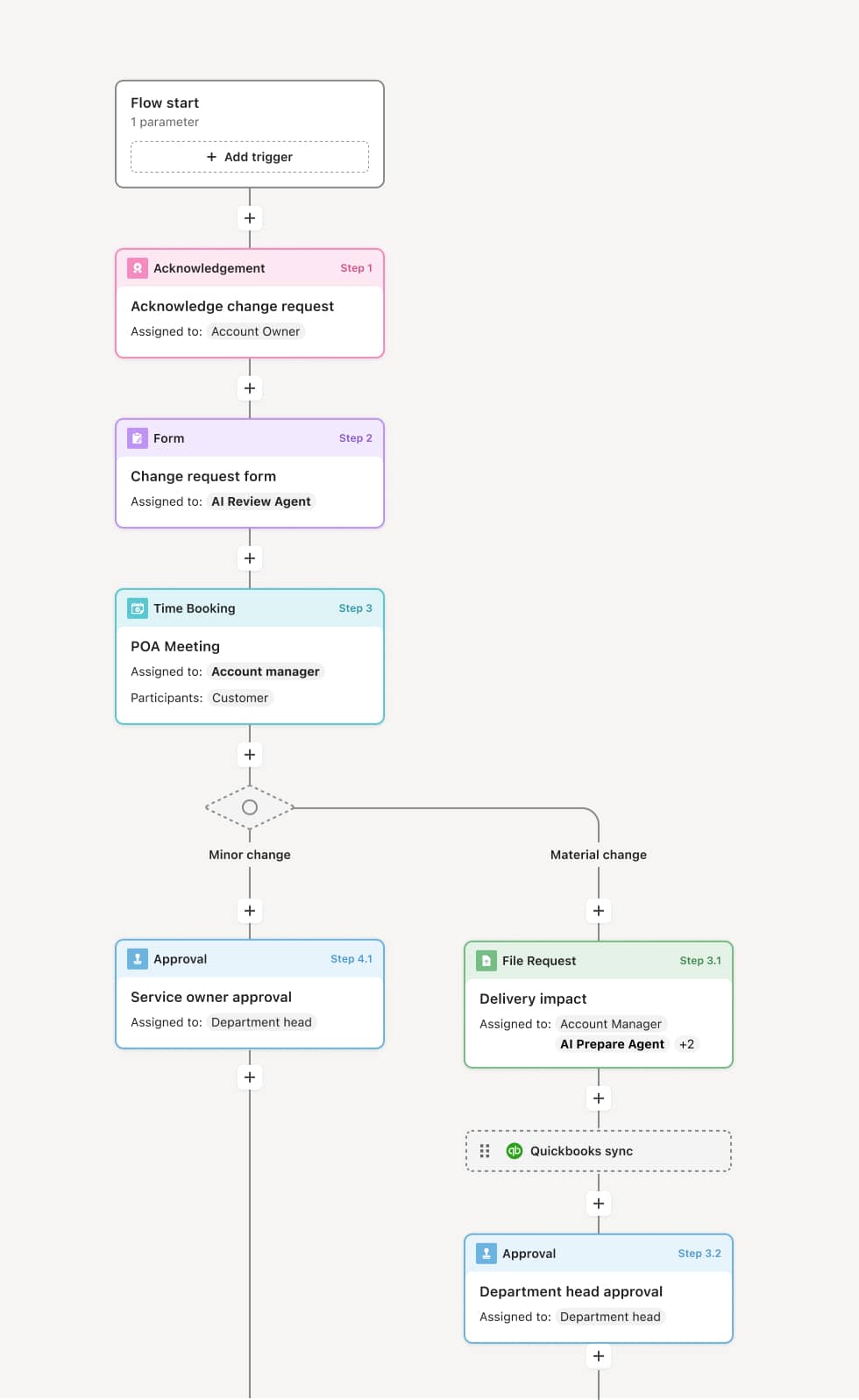
Your version of this process may vary based on roles, systems, data, and approval paths. Moxo’s flow builder can be configured with AI agents, conditional branching, dynamic data references, and sophisticated logic to match how your organization runs this workflow. The steps below illustrate one example.
Issue identification and escalation trigger
The process begins when the current issue owner determines that escalation is needed. This may be because resolution attempts have failed, the timeline is at risk, the impact has expanded, or the issue requires authority or expertise beyond the current level. The owner documents the issue context, including the nature of the problem, actions taken so far, current impact, and the reason escalation is needed. An AI Agent may assist by pulling related issue history, SLA status, and stakeholder data to enrich the escalation submission.
Severity assessment and routing
The escalation is assessed for severity based on factors such as business impact, customer exposure, financial risk, and urgency. Based on this assessment, the workflow routes the issue to the appropriate next level—whether that is a functional lead, a department manager, or senior leadership. The AI Agent may recommend a severity classification based on the issue’s characteristics and prior similar cases.
Engagement of additional resources
The escalated owner or team reviews the issue context and determines the response approach. This may involve engaging subject matter experts, coordinating across departments, contacting external vendors or partners, or reallocating resources. The workflow supports parallel engagement of multiple parties when the issue requires cross-functional response.
Resolution action and tracking
The designated responders execute the resolution plan. The workflow tracks progress against the resolution timeline, and the AI Agent may monitor for stalls or delays and alert the escalation owner. If the issue remains unresolved or the impact continues to grow, further escalation may be triggered based on configured thresholds.
Stakeholder communication
Throughout the escalation, affected stakeholders—whether customers, partners, or internal teams—receive updates on the issue status, expected resolution timeline, and any interim actions taken. Communication is managed within the workflow to ensure consistency and traceability.
Resolution confirmation and closure
Once the issue is resolved, the resolution is confirmed with affected parties, and the escalation is formally closed. The complete record—including the original issue, escalation context, all actions taken, communications, and the resolution outcome—is stored for trend analysis, process improvement, and future reference.
This process commonly relies on inputs such as issue reports, case histories, SLA data, customer account information, and prior resolution attempts. It may be triggered by a manual escalation from the issue owner, an SLA timer approaching or breaching threshold, or a stakeholder complaint. Systems commonly connected include CRM platforms like Salesforce for customer and account context, service management tools for issue tracking, and project management systems for cross-functional coordination.
Key decision points include whether the issue meets escalation criteria or can be resolved at the current level, what severity classification applies, which team or individual should take ownership at the next level, whether the response requires cross-functional coordination, and when the issue can be considered resolved. If further escalation is needed after the initial routing, the workflow triggers the next tier based on configured thresholds.
Issues escalated without sufficient context, forcing the next level to re-investigate rather than focus on resolution. Severity misclassified, causing high-impact issues to be under-resourced or low-impact issues to consume senior leadership time. Ownership unclear after escalation, leaving the issue in limbo between teams. Stakeholder communication delayed or inconsistent, eroding trust and creating confusion about resolution progress. Resolved issues not analyzed for root cause, allowing recurring problems to continue triggering escalations.
AI Agents enrich escalation submissions by pulling issue history, SLA status, and stakeholder data from connected systems like Salesforce, giving the next owner immediate context.
Routes escalated issues to the correct level based on severity, business impact, and organizational structure, ensuring the right authority and expertise are engaged.
Tracks resolution progress within the workflow, with automated alerts when timelines are at risk or when further escalation thresholds are approached.
Manages stakeholder communication within the escalation process, ensuring updates are consistent, timely, and traceable.
Maintains a complete escalation record from issue identification through resolution, supporting root cause analysis, trend identification, and process improvement.