Property manager
Leasing agent
Credit analyst
Compliance officer
Asset manager
Real estate operations director

This process is used when a prospective tenant submits an application for a residential or commercial lease and the application must be evaluated before an offer can be extended. It is triggered when an application is received, when supporting documentation such as financial statements, references, or identification is submitted, or when a property reaches the leasing stage of its lifecycle. It applies when the evaluation requires coordination across leasing, credit, compliance, and ownership stakeholders, and when fair housing, anti-discrimination, or regulatory requirements mandate documented evaluation criteria. This process is common in property management, commercial real estate, multifamily housing, and any organization that manages leasing operations at scale.
The lease application approval process typically involves leasing agents or property managers who receive and pre-screen applications, credit analysts who evaluate the applicant’s financial qualifications and credit history, compliance officers who ensure adherence to fair housing regulations and organizational policies, asset managers or ownership representatives who authorize lease terms for high-value or non-standard tenancies, and legal counsel who review lease exceptions or non-standard terms.
Consistent evaluation standards applied to every applicant based on defined financial and eligibility criteria. Faster leasing cycles by routing complete applications through parallel review tracks rather than sequential handoffs. Reduced compliance risk through documented evaluation criteria and decision records that demonstrate fair and consistent treatment. Lower vacancy costs because qualified applicants receive decisions faster, reducing the time between application and lease execution. Clear tenancy records with a documented trail from application through approval, supporting property management and audit requirements.
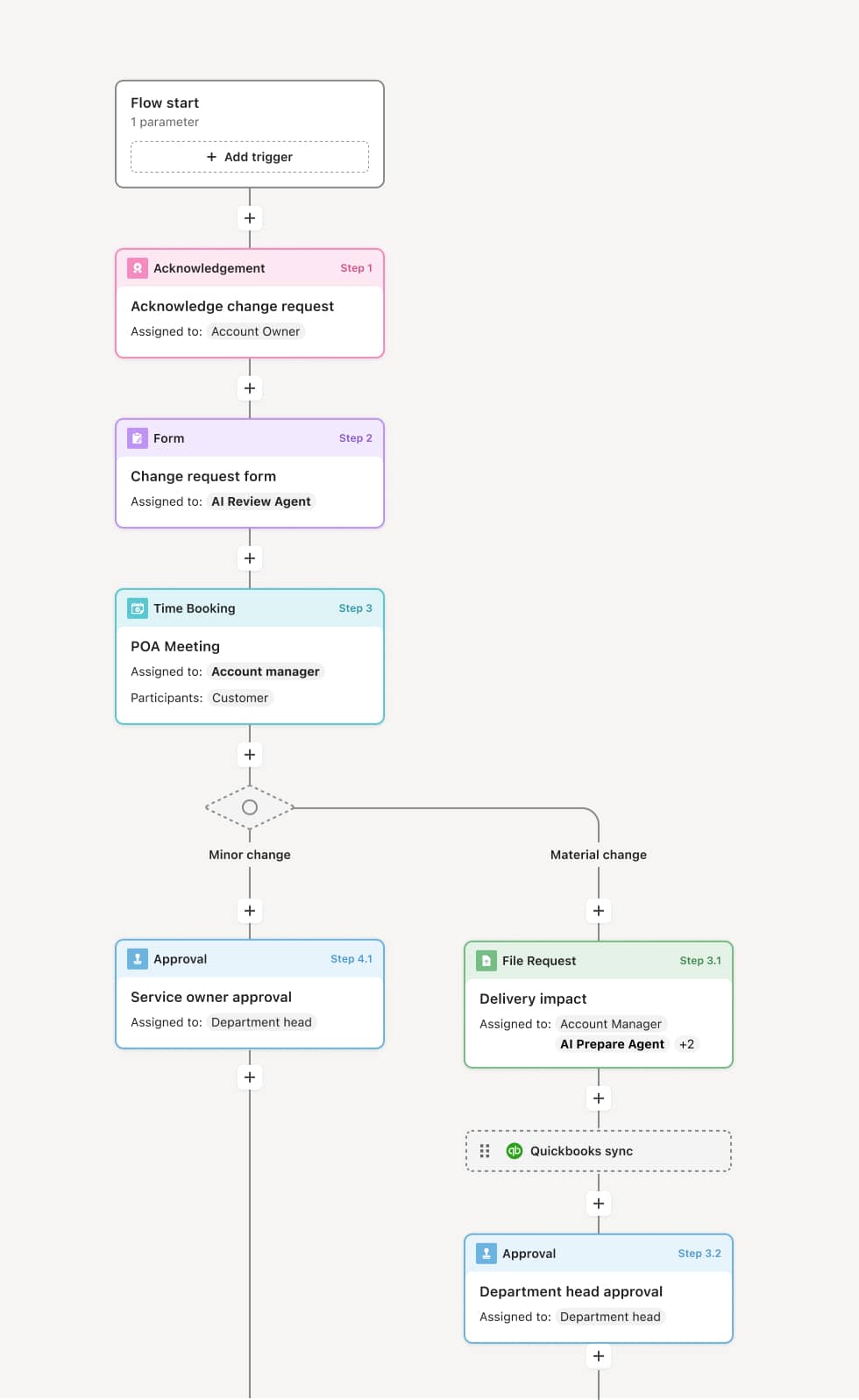
Your version of this process may vary based on roles, systems, data, and approval paths. Moxo’s flow builder can be configured with AI agents, conditional branching, dynamic data references, and sophisticated logic to match how your organization runs this workflow. The steps below illustrate one example.
Application submission and completeness check
The process begins when a prospective tenant submits a lease application along with supporting documents such as identification, proof of income, employment verification, references, and any required financial statements. An AI Agent may assist by validating that all required documents are included and that the application fields are complete before routing the application for review.
Credit and financial evaluation
The credit team reviews the applicant’s financial qualifications, including credit history, income verification, debt-to-income ratios, and any prior tenancy records. Applications that meet the property’s financial criteria proceed to the next review stage. Applications that fall below thresholds are flagged for additional review or denial, with documented reasoning.
Compliance and eligibility review
Compliance reviews the application and the evaluation process to confirm adherence to fair housing regulations, anti-discrimination requirements, and organizational policies. This step ensures that all applicants are evaluated using consistent, documented criteria and that the decision-making process is defensible. The AI Agent may flag any evaluation patterns that deviate from established criteria.
Property manager review and recommendation
The property manager or leasing agent reviews the consolidated evaluation and makes a tenancy recommendation. This includes confirming the desired unit, lease terms, move-in date, and any special conditions. If the application involves non-standard terms such as a shorter lease duration, guarantor arrangement, or commercial use exceptions, additional review from the asset manager or legal may be required.
Final approval and lease preparation
The application routes to the designated approver—typically the property manager, asset manager, or ownership representative—for final authorization. Upon approval, the lease agreement is prepared with the agreed terms and sent to the tenant for review and execution via e-signature.
Lease execution and record closure
The tenant reviews and signs the lease agreement. Upon execution, the lease is filed, move-in procedures are initiated, and relevant property management systems are updated. The complete application record, including all submitted documents, evaluation results, and approval decisions, is stored for tenancy management, compliance, and audit purposes.
This process commonly relies on inputs such as tenant applications, identification documents, credit reports, income verification, employment letters, landlord references, and financial statements. It may be triggered by an application submission through a property portal, a leasing agent’s form submission, or an inquiry conversion. Systems commonly connected include property management platforms like Yardi or AppFolio for unit and lease data, credit screening services for financial evaluation, and document management systems for application storage.
Key decision points include whether the application is complete and ready for evaluation, whether the applicant meets the property’s financial and credit criteria, whether the evaluation complies with fair housing and anti-discrimination requirements, whether non-standard lease terms require additional authorization, and whether the final tenancy is approved. If the application is denied, the workflow documents the specific criteria that were not met.
Applications reviewed with incomplete documentation, leading to delays while additional materials are requested. Financial evaluation criteria applied inconsistently across applicants, creating fair housing compliance risk. Compliance review skipped under pressure to fill vacancies, exposing the organization to discrimination claims. Non-standard lease terms approved without legal or ownership review, creating contract risk. Denied applications not documented with specific criteria, making it difficult to demonstrate fair evaluation in disputes or audits.
AI Agents validate application completeness at submission, flagging missing documents and incomplete fields before routing to reviewers.
Routes applications through credit, compliance, and property management reviews in parallel, reducing the time from submission to decision.
Ensures consistent evaluation criteria are applied and documented for every applicant, supporting fair housing compliance.
Connects to property management platforms like Yardi or AppFolio for unit availability, lease terms, and tenancy records.
Maintains a complete application-to-lease record for every prospective tenant, supporting compliance, audit, and property management reporting.