HR director
HR business partner
Benefits manager
Legal counsel
Department head
Disability coordinator

This process is used when an employee requests an extended leave of absence that falls outside standard time-off policies, including medical leave, family leave, personal leave, military leave, or other protected categories. It is triggered when an employee submits a leave of absence request, when a medical certification is received, when a qualifying event occurs under FMLA or equivalent regulations, or when an employee’s absence requires formal documentation and accommodation planning. It applies when the leave involves regulatory compliance obligations, benefits continuation decisions, job protection requirements, and return-to-work planning. This process is common in organizations of all sizes that must comply with employment regulations and manage extended absences with documented processes.
The leave of absence approval process typically involves the employee who submits the leave request, the direct manager who assesses operational impact, HR business partners who evaluate eligibility and coordinate the leave process, benefits managers who determine benefits continuation and cost-sharing arrangements, legal counsel who advises on regulatory compliance and accommodation obligations, and disability coordinators who manage medical documentation and return-to-work planning for medical leaves.
Regulatory compliance with leave entitlements evaluated and documented against applicable laws such as FMLA, ADA, and state-specific requirements. Consistent leave administration with every request evaluated using the same criteria and documentation standards. Clear leave terms communicated to the employee, including duration, benefits continuation, job protection, and return-to-work expectations. Reduced legal exposure because eligibility determinations, accommodation decisions, and communications are documented within a structured process. Smoother return-to-work transitions because return planning begins during the leave rather than at the last moment.
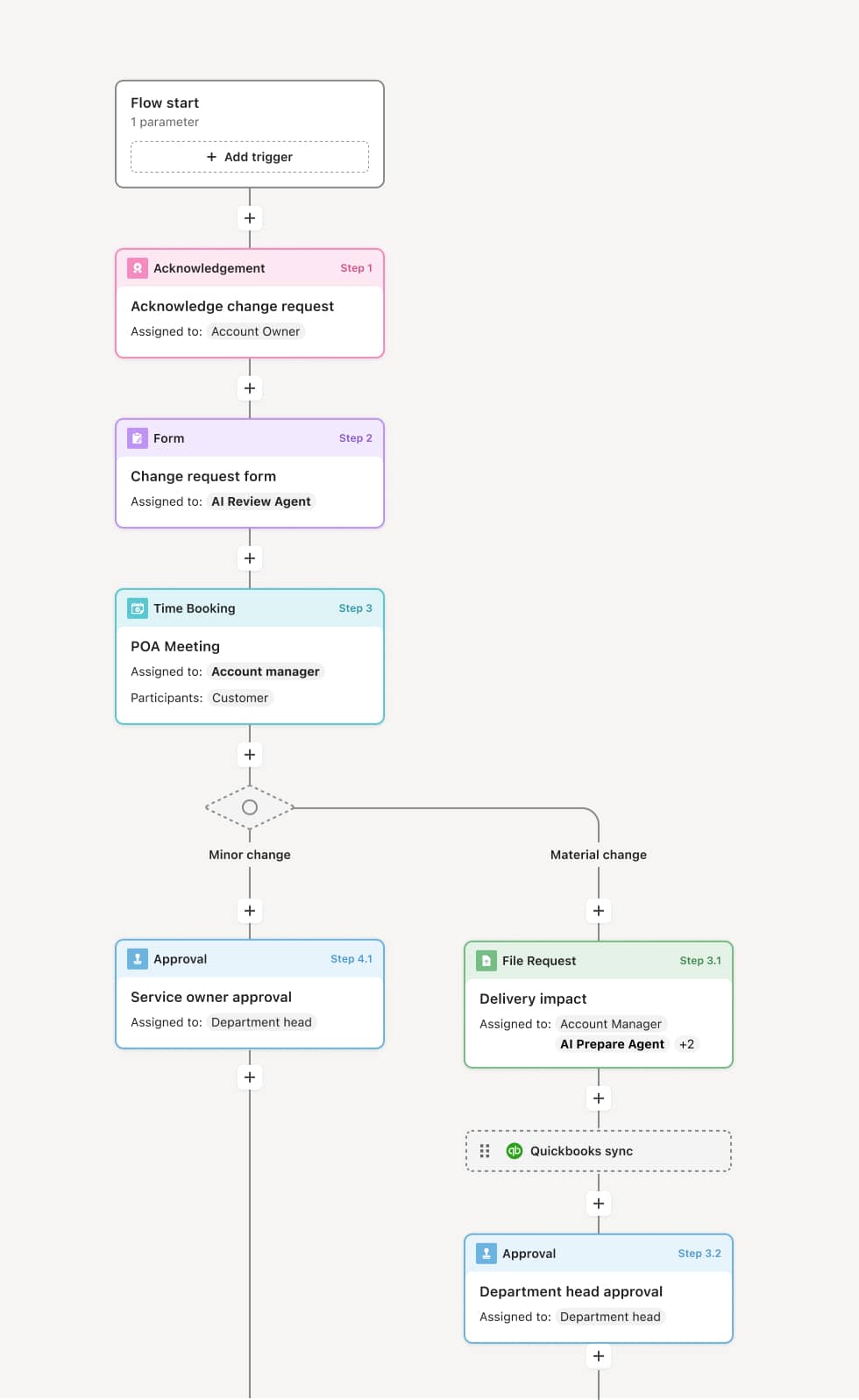
Your version of this process may vary based on roles, systems, data, and approval paths. Moxo’s flow builder can be configured with AI agents, conditional branching, dynamic data references, and sophisticated logic to match how your organization runs this workflow. The steps below illustrate one example.
Leave request and initial documentation
The process begins when an employee submits a leave of absence request, including the reason for leave, anticipated duration, and any available supporting documentation such as a medical certification or military orders. An AI Agent may validate that the request includes all required information and flag the applicable leave category based on the stated reason.
Eligibility determination
HR evaluates the employee’s eligibility for the requested leave type based on tenure, hours worked, prior leave usage, and the applicable regulatory framework. This includes determining whether the leave qualifies under FMLA, ADA, state leave laws, or organizational policy. If the employee is not eligible under the requested category, HR communicates the determination and explores alternative options. The AI Agent may compile the employee’s leave history and eligibility data from connected HRIS systems.
Medical certification and documentation review
For medical leaves, HR or the disability coordinator reviews the medical certification for completeness and sufficiency. If the certification is incomplete or unclear, a request for additional information is sent to the healthcare provider. The workflow tracks documentation status and deadlines for certification submission.
Operational impact assessment and coverage planning
The employee’s manager assesses the operational impact of the absence and develops a coverage plan. This may include redistributing responsibilities, arranging temporary coverage, or adjusting project timelines. For extended leaves, the coverage plan may require department head approval.
Benefits and accommodation decisions
The benefits team determines the employee’s benefits continuation options, including health insurance, retirement contributions, and any required cost-sharing during the leave. If the leave involves an accommodation request, HR and legal evaluate the request and determine appropriate accommodations consistent with organizational policy and legal requirements.
Leave approval and terms communication
Once all evaluations are complete, the leave is formally approved and the terms are communicated to the employee. This includes the approved duration, benefits continuation details, job protection status, any conditions for extending the leave, and the expected return date. The employee acknowledges the terms within the workflow.
Return-to-work planning and closure
As the approved return date approaches, the workflow initiates return-to-work planning. For medical leaves, this may include requesting a fitness-for-duty certification. The manager prepares for the employee’s reintegration, and HR confirms that all documentation is complete. Upon return, the leave record is closed and the complete file—including the request, eligibility determination, medical certifications, approval terms, and return documentation—is stored for compliance and audit purposes.
This process commonly relies on inputs such as leave requests, medical certifications, military orders, FMLA eligibility data, benefits enrollment records, and prior leave history. It may be triggered by an employee’s formal request, a manager notification, or a qualifying event. Systems commonly connected include HRIS platforms like Workday or ADP for employee data, eligibility, and leave tracking, benefits administration platforms for coverage details, and document management systems for certification storage.
Key decision points include whether the employee is eligible for the requested leave category, whether medical certification is sufficient and complete, what benefits continuation terms apply during the leave, whether accommodations are required and what form they should take, and when and under what conditions the employee is expected to return. If the leave is not approved under the requested category, the workflow routes to alternative evaluation paths.
Eligibility determinations made without complete employee data, leading to incorrect approvals or denials. Medical certification deadlines not tracked, causing leave to default to unapproved status. Benefits continuation terms not communicated clearly, resulting in employee confusion and coverage gaps. Return-to-work planning initiated too late, creating operational disruption when the employee returns. Leave documentation not centralized, making it difficult to demonstrate compliance during audits or legal proceedings.
AI Agents validate leave request completeness and flag the applicable leave category based on the stated reason and employee data from connected HRIS systems.
Orchestrates eligibility review, documentation collection, and operational planning across HR, benefits, legal, and management within a single workflow.
Tracks medical certification deadlines and documentation status, alerting HR when certifications are due, incomplete, or expired.
Communicates approved leave terms directly to the employee within the workflow, with acknowledgment tracking to confirm the employee received and understood the terms.
Initiates return-to-work planning proactively as the approved return date approaches, connecting to HRIS systems for reactivation and manager preparation.