General counsel
Legal operations manager
Contracts manager
Compliance officer
Business development lead
VP of operations

This process is used when a business action requires legal review before the organization can proceed. It is triggered when a contract, agreement, or commitment is being finalized, when a public statement or regulatory filing requires legal sign-off, when a new vendor, partner, or customer relationship involves non-standard terms, or when organizational policy mandates legal review for specific categories of actions. It applies when the legal risk, liability exposure, or regulatory implications of the action require counsel’s evaluation and authorization. This process is common in organizations of all sizes where legal review is required for contracts, partnerships, regulatory submissions, intellectual property matters, and significant business commitments.
The legal approval process typically involves the business requestor who submits the action for legal review, legal operations staff who triage and prioritize incoming requests, legal counsel who reviews the substance and provides the legal assessment, compliance officers who evaluate regulatory implications when applicable, and senior legal leadership who authorize high-risk or high-value matters that exceed standard counsel authority.
Reduced legal risk because every binding action is reviewed for liability, compliance, and contractual soundness before execution. Faster legal turnaround by delivering complete, well-organized review requests rather than requiring counsel to chase context. Consistent legal standards applied across all business units with clear review criteria and documented approvals. Fewer post-execution disputes because legal issues are identified and addressed before the organization is committed. Clear authorization records that document what was reviewed, what risks were identified, and what counsel authorized.
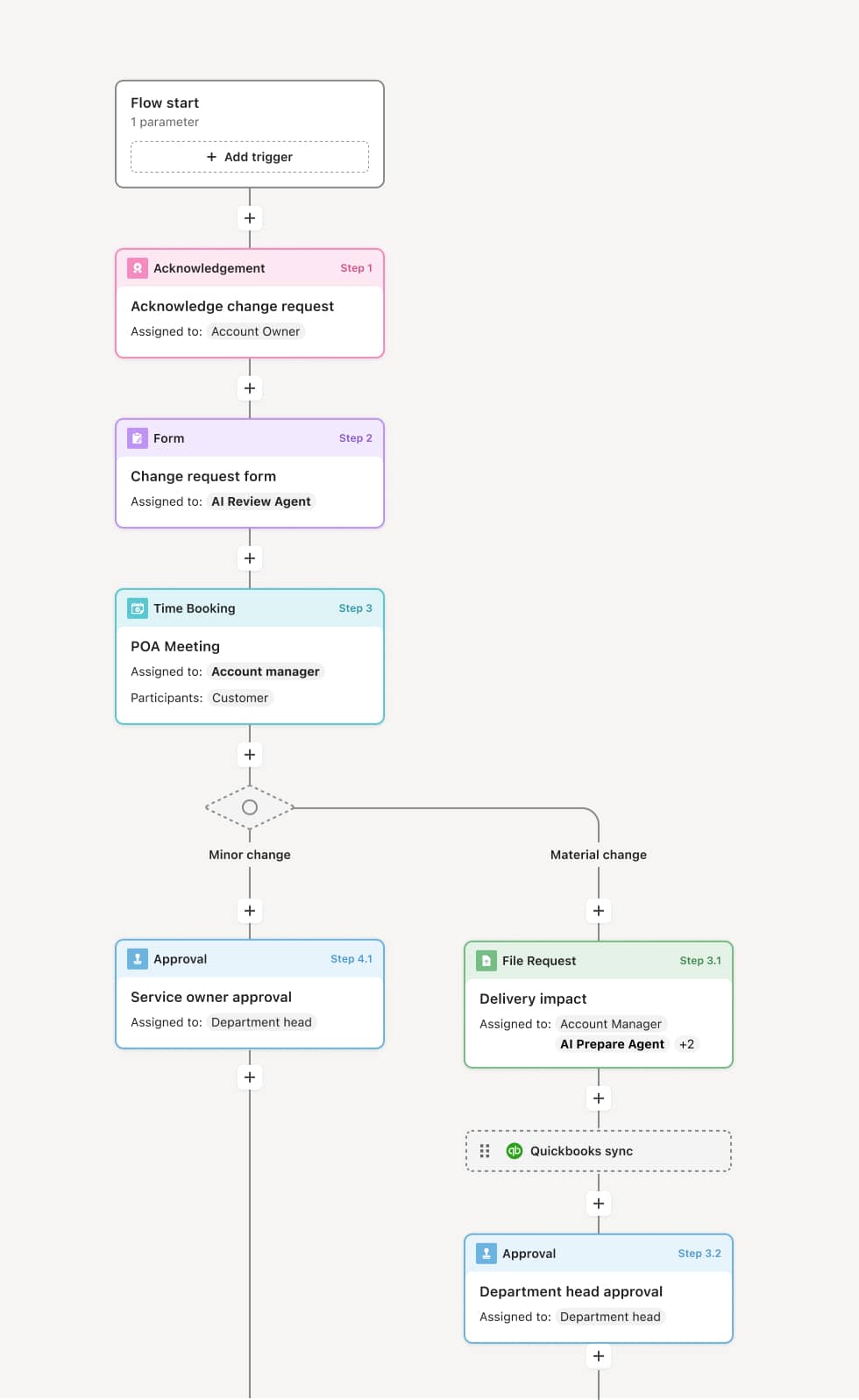
Your version of this process may vary based on roles, systems, data, and approval paths. Moxo’s flow builder can be configured with AI agents, conditional branching, dynamic data references, and sophisticated logic to match how your organization runs this workflow. The steps below illustrate one example.
Review request submission
The process begins when a business team member submits a request for legal review, including the document or action requiring review, the business context, any deadlines, and the specific questions or concerns they want counsel to address. An AI Agent may validate that the submission is complete and includes all required supporting materials before routing it to the legal team.
Triage and prioritization
Legal operations reviews the incoming request to assess complexity, urgency, and the appropriate counsel assignment. Simple matters such as standard contract reviews may be assigned to a junior attorney or handled through template-based guidance. Complex matters involving significant risk, non-standard terms, or regulatory implications are assigned to senior counsel. The AI Agent may categorize the request and suggest priority based on the matter type and deadline.
Legal review and risk assessment
Counsel reviews the submitted materials, evaluates the legal implications, and assesses the risk to the organization. This includes reviewing contract terms, regulatory compliance, liability exposure, intellectual property considerations, and any precedent implications. If counsel identifies issues, they document specific concerns and recommended modifications. The AI Agent may flag clauses that deviate from organizational standard terms or highlight provisions that have been flagged in prior reviews.
Feedback and revision coordination
If modifications are needed, counsel’s feedback is communicated to the business requestor with specific recommendations. The requestor works with the counterparty or internal team to address the issues, and the revised materials are resubmitted for counsel’s review. The workflow supports iterative review cycles until counsel is satisfied that the legal risk is acceptable.
Legal authorization
Once counsel determines that the action meets legal standards and the risk is acceptable, they provide formal legal approval. For high-risk or high-value matters, the approval may require sign-off from senior legal leadership. The authorization is documented with any conditions, caveats, or ongoing monitoring requirements.
Execution and record closure
Upon legal approval, the business action proceeds to execution. The complete legal review record—including the original request, all review feedback, revision history, risk assessment, and authorization—is stored in the organization’s legal matter management system for future reference, audit, and precedent tracking.
This process commonly relies on inputs such as draft contracts, agreements, public statements, regulatory filings, partnership proposals, and vendor terms. It may be triggered by a form submission from a business team, a contract management system workflow, or a policy-mandated review requirement. Systems commonly connected include contract lifecycle management platforms, matter management systems for legal tracking, CRM tools like Salesforce for deal context, and compliance platforms for regulatory reference.
Key decision points include whether the submitted action requires legal review based on organizational policy, what priority and complexity level the matter warrants, whether the legal risk is acceptable as-is or requires modification, whether the matter requires senior legal leadership authorization, and whether any conditions or ongoing monitoring obligations are attached to the approval.
Review requests submitted without complete context, forcing counsel to spend time gathering information rather than providing legal analysis. Legal review not prioritized effectively, causing routine matters to delay critical business actions. Counsel feedback not clearly communicated, leading to revisions that do not address the actual legal concern. Legal approval given verbally or via email, leaving no documented record of what was authorized and under what conditions. Business actions proceeding before legal review is complete, exposing the organization to unreviewed legal risk.
AI Agents validate review request completeness and categorize matters by type and priority before routing to the legal team, reducing triage overhead.
Routes matters to the appropriate counsel based on complexity, subject matter, and urgency, ensuring the right expertise is engaged.
Supports iterative review and revision cycles with complete version tracking, so counsel can see exactly what changed between rounds.
Flags non-standard clauses and provisions that have been identified as risk areas in prior reviews, accelerating counsel’s analysis.
Maintains a complete legal review record for every approved action, supporting matter management, precedent tracking, and organizational audit.