IT operations manager
Change manager
Release manager
Business operations director
Infrastructure lead
VP of engineering

This process is used when a planned maintenance activity requires system downtime, reduced service availability, or operational disruption that must be authorized before it can proceed. It is triggered when an infrastructure change, software deployment, database migration, or system upgrade is scheduled, when the maintenance window affects production systems or customer-facing services, or when organizational change management policies require formal approval for planned outages. It applies when multiple stakeholders must agree on the timing, scope, and risk mitigation approach before the maintenance can execute. This process is common in technology operations, financial services, healthcare, telecommunications, and any organization where system availability directly affects business operations and customer experience.
The maintenance window approval process typically involves IT operations or infrastructure teams who propose and plan the maintenance activity, engineering teams who prepare and validate the change, change managers who coordinate the approval process and assess risk, business operations leaders who evaluate the impact on business processes and customers, and senior IT or operations leaders who provide final authorization for high-risk or extended maintenance windows.
Minimized business disruption because maintenance timing is evaluated against business impact before approval. Coordinated stakeholder awareness with all affected teams and customers notified before the maintenance begins. Reduced maintenance risk through verified rollback plans and readiness checks completed before execution. Consistent change governance with every maintenance window evaluated against the same criteria and approval standards. Faster post-maintenance recovery because monitoring and validation procedures are defined before the window opens.
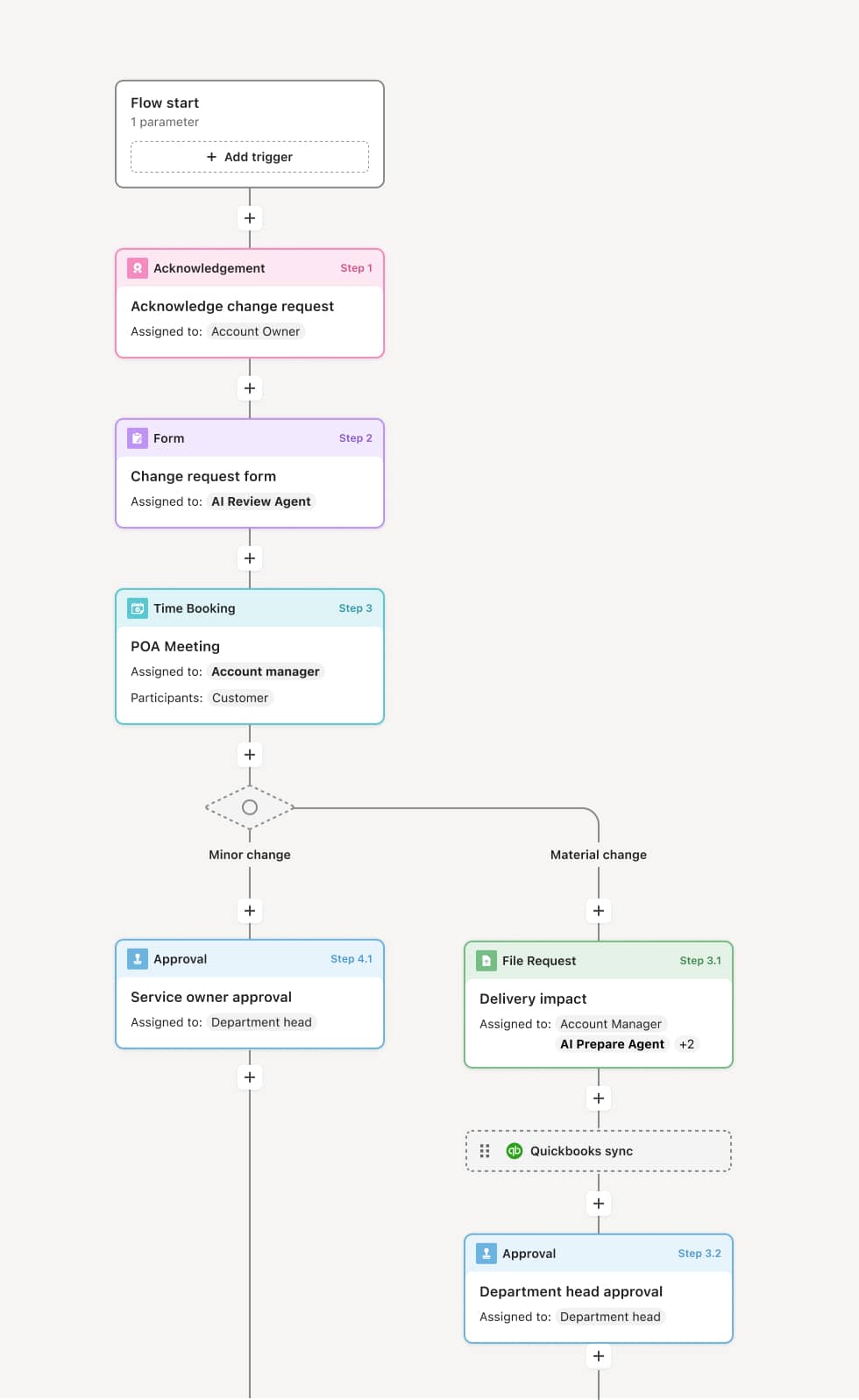
Your version of this process may vary based on roles, systems, data, and approval paths. Moxo’s flow builder can be configured with AI agents, conditional branching, dynamic data references, and sophisticated logic to match how your organization runs this workflow. The steps below illustrate one example.
Maintenance request and impact assessment
The process begins when the IT operations or infrastructure team submits a maintenance request that includes the proposed date and time, expected duration, affected systems and services, the nature of the change, and the business justification. An AI Agent may assist by identifying affected downstream services, pulling recent incident history for the targeted systems, and flagging scheduling conflicts with other planned activities or business-critical periods.
Technical readiness review
The engineering team confirms that the change has been tested, that the implementation plan is complete, and that rollback procedures are validated. This includes verifying that backups are current, that the change has been tested in a non-production environment, and that the team has the resources and expertise to execute the change within the proposed window. The AI Agent may check that all prerequisite testing and documentation milestones are complete.
Business impact evaluation
Business operations leaders evaluate the proposed timing against business requirements, including transaction volumes, customer-facing commitments, reporting cycles, and any other operational considerations. If the proposed window conflicts with business-critical activities, the business team may request an alternative time or additional risk mitigation measures.
Stakeholder notification and acknowledgment
Once the timing and scope are confirmed, all affected stakeholders—including internal teams, customers, and partners—are notified of the planned maintenance. The notification includes the timing, expected impact, and any actions stakeholders should take. The workflow tracks acknowledgments to confirm that all required parties have been informed.
Change approval
The maintenance request, along with technical readiness confirmation, business impact assessment, and stakeholder acknowledgments, is routed to the change manager or senior IT leader for formal approval. The approver evaluates the consolidated readiness and either authorizes the maintenance, requests modifications, or defers the activity. For high-risk or extended maintenance windows, additional executive authorization may be required.
Execution, monitoring, and closure
Upon approval, the maintenance proceeds during the authorized window. The team monitors the change execution and validates that systems return to normal operation. If issues arise, the rollback plan is executed. After the window closes, the maintenance is confirmed complete, stakeholders are notified of the outcome, and the complete record—including the request, approvals, execution notes, and validation results—is stored for change management reporting and audit.
This process commonly relies on inputs such as maintenance requests, change implementation plans, rollback procedures, system dependency maps, business calendars, and stakeholder notification lists. It may be triggered by a change request from the IT team, a scheduled release cycle, or an infrastructure maintenance calendar. Systems commonly connected include ITSM platforms like ServiceNow for change management, monitoring tools for system health and dependency data, and communication platforms for stakeholder notifications.
Key decision points include whether the proposed timing minimizes business impact, whether the technical team has confirmed readiness and validated rollback procedures, whether all affected stakeholders have been notified and have acknowledged the planned outage, and whether the risk level of the maintenance requires standard or elevated approval authority. If the change fails during execution, the rollback decision follows pre-defined criteria documented in the maintenance plan.
Maintenance scheduled without assessing business impact, causing unexpected disruption during critical operations. Rollback procedures not validated before execution, leaving the team without a recovery path if the change fails. Stakeholders not notified, leading to support escalations and customer complaints during the outage. Technical readiness not confirmed, resulting in the change extending beyond the approved window. Post-maintenance validation skipped, allowing undetected issues to affect operations after the window closes.
AI Agents identify affected systems and downstream services at submission, giving business teams a clear view of the maintenance’s operational impact.
Orchestrates parallel technical readiness, business impact, and stakeholder notification steps so the approval process completes within the pre-maintenance timeline.
Tracks stakeholder acknowledgments within the workflow, confirming that all required parties have been informed before the maintenance proceeds.
Routes maintenance approvals to the correct authority level based on risk, duration, and the systems affected, ensuring high-risk changes receive appropriate governance.
Connects to ITSM platforms like ServiceNow for change management tracking and post-maintenance reporting, maintaining a complete record from request through closure.