Manufacturing operations manager
Quality assurance lead
Production supervisor
Process engineer
Plant manager
EHS coordinator

This process is used when a new work instruction is created or an existing instruction is revised due to engineering changes, quality issues, corrective actions, or regulatory updates. It applies when changes affect materials, tooling, sequencing, or safety requirements and must be validated before production resumes. It is common when multiple departments such as engineering, quality, and production must coordinate sign-off. Ideal for manufacturing, automotive, aerospace, food production, and pharmaceutical industries where procedural accuracy directly impacts product quality and compliance.
Process engineers or technical writers typically draft or revise work instructions and submit them for review. Quality assurance leads validate that instructions meet quality standards and regulatory requirements. Safety or EHS coordinators review for environmental, health, and safety compliance. Production supervisors confirm that instructions are practical and implementable on the floor. Plant managers or operations directors provide final authorization before release.
Reduced instruction release delays by routing reviews in parallel across engineering, quality, and safety teams rather than sequentially through email chains. Clear version accountability ensuring every released work instruction is traceable to who authored, reviewed, and approved it and when. Fewer production errors caused by outdated or unauthorized procedures reaching the shop floor before proper sign-off is completed. Improved regulatory readiness with a documented approval history that supports audit and compliance requirements without manual record assembly.
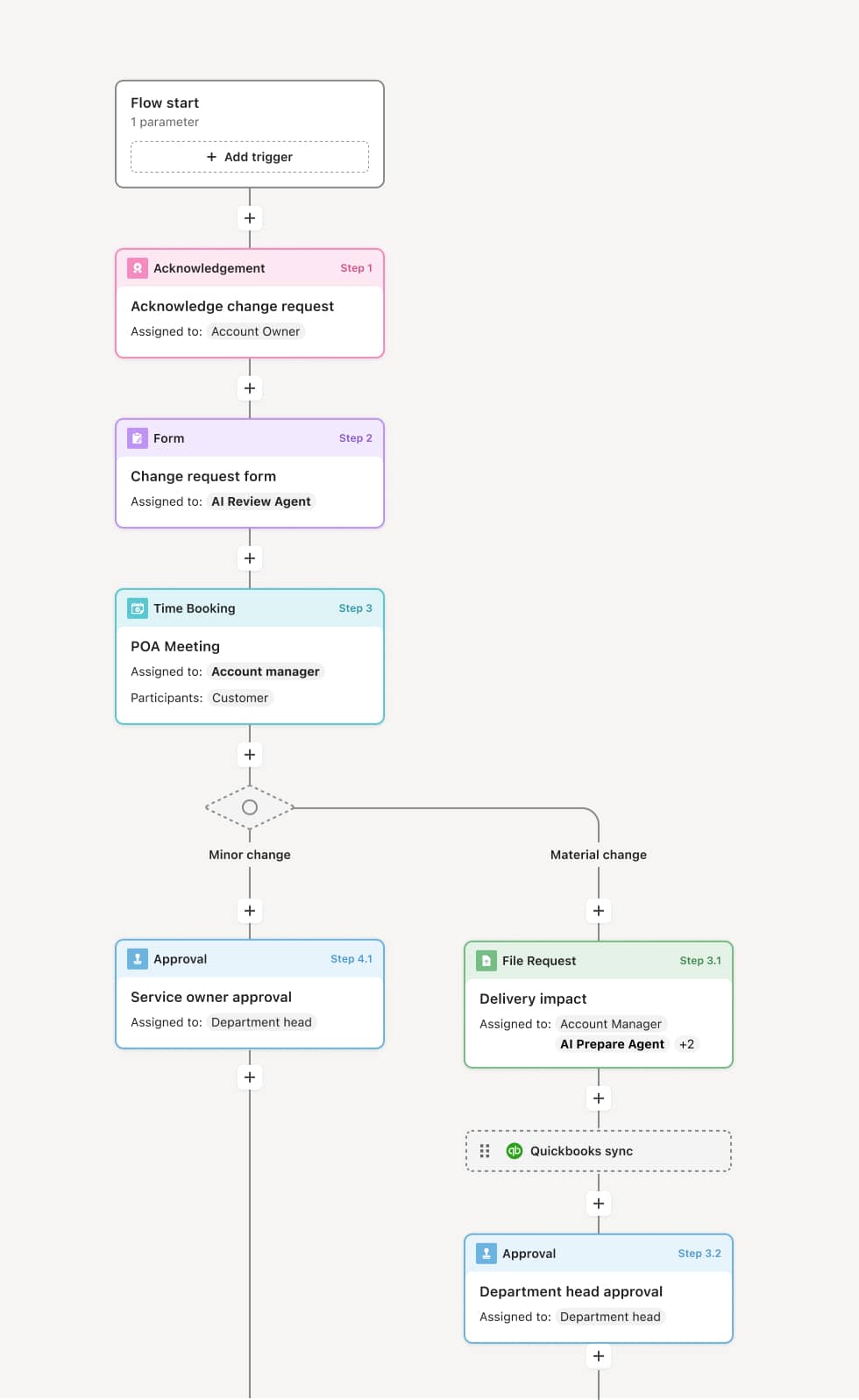
Your version of this process may vary based on roles, systems, data, and approval paths. Moxo’s flow builder can be configured with AI agents, conditional branching, dynamic data references, and sophisticated logic to match how your organization runs this workflow. The steps below illustrate one example.
Instruction draft submission
The process begins when a process engineer or technical writer submits a new or revised work instruction for review. The submission includes the instruction document, a summary of changes, the reason for revision such as an engineering change order, corrective action, or process improvement, and any supporting materials like diagrams or specifications. An AI agent can validate that all required fields and attachments are present before the submission moves forward.
Technical and quality review
Once submitted, the instruction is routed to quality assurance and, if applicable, safety or EHS reviewers. These reviewers evaluate whether the instruction meets quality standards, complies with regulatory requirements, and accurately reflects the intended production process. If the instruction involves changes to materials, tooling, or hazardous procedures, additional specialist review may be triggered. Reviewers may request clarification or revisions, which routes the instruction back to the author with specific feedback.
Production feasibility assessment
In parallel or following quality review, the production supervisor evaluates whether the work instruction is practical and implementable given current equipment, staffing, and floor layout. If adjustments are needed for sequencing, tooling references, or operator instructions, the supervisor flags those items. An AI agent can summarize review feedback from multiple reviewers so the author has consolidated context for revisions.
Revision and resubmission
If any reviewer requests changes, the instruction returns to the author for revision. The updated version is resubmitted with a change summary, and the review cycle repeats for affected reviewers only. The flow supports iterative review loops until all parties confirm the instruction is accurate and complete.
Final authorization and release
Once all reviewers have approved, the instruction moves to the plant manager or operations director for final authorization. Upon approval, the instruction is marked as the active version, and prior versions are archived. Stakeholders including production leads and training coordinators are notified of the release, and the instruction becomes available for shop floor use.
Distribution and acknowledgment
After release, affected operators and supervisors are prompted to acknowledge receipt and review of the new instruction. This ensures that the updated procedure has been communicated to everyone who needs to follow it before production resumes under the new instruction.
This process commonly relies on inputs such as work instruction documents, engineering change orders, corrective action reports, process diagrams, and revision history. It may be triggered by events like an engineering change notification, a quality nonconformance, or a scheduled procedure review. Systems such as an ERP (SAP, Oracle), a document management system, or a quality management system (QMS) are commonly connected to provide version control, change tracking, and compliance documentation.
Key decision points include whether the instruction change is substantive enough to require quality and safety review or can proceed with production sign-off alone, whether reviewer feedback requires revision or is informational, whether the instruction meets regulatory and quality standards for release, and whether additional training or acknowledgment is required before the instruction takes effect on the floor.
Unclear revision scope where reviewers cannot determine what changed from the prior version, slowing review cycles unnecessarily. Parallel review gaps where safety or EHS review is skipped because routing does not account for hazardous material or process changes. Delayed final authorization where instructions sit with a plant manager who lacks context on urgency, holding up production readiness. Missing operator acknowledgment where updated instructions are released but floor personnel continue following outdated procedures because distribution was informal.
Orchestrates cross-functional review across engineering, quality, safety, and production teams within a single workflow, eliminating email-based routing and version confusion.
Routes reviews conditionally based on instruction type, change severity, or affected production areas, ensuring the right reviewers are engaged without manual triage.
AI agents validate submission completeness by checking for required attachments, change summaries, and revision details before review begins, reducing rework caused by incomplete submissions.
Supports iterative revision loops so that rejected or revised instructions return to the author with consolidated feedback and re-enter the review cycle without restarting the entire process.
Tracks acknowledgment from floor personnel ensuring that released instructions are confirmed as received by operators and supervisors before production resumes under updated procedures.
Extends ERP and QMS systems by connecting work instruction approval to existing document management and change control platforms, keeping version histories and compliance records aligned.