Marketing operations manager
Content marketing lead
Brand manager
CMO
Demand generation manager
Creative director

This process is used when a marketing team finalizes its campaign calendar for a quarter, month, or planning cycle and needs cross-functional sign-off before execution begins. It applies when multiple teams, brands, or regions share marketing channels and must coordinate timing to avoid conflicts or audience fatigue. It is triggered at the close of a planning cycle or when significant changes to the approved calendar are proposed mid-cycle. Ideal for organizations with multiple marketing teams, distributed brand management, or environments where campaign timing impacts sales cycles, product launches, or partner activities.
Marketing operations managers or campaign planners typically compile and submit the proposed calendar for review. Brand managers or product marketing leads validate that their initiatives are accurately represented and properly sequenced. Demand generation or content leads confirm resource availability and channel capacity. Creative directors assess production feasibility given the proposed timeline. CMOs or marketing VPs provide final authorization on the consolidated calendar.
Reduced scheduling conflicts by surfacing overlapping campaigns, channel saturation, or resource bottlenecks before commitments are made. Clear calendar ownership with every planned activity traceable to who proposed, reviewed, and approved its placement in the schedule. Faster planning cycles by consolidating calendar review across teams within a single structured process rather than iterating through disconnected meetings and email threads. Improved execution readiness by confirming resource and production capacity before campaigns are locked into the calendar.
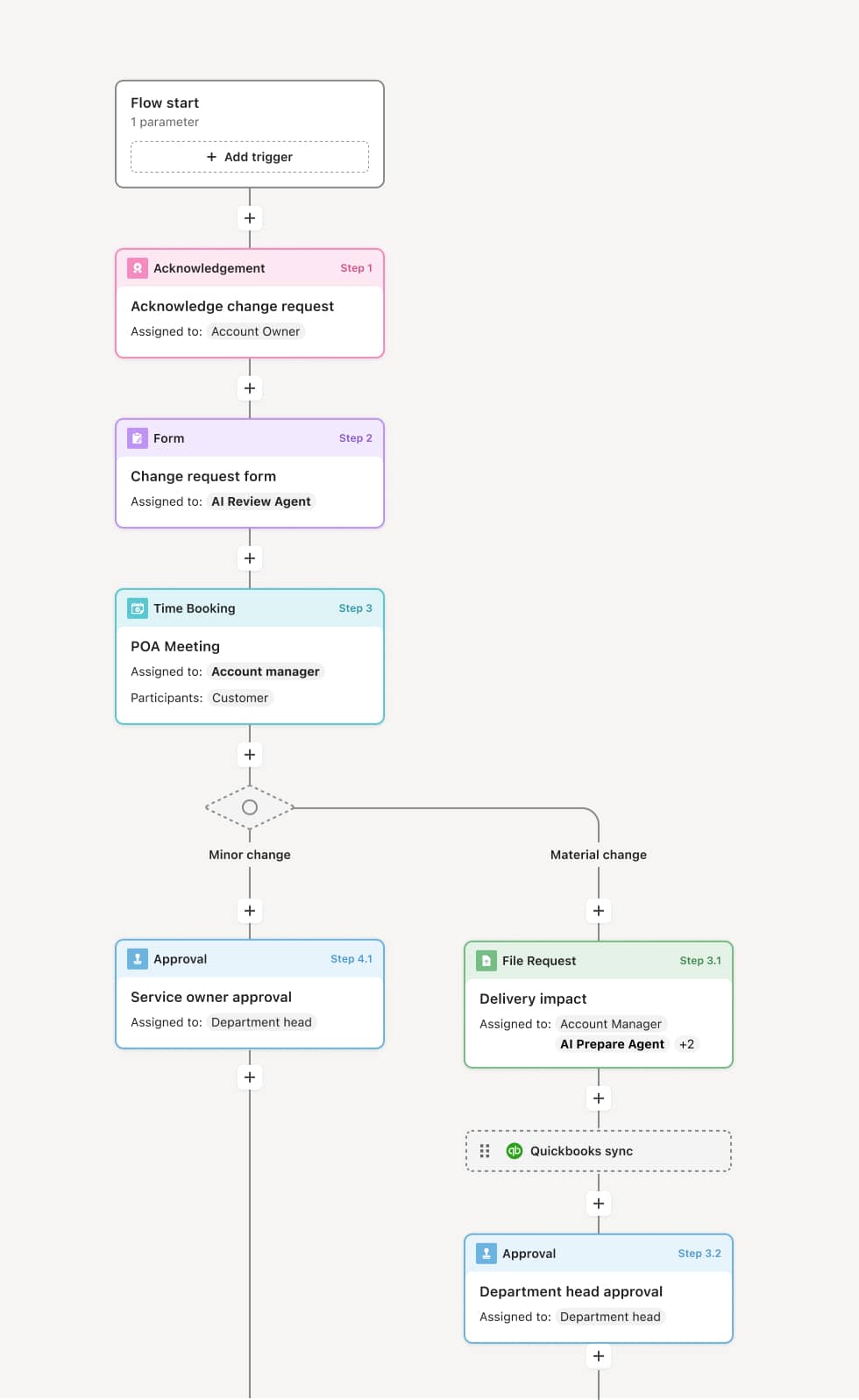
Your version of this process may vary based on roles, systems, data, and approval paths. Moxo’s flow builder can be configured with AI agents, conditional branching, dynamic data references, and sophisticated logic to match how your organization runs this workflow. The steps below illustrate one example.
Calendar compilation and submission
The process begins when marketing operations or the campaign planning team compiles the proposed marketing calendar for the upcoming period. The submission includes campaign names, target dates, channels, responsible teams, and any dependencies on product launches, events, or partner activities. An AI agent can flag potential scheduling conflicts or gaps in required fields before the calendar moves to review.
Team-level review
The proposed calendar is routed to brand managers, product marketing leads, and demand generation managers for validation. Each reviewer confirms that their initiatives are accurately represented, properly sequenced, and do not conflict with other planned activities in their area. If adjustments are needed, reviewers provide feedback on timing, priority, or resource requirements.
Production and resource feasibility review
In parallel, creative directors or production leads review the calendar against available creative resources, agency capacity, and production timelines. If the proposed calendar requires more production capacity than is available, they flag bottlenecks and suggest adjustments. An AI agent can summarize feedback from multiple reviewers so the planning team has a consolidated view of requested changes.
Calendar revision and resubmission
If reviewers request changes, the planning team revises the calendar and resubmits for a focused review of updated items. The flow supports iterative review cycles until all teams confirm alignment. Only affected sections re-enter review, avoiding redundant approvals on unchanged portions.
Leadership authorization
Once team-level reviewers have approved, the consolidated calendar moves to the CMO or marketing VP for final authorization. This review evaluates overall strategic alignment, budget implications, and coordination with broader organizational priorities. Upon authorization, the calendar is locked for the planning period.
Calendar distribution and commitment
After final approval, the authorized calendar is distributed to all stakeholders including execution teams, agencies, sales enablement, and partner marketing. Teams are notified of their committed activities and timelines, and any downstream production or procurement workflows are initiated.
This process commonly relies on inputs such as campaign briefs, content plans, channel availability schedules, production capacity reports, and product launch timelines. It may be triggered by events like a quarterly planning milestone, a mid-cycle calendar change request, or an organizational shift in marketing priorities. Systems such as a marketing operations platform (Asana, Monday, Workfront), a CRM (Salesforce, HubSpot), or a content management system are commonly connected to provide campaign data, scheduling context, and resource visibility.
Key decision points include whether proposed campaign timing conflicts with other planned activities or channel saturation limits, whether production resources can support the proposed calendar within the given timeframe, whether mid-cycle changes are significant enough to require re-approval from leadership, and whether the overall calendar aligns with strategic priorities and budget allocations for the period.
Incomplete submissions where proposed calendars lack key details like target channels or dependencies, requiring multiple rounds of clarification before review can begin. Siloed review where brand or product teams approve their own sections without visibility into the full calendar, leading to undetected conflicts. Production bottlenecks discovered late where creative capacity constraints are identified after leadership has already approved the calendar, forcing last-minute rescoping. Calendar drift where approved activities shift without formal change management, eroding the value of the original approval process.
Orchestrates calendar review across brand, demand generation, creative, and leadership teams within a single workflow, replacing fragmented review across meetings and email.
Routes calendar sections to relevant reviewers based on team, brand, or region, ensuring each reviewer evaluates only the portions that affect them.
AI agents flag scheduling conflicts and submission gaps before review begins, reducing the rounds of clarification needed to start meaningful evaluation.
Supports iterative revision cycles so that only changed calendar items re-enter review, avoiding full re-approval of unchanged activities.
Connects to marketing operations platforms and CRM systems to pull campaign data, channel schedules, and resource availability into the approval context.
Distributes the approved calendar to all execution teams upon final authorization, ensuring committed activities and timelines are communicated without manual follow-up.