Campaign manager
Brand manager
Creative director
Marketing compliance lead
CMO
Legal counsel

This process is used when a marketing team prepares a campaign for launch and needs cross-functional review of creative assets, messaging, legal compliance, and strategic alignment. It applies to campaigns involving paid media, email, social, events, or partner co-marketing that require sign-off from multiple stakeholders before going live. It is triggered when campaign materials are ready for review or when a campaign concept needs authorization before production begins. Ideal for organizations with brand guidelines, legal review requirements, multi-channel campaigns, or environments where campaign errors carry reputational or regulatory risk.
Campaign managers typically submit campaign briefs, creative assets, and launch plans for review. Creative directors evaluate design, messaging, and brand consistency. Brand managers validate alignment with brand guidelines and positioning. Legal or compliance reviewers assess regulatory risk, claims, disclosures, and intellectual property considerations. CMOs or marketing VPs provide final go or no-go authorization on high-profile or high-spend campaigns.
Faster campaign launch cycles by routing creative, brand, legal, and leadership reviews in parallel rather than sequentially through email. Fewer post-launch corrections by catching brand inconsistencies, legal risks, or messaging errors during structured review rather than after the campaign is live. Clear approval accountability with every campaign traceable to who reviewed and authorized each element before launch. Better cross-functional alignment by ensuring all stakeholders review the same campaign materials in context rather than disconnected attachments.
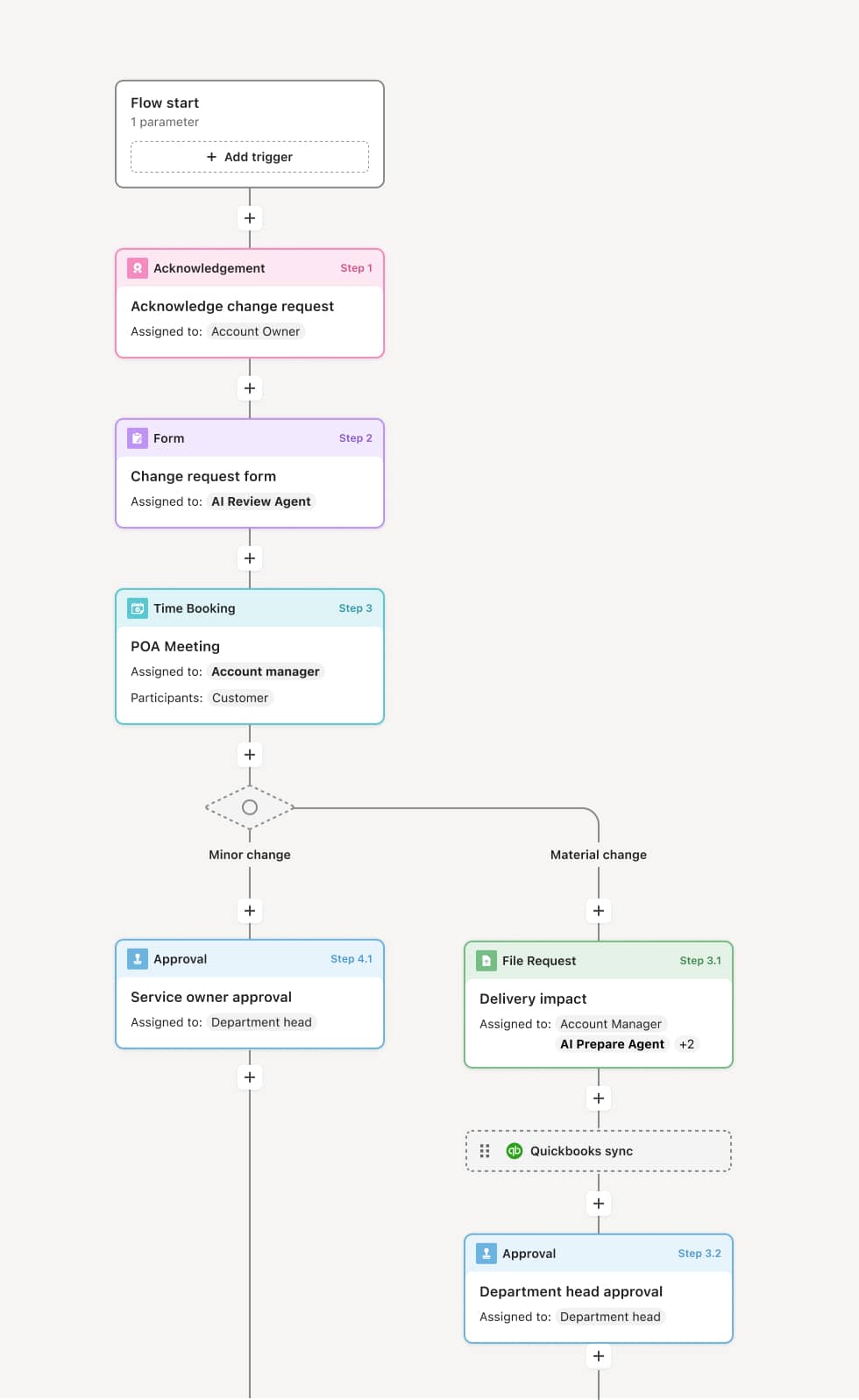
Your version of this process may vary based on roles, systems, data, and approval paths. Moxo’s flow builder can be configured with AI agents, conditional branching, dynamic data references, and sophisticated logic to match how your organization runs this workflow. The steps below illustrate one example.
Campaign brief submission
The process begins when a campaign manager submits the campaign for review. The submission includes the campaign brief, target audience, key messaging, creative assets, channel plan, budget, and timeline. An AI agent can validate that all required elements are present and flag any missing components before the review begins.
Creative and brand review
Creative directors and brand managers review the campaign assets for design quality, messaging clarity, tone, and adherence to brand guidelines. If assets need revision, specific feedback is provided and the campaign returns to the creative team for updates. This review ensures that visual and verbal identity is consistent across all campaign materials.
Legal and compliance review
In parallel, legal counsel or a marketing compliance lead reviews the campaign for regulatory risk, required disclosures, intellectual property concerns, trademark usage, and claims that may require substantiation. If legal issues are identified, the campaign is routed back to the campaign manager with specific required changes. For campaigns in regulated industries, this step may involve additional specialist review.
Revision and resubmission
If any reviewer requests changes, the campaign manager coordinates revisions with the creative team and resubmits updated materials. The flow supports targeted re-review so that only affected reviewers evaluate the changes, avoiding redundant review of approved elements. An AI agent can summarize the revision history and outstanding feedback to help reviewers assess changes efficiently.
Leadership authorization
Once creative, brand, and legal reviews are complete, high-profile or high-spend campaigns move to the CMO or marketing VP for final authorization. This review evaluates overall strategic fit, budget commitment, and timing relative to other organizational priorities. The reviewer may approve, request modifications, or defer the campaign.
Launch confirmation and distribution
Upon final approval, the campaign manager and execution teams are notified. The approved campaign package is distributed to media buyers, email operations, social media teams, or partner marketing contacts as appropriate. Launch proceeds according to the authorized timeline and channel plan.
This process commonly relies on inputs such as campaign briefs, creative assets, copy documents, media plans, legal disclosure checklists, and brand guidelines. It may be triggered by events like a campaign production milestone, a launch date approaching, or a creative review request. Systems such as a digital asset management platform (Bynder, Brandfolder), a project management tool (Asana, Workfront), or a CRM (Salesforce, HubSpot) are commonly connected to provide campaign data, asset files, and approval status tracking.
Key decision points include whether creative assets and messaging meet brand standards and design quality expectations, whether the campaign complies with legal and regulatory requirements including required disclosures, whether revisions adequately address reviewer feedback or require additional rounds of review, and whether the campaign’s strategic alignment and budget justify leadership authorization for launch.
Incomplete creative packages where campaigns are submitted for review without all required assets or channels represented, causing delays while reviewers wait for missing materials. Legal review bottlenecks where compliance review is scheduled sequentially after creative review rather than in parallel, extending the overall approval timeline. Feedback fragmentation where reviewer comments are scattered across email, chat, and markup tools, making it difficult for campaign managers to consolidate and act on all required changes. Last-minute scope changes where campaign elements are modified after approval without re-entering the review cycle, introducing brand or legal risk.
Orchestrates review across creative, brand, legal, and leadership teams within a single workflow, eliminating the fragmented email and markup cycles that typically slow campaign approvals.
Routes reviews in parallel so that brand, creative, and legal evaluation happen concurrently rather than sequentially, compressing the overall approval timeline.
AI agents validate submission completeness and summarize reviewer feedback across rounds, helping campaign managers consolidate changes and reviewers assess revisions efficiently.
Supports targeted re-review so that only modified campaign elements return to affected reviewers, avoiding redundant approval of unchanged assets.
Connects to digital asset management and project management systems to centralize campaign materials and approval status within the workflow.
Notifies execution teams upon final approval including media buyers, email operations, and partner contacts, ensuring launch proceeds without manual handoff coordination.