Master data manager
Data steward
IT operations lead
Data governance analyst
Business systems administrator
Chief data officer

This process is used when a data quality issue, conflict, or governance exception cannot be resolved through standard data management procedures and requires escalation to a more senior owner or cross-functional team. It applies when duplicate records, conflicting data sources, unauthorized changes, or data integrity failures are detected and need coordinated resolution. It is triggered by automated data quality checks, system integration errors, or stakeholder-reported anomalies. Ideal for organizations with complex ERP, CRM, or multi-system environments where master data integrity directly impacts financial reporting, customer operations, and regulatory compliance.
Data stewards or analysts typically identify and initially triage data quality exceptions. Master data managers assess the scope and impact of the issue and determine the appropriate escalation path. IT operations leads investigate technical root causes such as integration failures, sync errors, or system configuration issues. Business systems administrators resolve data conflicts within specific platforms. Chief data officers or data governance committees provide final resolution authority on cross-system or high-impact exceptions.
Faster exception resolution by routing data quality issues directly to the owner with authority and context to resolve them, rather than escalating through generic support channels. Reduced downstream impact by identifying and containing data integrity failures before they propagate across integrated systems. Clear escalation accountability with every data exception traceable to who identified, triaged, investigated, and resolved the issue. Improved data governance maturity by documenting escalation patterns and root causes that inform preventive measures and policy updates.
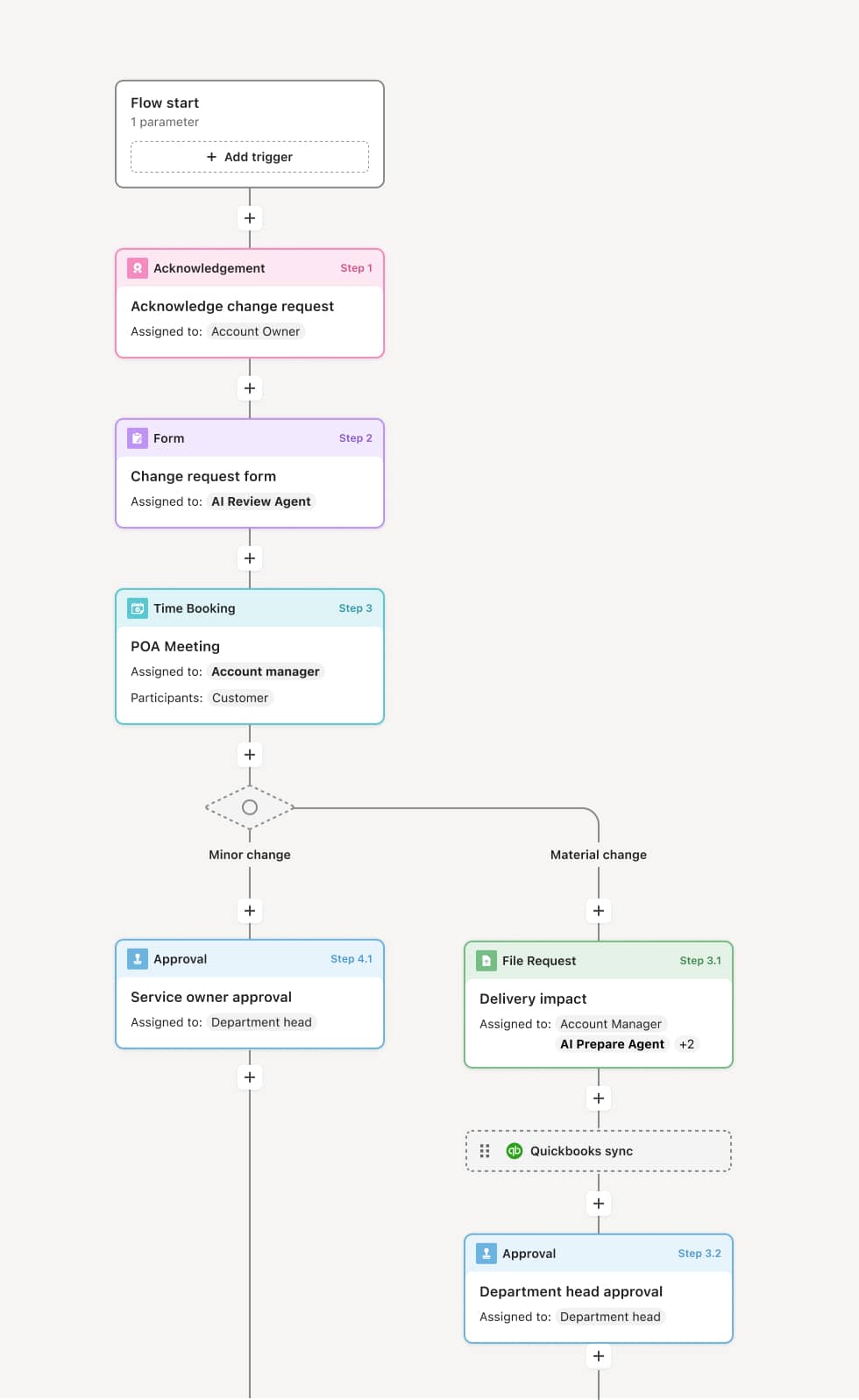
Your version of this process may vary based on roles, systems, data, and approval paths. Moxo’s flow builder can be configured with AI agents, conditional branching, dynamic data references, and sophisticated logic to match how your organization runs this workflow. The steps below illustrate one example.
Exception identification and triage
The process begins when a data quality issue is detected, either through automated data quality monitoring, a system integration error, or a stakeholder report. The data steward or analyst performs initial triage to assess the nature of the issue: whether it involves duplicate records, conflicting values across systems, unauthorized modifications, or missing required data. An AI agent can enrich the exception with contextual information such as which systems and records are affected and the potential downstream impact.
Impact assessment and escalation routing
The master data manager evaluates the severity and scope of the exception. If the issue is isolated to a single record or system, it may be resolved directly by the data steward. If it affects multiple systems, financial data, customer records, or regulatory reporting, the exception is escalated to the appropriate technical or business owner. Routing depends on the data domain (customer, product, vendor, financial) and the nature of the issue (technical, business logic, governance).
Technical investigation
For exceptions rooted in system behavior, the IT operations lead or business systems administrator investigates the technical cause. This may involve reviewing integration logs, sync configurations, or system change histories. If the root cause is a configuration error or integration failure, a fix is proposed and reviewed. An AI agent can compile relevant system data and error logs to accelerate the investigation.
Business resolution and data correction
For exceptions involving business logic, conflicting ownership, or governance policy, the responsible business owner reviews the data and determines the correct resolution. This may involve merging duplicate records, selecting the authoritative data source, updating master records, or creating new governance rules. If the resolution affects multiple stakeholders, their input may be solicited before the correction is applied.
Approval and implementation
Once a resolution is determined, it is reviewed and approved by the master data manager or data governance authority. For high-impact corrections, the chief data officer or a governance committee may provide final authorization. The approved correction is then implemented in the affected systems, and data integrity checks confirm the resolution.
Closure and documentation
After the correction is verified, the exception is closed. A summary of the root cause, resolution, and any recommended preventive actions is documented. Stakeholders affected by the exception are notified of the resolution. Escalation patterns and root cause data are available for governance reporting and continuous improvement.
This process commonly relies on inputs such as data quality exception reports, system integration error logs, duplicate record flags, and stakeholder-reported data anomalies. It may be triggered by events like an automated data quality check failure, a system sync error, or a business user reporting incorrect master data. Systems such as an MDM platform (Informatica, SAP MDG), an ERP (SAP, Oracle, NetSuite), or a CRM (Salesforce) are commonly connected to provide record-level data, integration status, and change audit histories.
Key decision points include whether the exception can be resolved at the data steward level or requires escalation to a technical or business owner, whether the root cause is technical (integration, configuration) or business (governance, ownership, policy), whether the proposed resolution requires governance committee or executive authorization due to scope or impact, and whether the correction needs to be propagated across multiple integrated systems.
Delayed triage where data exceptions sit in a queue without impact assessment, allowing downstream systems to consume and propagate incorrect data. Unclear data ownership where escalated exceptions bounce between IT and business teams because accountability for specific data domains is not defined. Incomplete root cause analysis where corrections address symptoms without resolving the underlying integration or governance issue, leading to recurring exceptions. Missing downstream notification where affected systems and teams are not informed of corrections, causing continued use of stale or incorrect data.
Orchestrates escalation across data stewards, IT operations, and business owners within a single workflow, replacing ad hoc email and ticket-based routing that slows exception resolution.
Routes exceptions conditionally based on data domain, severity, and root cause type, ensuring the right owner is engaged without manual triage.
AI agents enrich exceptions with system context including affected records, integration status, and potential downstream impact, accelerating investigation and decision-making.
Supports iterative investigation and resolution cycles so that exceptions requiring cross-functional input can move between technical and business owners without losing context.
Connects to MDM, ERP, and CRM systems to pull record-level data and integration logs into the escalation workflow, reducing manual data gathering.
Documents root causes and resolutions within the workflow, building a structured knowledge base that supports governance reporting and preventive action planning.