Revenue cycle director
Denial management specialist
Medical billing manager
Coding supervisor
Payer relations coordinator
Chief financial officer

This process is used when a healthcare organization receives a denial from an insurance payer on a submitted claim and must determine whether the denial is valid, correctable, or appealable. It applies when denials result from coding errors, missing documentation, authorization failures, eligibility issues, or payer policy disputes and the claim represents recoverable revenue. It is common when billing, coding, clinical documentation, and payer relations teams must coordinate to prepare and submit appeals within payer-specific deadlines. Ideal for hospitals, physician practices, ambulatory surgery centers, behavioral health providers, and any healthcare organization managing insurance claim revenue.
The denial management process typically involves denial analysts who identify and categorize denials, medical coders who review coding accuracy and make corrections, clinical documentation specialists who gather supporting medical records, billing staff who resubmit corrected claims or prepare appeals, and payer relations coordinators who escalate complex disputes with insurance companies.
Higher denial overturn rates by routing denials to the right specialist with the clinical and billing context needed to build a strong appeal. Faster appeal turnaround because denials are worked within payer filing deadlines rather than discovered after the appeal window has closed. Reduced revenue leakage through systematic identification and resolution of denied claims that represent legitimate, collectible revenue. Root cause visibility that reveals denial patterns tied to specific payers, procedure codes, or documentation gaps, enabling upstream prevention. Lower cost to collect because denials are resolved more efficiently with fewer rework cycles and less manual follow-up.
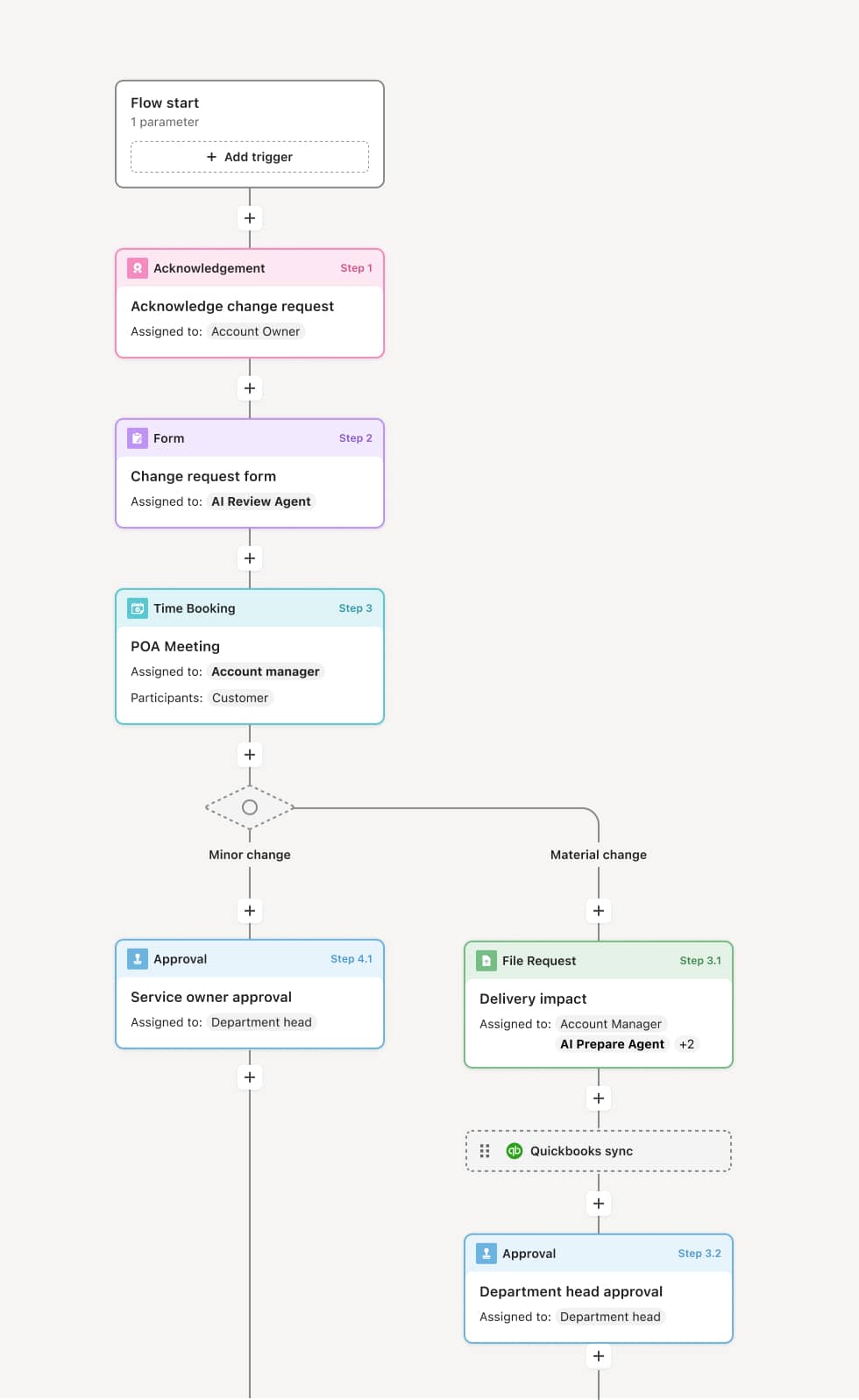
Your version of this process may vary based on roles, systems, data, and approval paths. Moxo’s flow builder can be configured with AI agents, conditional branching, dynamic data references, and sophisticated logic to match how your organization runs this workflow. The steps below illustrate one example.
Denial identification and categorization
The process begins when a denied claim is received from the payer and entered into the denial management workflow. The denial is categorized by type — such as coding error, missing authorization, medical necessity, eligibility, or duplicate claim. An AI Agent can assist by parsing the denial reason code and categorizing the denial to route it to the appropriate specialist.
Root cause investigation
The assigned specialist investigates the denial to determine whether it is valid, correctable, or appealable. For coding-related denials, the coder reviews the original claim against the medical record. For documentation-related denials, the clinical documentation team gathers supporting records. For authorization denials, the team verifies whether prior authorization was obtained and documented. An AI Agent may pull the original claim, medical record excerpts, and authorization records into a single review package.
Corrected claim or appeal preparation
Based on the investigation, the team either corrects and resubmits the claim or prepares a formal appeal. Appeals include a cover letter, supporting clinical documentation, relevant coding references, and any payer policy citations that support the claim. If the denial is determined to be valid and not recoverable, it is written off with documented justification.
Appeal submission
The appeal is submitted to the payer within the required filing deadline through the appropriate channel — electronic portal, fax, or mail. The submission is tracked to confirm receipt. An AI Agent may verify that the appeal package meets the payer’s specific submission requirements before it is sent.
Payer response and resolution tracking
The team monitors for the payer’s response. If the appeal is approved, the payment is posted and reconciled. If the appeal is denied, the team evaluates whether a second-level appeal or external review is warranted. If all appeal options are exhausted, the denial is finalized.
Closure and root cause reporting
The denial is closed with the final resolution documented. Denial patterns are aggregated for root cause analysis, informing improvements to coding practices, documentation standards, authorization workflows, and payer contracting.
This process commonly relies on inputs such as the denied claim record, payer remittance advice, denial reason codes, original medical records, coding documentation, and authorization records. It may be triggered by an electronic remittance, a payer notification, or a billing system denial report. Connected systems often include practice management and billing systems like Epic, Athenahealth, or AdvancedMD, clearinghouses for claim submission, and EHR platforms for clinical documentation.
Key decision points include how the denial is categorized and which specialist should investigate it, whether the denial is valid, correctable through resubmission, or requires a formal appeal, whether the appeal documentation is sufficient to meet the payer’s evidence requirements, and whether a denied appeal warrants escalation to a second-level appeal or external review.
Denials not identified promptly, causing appeal filing deadlines to expire before the claim is worked. Root cause misidentified when the denial is categorized incorrectly and routed to the wrong specialist. Incomplete appeal packages that are rejected by payers because supporting documentation, coding references, or clinical evidence are missing. Payer response not tracked, allowing appeals to go unresolved without follow-up. Denial trends not analyzed, causing the same root causes to generate repeated denials without upstream correction.
Orchestrates denial management from identification through resolution across billing, coding, clinical documentation, and payer relations teams in a single coordinated flow.
Routes denials based on reason code and category so each denial reaches the specialist best equipped to investigate and resolve it.
AI Agents categorize denials and assemble review packages by pulling the original claim, denial reason, medical records, and authorization data into a single workspace.
Tracks appeal filing deadlines and alerts the team when payer-specific submission windows are approaching.
Connects to billing, clearinghouse, and EHR platforms like Epic, Athenahealth, and claims clearinghouses so denial data and clinical records flow into the workflow.
Captures denial resolution and root cause data for every case, enabling pattern analysis that drives improvements to coding, documentation, and authorization processes.