Health information management director
Release of information coordinator
Privacy officer
Compliance manager
Medical records supervisor
Patient access director

This process is used when the organization receives a request to release patient health information — from the patient themselves, another provider for continuity of care, an attorney for legal proceedings, an insurer for claims adjudication, or a public health authority. It applies when the request must be validated for proper authorization, the scope of records must be determined, and sensitive information categories such as mental health, substance abuse, or HIV records may require additional consent under state or federal law. It is common when HIM staff, privacy officers, and the requesting party must coordinate to fulfill the request within regulatory deadlines. Ideal for hospitals, health systems, physician practices, behavioral health facilities, and any organization managing protected health information.
The medical records request process typically involves release of information (ROI) coordinators who receive and process the request, privacy officers who review authorization validity and scope, HIM staff who locate and compile the requested records, clinicians who may need to review records before release for sensitive content, and the requesting party who receives the fulfilled records.
Timely records fulfillment by routing requests through a structured workflow that meets HIPAA’s 30-day response requirement and any applicable state deadlines. HIPAA-compliant authorization validation so every release is backed by a properly executed authorization or qualifies under a permitted disclosure. Accurate scope determination that ensures only the records authorized for release are compiled and sent, preventing over-disclosure. Secure delivery of records through compliant channels, with documentation of what was sent, when, and to whom. Complete release tracking that supports audit, complaint investigation, and HIPAA accounting of disclosures requirements.
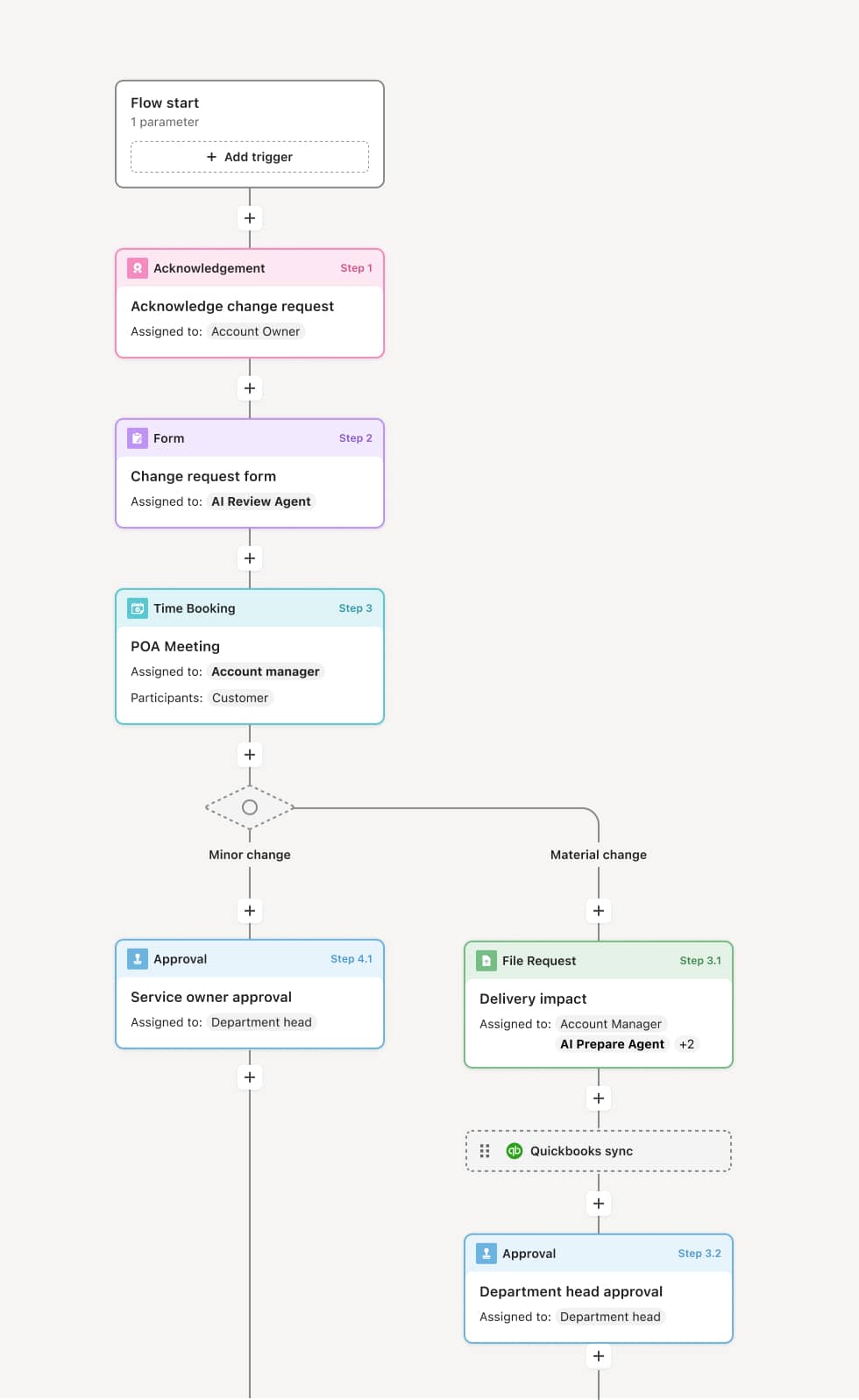
Your version of this process may vary based on roles, systems, data, and approval paths. Moxo’s flow builder can be configured with AI agents, conditional branching, dynamic data references, and sophisticated logic to match how your organization runs this workflow. The steps below illustrate one example.
Request receipt and logging
The process begins when a records request is received — via mail, fax, patient portal, or in person. The request is logged with the requester’s identity, relationship to the patient, the specific records requested, the purpose of the disclosure, and the authorization form. An AI Agent can assist by extracting key data elements from the request and flagging incomplete or missing authorization components.
Authorization validation
The ROI coordinator or privacy officer reviews the authorization for HIPAA compliance: confirming patient identity, verifying the authorization is signed and dated, checking that it has not expired or been revoked, and confirming the scope of authorized records. If the request qualifies under a HIPAA-permitted disclosure (such as treatment, payment, or healthcare operations), the applicable exception is documented. If the authorization is deficient, the requester is contacted for correction.
Scope determination and sensitive content review
The HIM team determines which records fall within the authorized scope and locates them in the EHR or archive systems. If the records include categories requiring special handling — such as psychotherapy notes, substance use disorder treatment records, HIV status, or genetic information — additional consent or redaction requirements are assessed. An AI Agent may flag record categories that trigger additional privacy protections based on the content and applicable state law.
Record compilation and quality review
The authorized records are compiled, reviewed for accuracy, and checked for inadvertent inclusion of records outside the authorized scope. If records from multiple sources or systems must be combined, the compilation is verified for completeness and proper patient identification.
Fulfillment and secure delivery
The records are delivered to the requesting party through the authorized channel — secure electronic transmission, encrypted portal, mail, or in-person pickup. The delivery is logged with the date, method, recipient, and content summary.
Accounting of disclosure and record closure
The release is documented in the organization’s accounting of disclosures log as required by HIPAA. The request is closed, and the complete processing record is preserved for audit and compliance purposes.
This process commonly relies on inputs such as the records request form, patient authorization, patient identification, and the EHR or archived records. It may be triggered by a patient request, a provider request for continuity of care, a legal subpoena, or an insurer’s claims request. Connected systems often include EHR platforms like Epic or Cerner for record retrieval, ROI management platforms like Ciox or MRO, and secure file exchange systems for delivery.
Key decision points include whether the authorization meets HIPAA requirements or the request qualifies under a permitted disclosure, whether the records contain sensitive categories requiring additional consent or redaction, whether the compiled records match the authorized scope without over-disclosure, and whether the delivery method meets security and compliance requirements.
Deficient authorizations not identified at intake, causing processing delays when the issue is discovered later. Over-disclosure when records outside the authorized scope are inadvertently included in the release. Sensitive content not identified before release, violating additional state or federal protections for mental health, substance use, or HIV records. Fulfillment deadlines missed when requests are not tracked against regulatory timelines. Accounting of disclosures not maintained, creating compliance gaps during audits or patient complaints.
Orchestrates records requests from intake through fulfillment across ROI coordinators, privacy officers, HIM staff, and requesting parties in a single secure flow.
Validates authorization completeness at intake with AI Agents that flag missing signatures, expired dates, or scope issues before processing begins.
Routes requests involving sensitive content to privacy review for additional consent verification or redaction before release.
Tracks fulfillment against regulatory deadlines so every request is completed within HIPAA and state-mandated timeframes.
Connects to EHR and ROI platforms like Epic, Cerner, and Ciox so records are located and compiled within the workflow.
Preserves the complete release record including authorization, scope determination, delivery confirmation, and accounting of disclosure for audit and compliance.