General counsel
Contracts manager
VP of business development
Finance director
Chief revenue officer
Procurement lead

This process is used when a new master service agreement is being established with a client, vendor, or partner and requires cross-functional review before execution. It applies when the agreement involves significant commercial commitments, liability provisions, intellectual property terms, or service level obligations that require legal, financial, and business evaluation. It is triggered by a deal reaching the contract stage, a vendor relationship being formalized, or a partnership requiring a governing agreement. Ideal for professional services, technology, consulting, managed services, and any environment where MSAs establish the foundation for ongoing commercial relationships.
Business development or sales leads typically initiate the MSA process by submitting the draft agreement or requesting standard terms. Contracts managers coordinate the review cycle and track redline iterations. Legal counsel reviews liability, indemnification, IP, termination, and governing law provisions. Finance directors evaluate payment terms, pricing structures, and financial risk. Chief revenue officers or executive sponsors authorize agreements that deviate from standard terms or involve significant commitments.
Reduced MSA cycle time by routing legal, finance, and business reviews in parallel and consolidating redline feedback within a single process. Clear negotiation accountability with every redline, comment, and approval traceable to the responsible reviewer and decision point. Fewer deal delays caused by MSAs stalling between legal and business teams without visibility into outstanding issues or required actions. Stronger risk management by ensuring every non-standard term receives appropriate legal and financial review before execution.
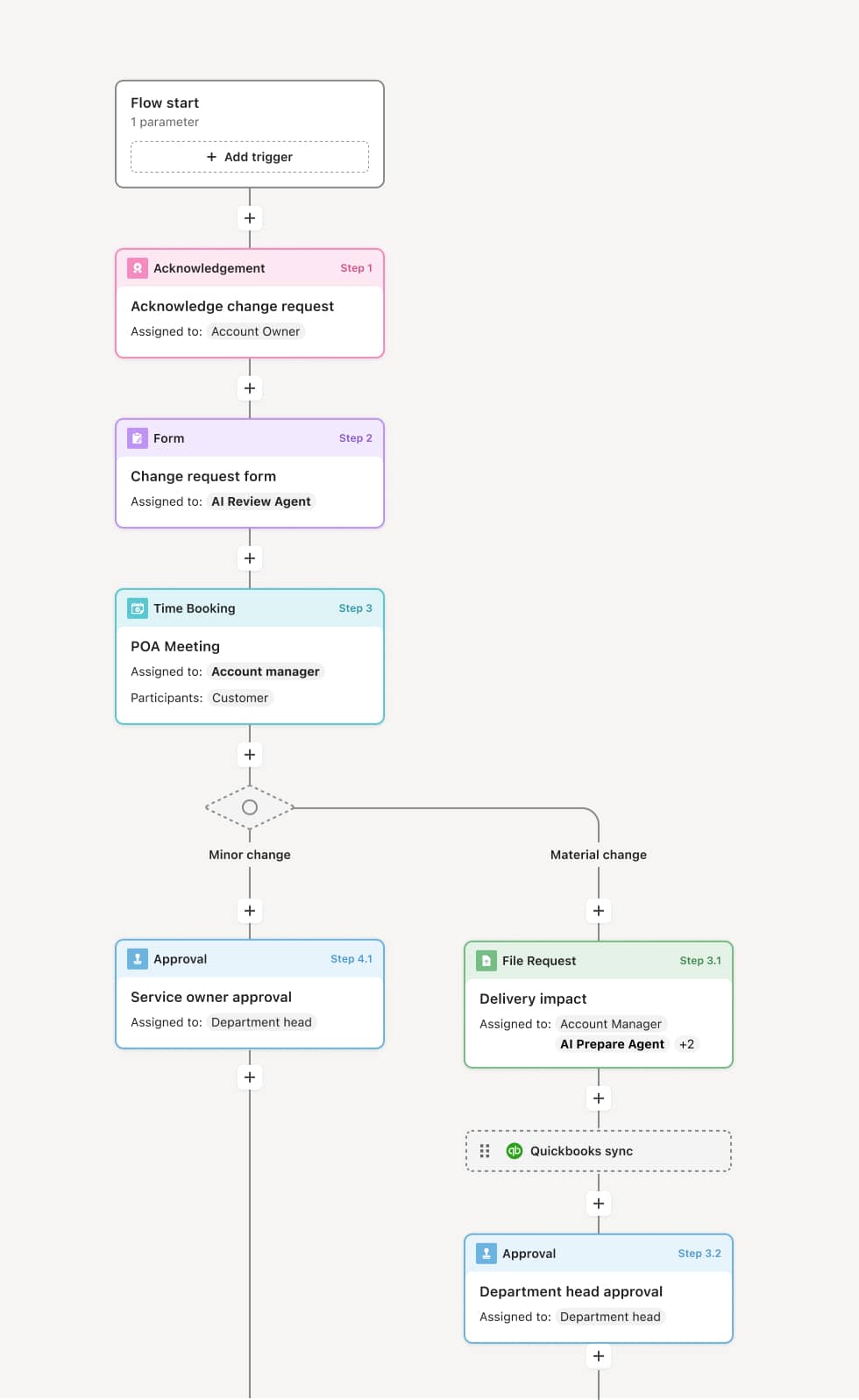
Your version of this process may vary based on roles, systems, data, and approval paths. Moxo’s flow builder can be configured with AI agents, conditional branching, dynamic data references, and sophisticated logic to match how your organization runs this workflow. The steps below illustrate one example.
MSA initiation and draft submission
The process begins when a business development lead or sales team submits a request for an MSA, either using the organization’s standard template or providing a counterparty’s draft agreement for review. The submission includes key deal context such as the scope of services, estimated contract value, counterparty details, and any known non-standard requirements. An AI agent can validate that the submission includes all required context and flag any terms that deviate from standard provisions.
Legal review and redlining
Legal counsel reviews the agreement for risk, compliance, and enforceability. This includes evaluating liability and indemnification provisions, intellectual property ownership and licensing terms, confidentiality and data protection obligations, termination and renewal conditions, and governing law and dispute resolution. Legal produces redlines and comments where terms require modification. If the counterparty has submitted their own draft, legal compares it to standard positions and identifies areas requiring negotiation.
Financial and commercial review
In parallel, the finance director reviews payment terms, pricing structures, revenue recognition implications, and any financial commitments or guarantees. The business development lead evaluates commercial terms for alignment with deal strategy and customer relationship objectives. If financial or commercial terms require adjustment, feedback is consolidated with legal redlines.
Negotiation coordination
If redlines are required, the contracts manager coordinates the exchange of marked-up drafts with the counterparty. Each round of negotiation feedback is routed back through legal and, if necessary, finance for evaluation. An AI agent can summarize the redline history and outstanding open issues to help reviewers focus on remaining points of negotiation rather than re-reading entire agreements.
Escalation for non-standard terms
If the negotiation results in terms that deviate from approved standards, such as uncapped liability, non-standard IP provisions, or extended payment terms, the agreement escalates to the chief revenue officer or executive sponsor for authorization. This reviewer evaluates whether the business value of the deal justifies the additional risk.
Final approval and execution
Once all reviewers have approved the final agreement, the MSA moves to execution. Signatures are collected from authorized signatories on both sides. Upon execution, the contracts manager files the agreement, notifies relevant teams, and initiates any downstream onboarding, implementation, or service delivery workflows.
This process commonly relies on inputs such as MSA drafts or templates, deal context briefs, counterparty information, redline documents, and standard terms playbooks. It may be triggered by events like a deal advancing to the contract stage, a vendor engagement requiring formalization, or a partner requesting a governing agreement. Systems such as a CLM platform (Ironclad, DocuSign CLM), a CRM (Salesforce), or an ERP (NetSuite) are commonly connected to provide deal data, contract templates, and execution tracking.
Key decision points include whether the counterparty’s draft requires full legal review or minor modifications to standard terms, whether redlined provisions are acceptable, require further negotiation, or represent deal-breakers, whether non-standard terms such as liability caps, IP provisions, or payment terms require executive authorization, and whether the final agreement has received all required approvals before signatures are collected.
Redline fragmentation where legal, finance, and business feedback is delivered in separate documents or channels, making it difficult for the contracts manager to produce a consolidated redline for the counterparty. Negotiation stalls where outstanding issues are not clearly tracked, causing rounds of negotiation to revisit previously resolved terms. Escalation delays where non-standard terms are not flagged early, resulting in late-stage executive review that extends the deal timeline. Execution gaps where fully approved MSAs are not signed promptly because signature coordination happens outside the approval workflow.
Orchestrates MSA review across legal, finance, and business teams within a single workflow, replacing the fragmented redline cycles and email threads that typically extend agreement timelines.
Routes reviews in parallel so that legal, financial, and commercial evaluation happen concurrently rather than sequentially, compressing the overall approval cycle.
AI agents flag non-standard terms and summarize redline history to help reviewers focus on outstanding negotiation points rather than re-reading entire agreements each round.
Supports iterative negotiation cycles with structured feedback routing between internal teams and counterparties, maintaining a clear record of each redline iteration.
Escalates non-standard terms automatically to executive sponsors when deviations from approved positions are identified, ensuring timely authorization without manual triage.
Connects to CLM and CRM systems to pull deal context, contract templates, and execution tracking into the approval workflow, reducing manual data entry and ensuring agreement records are synchronized.