Operations director
Program manager
Contracts administrator
Compliance officer
VP of partnerships
Project lead

This process is used when a decision, commitment, or document requires formal approval from multiple independent parties who may have different review criteria, authority levels, and organizational affiliations. It applies when approvals must come from both internal departments and external stakeholders such as clients, partners, or regulators. It is triggered by high-value commitments, cross-organizational agreements, joint ventures, regulatory submissions, or any action where no single party has unilateral authority. Ideal for professional services, financial services, construction, government contracting, and any environment where multi-party governance is required.
The process coordinator, often a project lead, contracts administrator, or operations manager, compiles the approval package and manages the routing. Internal approvers may include department heads, legal counsel, finance directors, and compliance officers, each evaluating the item against their area of responsibility. External approvers may include clients, partners, joint venture counterparts, or regulatory representatives. Program managers or operations directors provide oversight to ensure the multi-party process stays on track.
Reduced approval cycle time by enabling multiple parties to review and approve in parallel rather than waiting in a sequential chain. Clear multi-party accountability with every approval decision traceable to the specific party, their role, and the basis for their decision. Fewer coordination failures by centralizing the approval process rather than managing sign-offs across disconnected email threads and systems. Improved governance confidence by producing a consolidated approval record that documents each party’s review and authorization.
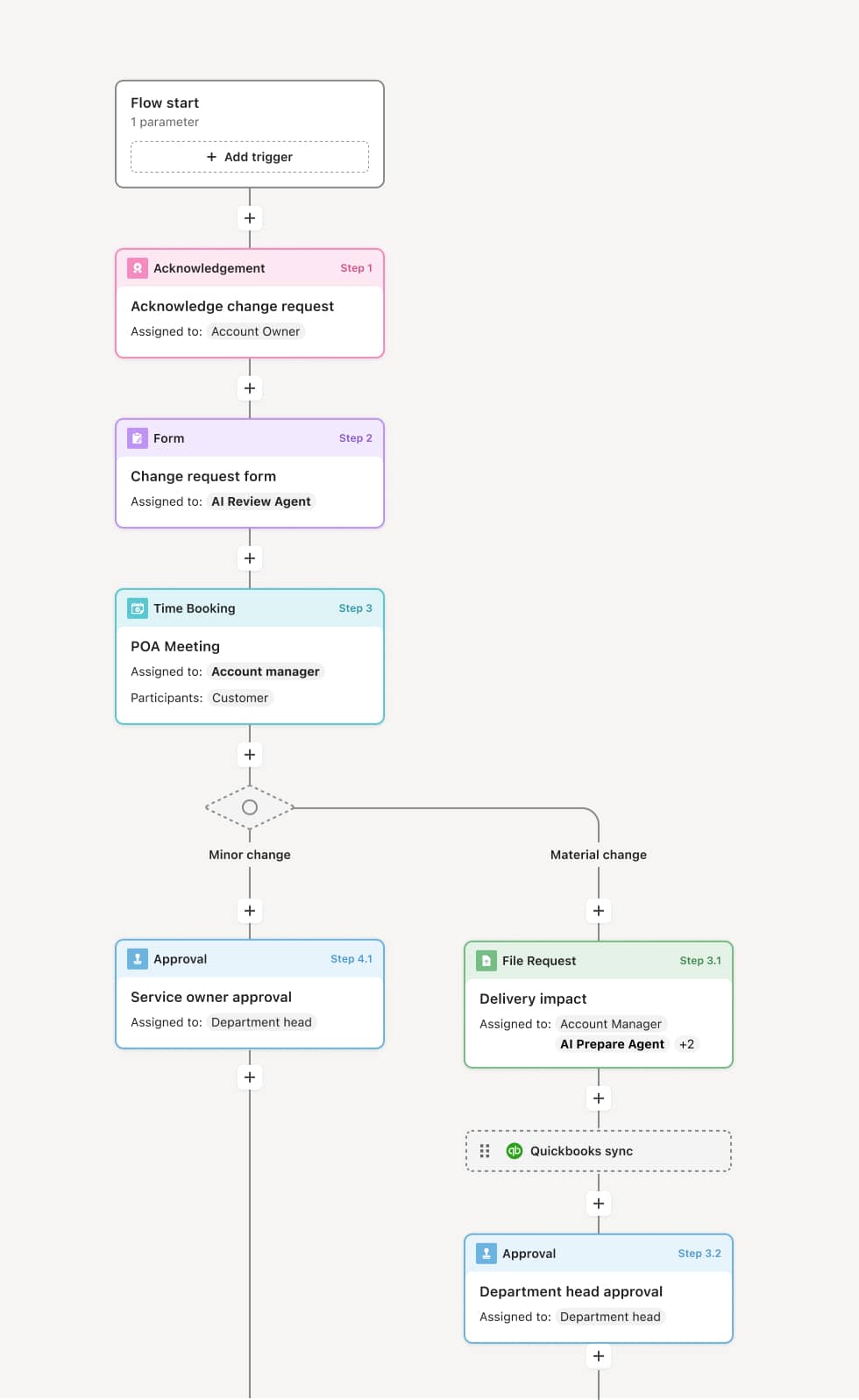
Your version of this process may vary based on roles, systems, data, and approval paths. Moxo’s flow builder can be configured with AI agents, conditional branching, dynamic data references, and sophisticated logic to match how your organization runs this workflow. The steps below illustrate one example.
Approval package assembly
The process begins when the coordinator assembles the materials requiring multi-party approval. This may include contracts, proposals, project plans, regulatory submissions, or operational commitments. The package includes supporting documentation, context for each approving party, and a summary of what is being requested. An AI agent can validate that the package is complete and that all required supporting documents are attached before routing begins.
Parallel routing to approving parties
The approval package is routed simultaneously to all required approving parties. Each party receives the materials relevant to their review, along with instructions on what they are being asked to evaluate. Internal approvers such as legal, finance, and compliance review against their respective criteria. External approvers such as clients, partners, or regulatory contacts review against their own requirements. Parallel routing ensures that no single party’s review blocks others from proceeding.
Independent review and decision
Each approving party conducts their review independently. Reviewers may approve, request modifications, or reject the item. If a party requests changes, the coordinator receives the feedback and determines whether the change affects other parties’ reviews. An AI agent can monitor review status across all parties, flag overdue reviews, and notify the coordinator of any rejections or conditional approvals.
Consolidation and conflict resolution
If multiple parties request conflicting changes or one party’s approval is conditional on another’s, the coordinator manages the resolution. This may involve revising the approval package, seeking clarification, or facilitating discussion between parties. The flow supports iterative cycles where revised materials are re-routed only to affected parties.
Final consolidated approval
Once all required parties have approved, the consolidated approval is confirmed. The coordinator verifies that all approvals are complete, unconditional, and aligned. If any party’s approval carries conditions, those conditions are documented and routed for acknowledgment.
Closure and record distribution
Upon consolidated approval, all parties are notified of the outcome. The approval record, including each party’s decision, timestamp, and any conditions, is finalized and distributed. Downstream actions such as contract execution, project initiation, or regulatory filing are triggered based on the completed approval.
This process commonly relies on inputs such as contracts, proposals, project plans, regulatory submissions, and supporting documentation from multiple sources. It may be triggered by events like a deal reaching final commitment, a joint venture milestone, a regulatory filing deadline, or a project gate requiring cross-organizational sign-off. Systems such as a CLM platform (Ironclad, DocuSign), a project management tool (Monday, Asana), or an ERP (NetSuite, SAP) are commonly connected to provide deal context, project data, and approval tracking.
Key decision points include whether all required approving parties have been identified and routed the appropriate materials, whether any party’s requested changes affect other parties’ reviews and require re-routing, whether conditional approvals need resolution before the consolidated approval can be confirmed, and whether the consolidated approval record is complete and ready to trigger downstream actions.
Incomplete party identification where not all required approvers are included in the initial routing, causing late-stage delays when a missing party’s review is discovered. Sequential bottlenecks where approvals are routed one at a time rather than in parallel, extending the cycle unnecessarily. Conflicting feedback where multiple parties request contradictory changes and the coordinator lacks a structured way to resolve disagreements. Lost approval status where the coordinator cannot easily determine which parties have approved, which are pending, and which have conditions, especially across organizational boundaries.
Orchestrates approval across multiple internal and external parties within a single workflow, replacing the fragmented email and document exchange that typically slows multi-party processes.
Routes approvals in parallel to all required parties simultaneously, ensuring no single party’s review blocks others and compressing the overall cycle time.
AI agents monitor review status across all parties and flag overdue reviews, conditional approvals, or rejections, keeping the coordinator informed without manual follow-up.
Supports iterative resolution cycles where revised materials are re-routed only to affected parties, avoiding redundant review of unchanged elements.
Provides external stakeholders with a clear, action-oriented experience so that clients, partners, or regulatory contacts can review and approve without navigating unfamiliar systems.
Produces a consolidated approval record documenting each party’s decision, timing, and conditions, supporting governance, audit, and downstream process initiation.