Operations manager
Chief of staff
Program director
Business unit lead
VP of strategy
Compliance director

This process is used when a decision, initiative, or commitment requires formal approval from stakeholders across multiple internal functions or business units, each bringing a different perspective or authority. It applies when no single department can unilaterally authorize the action and the decision requires alignment across operations, finance, legal, compliance, or executive leadership. It is triggered by strategic initiatives, policy changes, large expenditures, cross-functional projects, or organizational decisions that affect multiple business areas. Ideal for enterprise environments, matrixed organizations, and any context where decisions require alignment across functional silos.
The process coordinator, often a chief of staff, program director, or operations manager, assembles the approval package and manages routing. Stakeholders from relevant functions such as finance, legal, compliance, HR, IT, and business unit leadership each review against their area of responsibility. Executive sponsors or VPs provide final authorization when the decision crosses a defined threshold of impact or risk.
Faster cross-functional alignment by routing stakeholder reviews in parallel rather than scheduling sequential meetings or circulating documents by email. Clear decision ownership with every stakeholder’s review and authorization documented within a single consolidated record. Reduced approval bottlenecks by giving each stakeholder a defined review window and clear instructions on what they are being asked to evaluate. Stronger organizational alignment by ensuring all relevant perspectives are incorporated before a commitment is made.
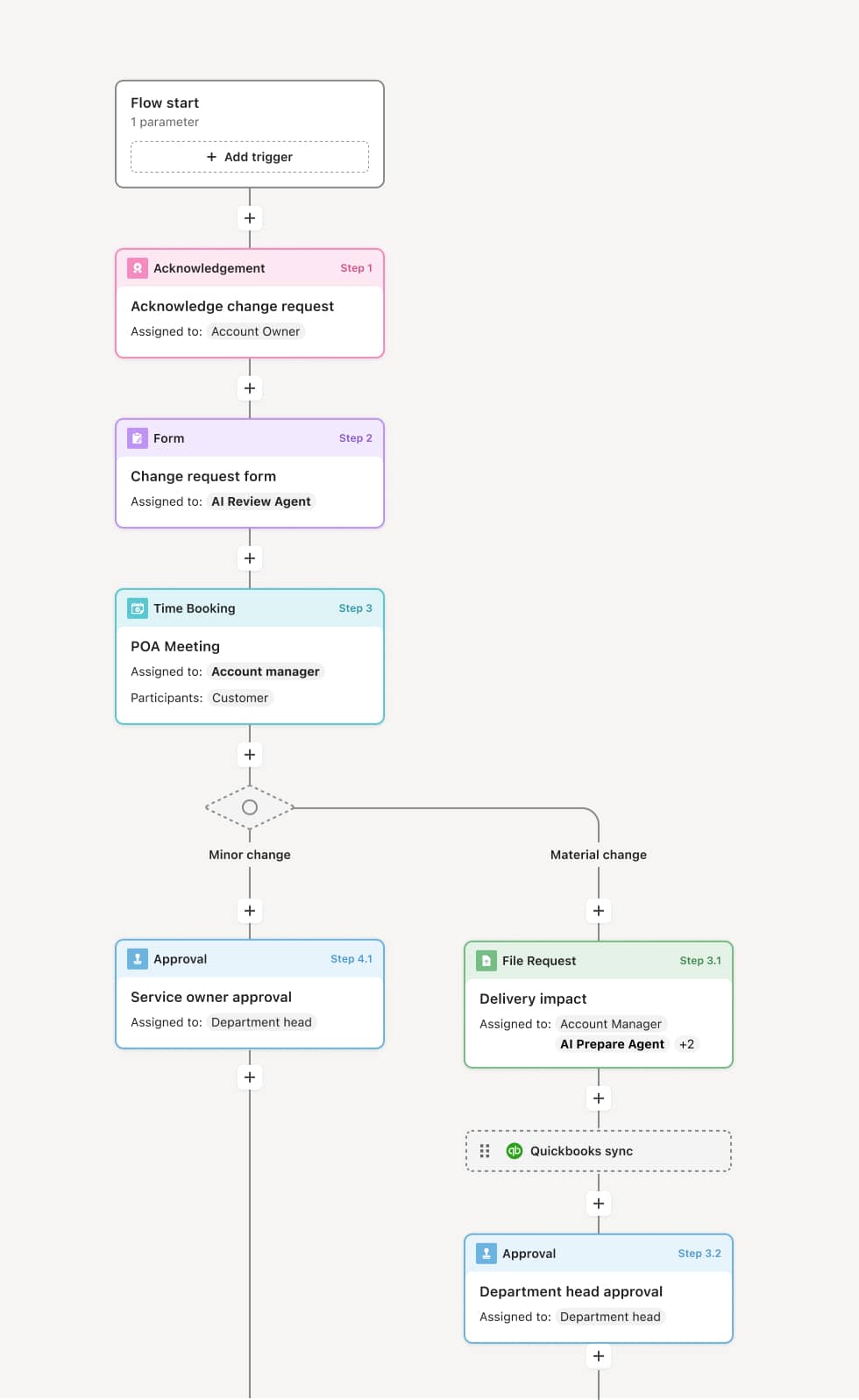
Your version of this process may vary based on roles, systems, data, and approval paths. Moxo’s flow builder can be configured with AI agents, conditional branching, dynamic data references, and sophisticated logic to match how your organization runs this workflow. The steps below illustrate one example.
Approval request preparation
The process begins when the coordinator prepares the approval request, including a clear description of what is being decided, the business case, supporting documentation, and a summary of stakeholder impact. An AI agent can validate that the request is complete, that all required supporting materials are included, and that the stakeholder list is appropriate for the decision type.
Stakeholder routing
The request is routed to all required stakeholders based on the decision type and organizational structure. Each stakeholder receives the materials relevant to their area of responsibility along with clear instructions on what they are evaluating. Routing may be fully parallel, partially sequential where certain approvals must precede others, or conditional where one stakeholder’s feedback determines whether additional review is needed.
Stakeholder review and input
Each stakeholder reviews the request independently and provides their approval, conditional approval, or feedback. Stakeholders evaluate the request against their functional criteria, whether financial, legal, operational, compliance, or strategic. If a stakeholder requires additional information, they request it through the workflow. An AI agent can summarize incoming feedback for the coordinator to track alignment and outstanding concerns.
Feedback consolidation and resolution
If stakeholders raise concerns or request modifications, the coordinator consolidates feedback and determines whether revisions are needed. Revised materials may be re-routed to affected stakeholders for focused re-review. The flow supports iterative cycles until alignment is achieved or unresolved issues are escalated.
Executive authorization
For decisions above a defined threshold of impact, risk, or expenditure, the consolidated request and stakeholder feedback are presented to an executive sponsor or leadership committee for final authorization. An AI agent can prepare a summary of stakeholder positions and outstanding items to support efficient executive decision-making.
Confirmation and next steps
Upon final approval, all stakeholders are notified of the outcome. The approval record is finalized, and downstream actions such as project initiation, budget release, policy implementation, or vendor engagement are triggered.
This process commonly relies on inputs such as business cases, project proposals, policy change requests, expenditure summaries, and supporting documentation from relevant functions. It may be triggered by events like a strategic initiative kickoff, a policy review cycle, a large expenditure request, or a cross-functional project gate. Systems such as an ERP (SAP, NetSuite), a project management platform (Asana, Monday), or an enterprise collaboration tool are commonly connected to provide organizational data, budget context, and project status.
Key decision points include whether the stakeholder list is complete for the specific decision type, whether any stakeholder’s conditional approval or concern requires revisions before proceeding, whether unresolved stakeholder disagreements need escalation to executive leadership, and whether the decision meets the threshold requiring executive authorization.
Stakeholder list gaps where relevant functions are omitted from the initial routing, requiring late-stage re-review that delays the overall decision. Review fatigue where stakeholders receive requests without clear instructions on what they are evaluating, leading to delayed or superficial reviews. Unresolved disagreements where conflicting stakeholder feedback is not surfaced and resolved, resulting in stalled approvals or decisions made without true alignment. Executive bottlenecks where escalated decisions sit with leadership without adequate context or summary, extending the final authorization timeline.
Orchestrates review across multiple internal stakeholders and functions within a single workflow, replacing the meetings, email chains, and document circulation that typically slow cross-functional approvals.
Routes reviews in parallel, sequentially, or conditionally based on the decision type and organizational structure, ensuring the right stakeholders review in the right order.
AI agents validate request completeness and summarize stakeholder feedback for the coordinator and executive sponsors, accelerating alignment and decision-making.
Supports iterative revision and re-review cycles so that modified requests return only to affected stakeholders, avoiding redundant full-cycle reviews.
Provides clear, time-bound review windows for each stakeholder, reducing delays caused by unclear ownership or open-ended review periods.
Produces a consolidated approval record that documents every stakeholder’s input, decision, and timing, supporting governance, accountability, and downstream action.