Legal counsel
Contracts administrator
Business development manager
Partnership lead
VP of sales
Compliance officer

This process is used when a non-disclosure agreement must be established before sharing confidential information with a potential client, vendor, partner, or other external party. It applies when the organization’s standard NDA template is used or when a counterparty submits their own NDA requiring legal review. It is triggered at the start of a business relationship, during due diligence, before a proposal or RFP response, or when sensitive information must be exchanged. Ideal for professional services, technology, financial services, life sciences, and any environment where confidentiality agreements are a routine prerequisite to business engagement.
Business development managers or partnership leads typically initiate the NDA request by identifying the need for a confidentiality agreement. Contracts administrators manage the routing, template selection, and counterparty coordination. Legal counsel reviews the NDA for risk, scope, duration, exclusions, and enforceability, especially when the counterparty proposes non-standard terms. Compliance officers may review agreements involving sensitive data categories or regulated information. VPs of sales or business leads authorize execution when the NDA involves strategic relationships.
Faster NDA execution by using pre-approved templates for standard agreements and reserving legal review for non-standard or counterparty-submitted NDAs. Clear accountability for every NDA with a documented record of who initiated, reviewed, negotiated, and authorized the agreement. Reduced deal delays by preventing NDAs from stalling between legal and business teams due to unclear routing or untracked redlines. Better risk management by ensuring non-standard confidentiality terms receive appropriate legal evaluation before execution.
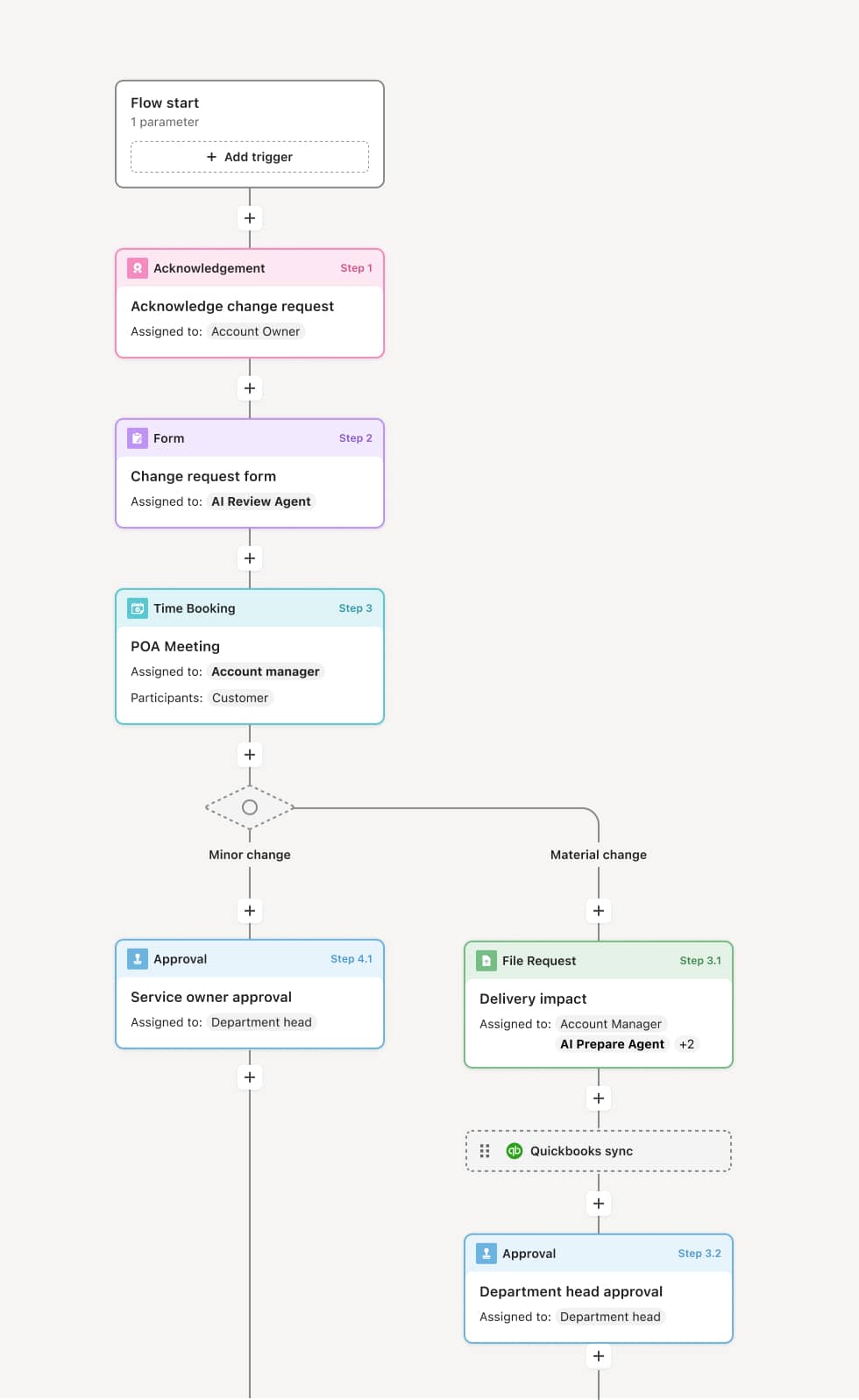
Your version of this process may vary based on roles, systems, data, and approval paths. Moxo’s flow builder can be configured with AI agents, conditional branching, dynamic data references, and sophisticated logic to match how your organization runs this workflow. The steps below illustrate one example.
NDA request initiation
The process begins when a business development manager or partnership lead submits a request for an NDA. The request includes the counterparty name, the business context for the agreement, and whether the organization’s standard template should be used or the counterparty has submitted their own draft. An AI agent can pre-populate the NDA template with counterparty details and flag whether the request is standard or requires legal review.
Template selection and routing
If the request uses the organization’s standard NDA template with no modifications, the agreement may proceed directly to execution with minimal review. If the counterparty has submitted their own NDA or requested non-standard terms, the agreement is routed to legal counsel for review. The routing is determined by whether the terms are standard, the data sensitivity involved, and any regulatory considerations.
Legal review and redlining
Legal counsel reviews the NDA for scope of confidentiality, duration, exclusions, permitted disclosures, governing law, and any terms that create unacceptable risk. If modifications are needed, legal produces redlines and the contracts administrator coordinates the exchange with the counterparty. An AI agent can highlight terms that deviate from the organization’s standard positions to help legal focus on material differences.
Negotiation coordination
If the counterparty responds with counter-redlines, the updated draft is routed back to legal for evaluation. The flow supports iterative negotiation rounds, with each version tracked and previous positions available for reference. The contracts administrator manages the exchange and ensures both parties are working from the current version.
Approval and execution
Once legal approves the final terms, the NDA moves to execution. For standard agreements, execution may be authorized by the contracts administrator. For strategic relationships or non-standard terms, the VP of sales or a business lead may provide final authorization. Signatures are collected from authorized signatories on both sides, and the executed agreement is filed and distributed to relevant stakeholders.
Agreement distribution and activation
After execution, the NDA is shared with the business team and any parties who need to operate under its terms. The contracts administrator confirms the agreement’s effective date, duration, and any specific obligations that must be communicated to teams handling confidential information.
This process commonly relies on inputs such as NDA templates, counterparty draft agreements, counterparty details, deal context, and redline documents. It may be triggered by events like a new business inquiry, a partnership discussion, a vendor evaluation, or a due diligence request. Systems such as a CLM platform (Ironclad, DocuSign CLM), a CRM (Salesforce, HubSpot), or a deal management tool are commonly connected to provide counterparty data, template libraries, and execution tracking.
Key decision points include whether the NDA uses the organization’s standard template or requires legal review of counterparty terms, whether proposed terms fall within acceptable risk parameters or require redlining, whether negotiation has reached acceptable terms or the organization should decline the agreement, and whether execution authority rests with the contracts administrator or requires business leadership sign-off.
Standard NDAs routed unnecessarily to legal causing delays for agreements that could proceed directly to execution under pre-approved templates. Version confusion where multiple redline iterations circulate between parties without clear tracking, leading to execution of outdated terms. Missing deal context where legal reviews the NDA without understanding the business relationship, leading to overly conservative positions that delay the engagement. Execution delays where fully approved NDAs await signatures because coordination with the counterparty happens outside the approval workflow.
Orchestrates NDA review across legal, business, and counterparties within a single workflow, replacing the email-based redline exchanges that typically delay agreement execution.
Routes NDAs conditionally based on whether standard templates or counterparty drafts are used, ensuring legal review is engaged only when necessary.
AI agents pre-populate templates and flag non-standard terms to accelerate legal review by highlighting material deviations from approved positions.
Supports iterative negotiation cycles with structured version tracking so that both parties always work from the current draft and previous positions are available for reference.
Enables external counterparties to review and sign within the workflow without requiring access to internal systems, simplifying the execution process.
Connects to CLM and CRM systems to pull counterparty data, store executed agreements, and track NDA status alongside the broader business relationship.